


 Francais
 Deutsch
 Italiano
Refine Your Search
US-Gliders- stock footage and images
- Showing 2755 to 2760 of 21924 results more
more Hide
Hide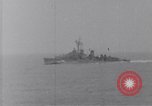
Views of U.S. 7th fleet ships comprising part of the “Formosa Strait Force” established to keep peace between China and Formosa (Taiwan) in 1950
Elements of the U.S. Navy 7th Fleet designated “Formosa Strait Force” (Task Force 72), sent by President Harry S. Truman to keep peace between Formosa (Republic of China or Taiwan) and Mainland China (People’s Republic of China), in 1950. The U.S. Navy Destroyer Maddox (DD 731) underway. Views aboard the flagship of the Formosa Patrol, the light cruiser, USS Juneau (CL 119) as sailors respond to a drill. Two are seen entering one of the USS Juneau's gun turrets housing a Mark 12, 5-inch/38 caliber gun. Glimpse of the closed turret with single gun barrel seen at the front. Gun crew maneuvering one of the USS Juneau's quad 40 mm (1.6 in) Bofors anti-aircraft guns. Sailors arranging shells for the USS Juneau's guns. Officers on deck pointing at other ships and observing them through binoculars. Glimpse of two landing craft (possibly Landing Craft Infantry) underway.
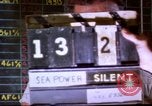
Radar operators aboard USS Essex (CVA-9) during U.S. Marine deployment to Beirut, Lebanon. Ship's position plotted.
Operations aboard the U.S. aircraft carrier, USS Essex (CVA-9) during amphibious deployment of U.S. Marines to Beirut, Lebanon, in 1958. Sailor writes information on plexiglass board as he receives it through headset earphones. Sailors monitor radar scopes. Room is dimly lit and light reflects off their faces as they receive information and converse on interphone. Radar man, holds mike and speaks a while monitoring scope. Navigator plots positions on a navigation chart in chart room aboard the USS Essex. Chart and notes indicate the ship's position in the Mediterranean, as 270 miles from Nicosia, Cyprus, and 480 miles from Beirut, Lebanon. (Note on chart states that flight over Cyprus is prohibited.)
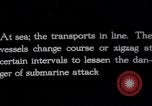
U.S. troops aboard troopship at sea, bound for Europe during World War I
U.S. Army troop transports in line during World War I. Convoy of ships at sea. U.S. troops aboard ship. The Commissary Officer inspects the butcher shop, the bakery and galley. Troops line up in galley and receive food and eat it. Troops sleep in crowded bunks. View of sick bay. Men in the Engine room. Men stoke boiler furnace. View of waves crashing over bow of ship in heavy seas and rough waters.
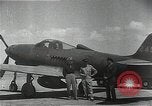
U.S. Lend-lease aircraft being supplied to USSR by way of Iran in World War II
Film about the shipping of American Lend-Lease aircraft to the Soviet Union, via the " Persian Corridor " during World War 2. It focuses on activities at Abadan Airfield, Iran. U.S. Army Air Forces (USAAF) Colonel Charles Porter, Commanding Officer of the Allied Abadan military establishment in Iran, stands with a Soviet Colonel, who supervises Soviet work on the field. With them is USAAF Brigadier General Macmillan., who was visiting the base at this time. They pose in front of a P-39 Bell Aircobra airplane displaying a red Soviet Star insignia. Next, ground crews are seen towing aircraft on the field, including a Douglas A-20 Havoc and a Curtiss P-40 Warhawk. Mechanics work on several P-40 airplanes on the ramp. A North American Aviation T-6 Texan aircraft is being refueled from a truck .Closeup of ground crewman holding refueling hose over the wing of the T-6. USAAF mechanics conduct post-assembly checks on a North American B-25 Mitchell bomber and tow another one (Serial number 41-3225) from a hangar, to the Soviet side of the field, after completing its inspection. Soviet mechanics are seen checking guns in the rear cockpit of an aircraft. Glimpse of several P-40 aircraft and a T-6 aircraft on a ramp. Soviet and American mechanics working together on the wings of aircraft. Closeup of two working together. As a Soviet soldier watches, an American airman uses a paint brush to change the American white star on an airplane, into the Soviet red star. The two shake hands when the painting is done. Soviet ground crew push a P-40 aircraft into position for starting. A soviet pilot, wearing a seat pack parachute, climbs into the cockpit. Closeup of him as he nods to a ground crewman for engine start. He taxis out and takes off. Several T-6 aircraft on the Soviet side of the field are seen, ready to be flown away. Views of other aircraft being readied for ferrying to Russia. Camera pans over the airfield and the many aircraft parked there.
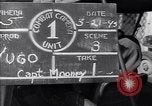
U.S. officer checks the wounded face of a soldier in Yugoslavia during World War 2
Two wounded soldiers walk out of a building. An officer gives wounded soldiers cigarettes to smoke. Officer lights the cigarette. A soldier with a fully bandaged face and hands smokes a cigarette and talks to the U.S. officer. U.S. officer removes the dressing from another wounded soldier's face. He checks the wounds on the soldier's face.
Various diplomats and leaders at the reception given by U.S. Ambassador George V Allen.
Reception given by U.S. Ambassador George V Allen in the garden at his summer home, Villa Podkoren, Bled. Foreign Minister Eduard Kardelj and Mrs Kardelj arrive at the garden and received by Ambassador in white dinner jacket. The Chef de Protocol of the Foreign Office Mr Smodolka also arrives. Marshal Josip Broz Tito accompanied by his aide Major General Gegelj arrives at the gates and received by Ambassador and Mr Smodolka. Marshal Tito drinks cocktails talking to Ambassador and Mrs Allen. At the head of the table is De Joseph Vilfan, Deputy Foreign Minister and formerly Yugoslav delegate to the UN. Others at the table are U.S. Ambassador, wife of Turkish Ambassador, Dr. Slovan Smodolka, Mr Kardelj and Lady Peake, wife of British Ambassador. Marshal Tito's table with Mrs Allen, Mrs Kardelj, British Ambassador Sir Charles Peake, wife of Belgium Minister, Deputy Foreign Minister Dr Leo Mates, Dutch Minister Mr Dozy and the Belgium Minister. Table of Mrs Vilfan, Deputy Director of the Department of Information, with Joseph Vidmar, President of the Federal Parliament, Dr Brecelj and his wife, Vice President of Slovania. Tables with diplomats and the Canadian Military Attache. Mr And Mrs Kardelj leave the party escorted by Ambassador Allen.
CRITICALPAST.COM: About Us | Contact Us | FAQs - How to Order | License Agreement | My Account | My Lightboxes | Shopping Cart | Advanced Search | Featured Collections | Website Terms & Conditions | Privacy Policy ©2026 CriticalPast LLC.
License Agreement |
Terms & Conditions |
Privacy Policy
©2026 CriticalPast LLC.