


 Francais
 Deutsch
 Italiano
Refine Your Search
US-Gliders- stock footage and images
- Showing 343 to 348 of 21920 results more
more Hide
Hide
A U.S. air mail truck is backed up to a U.S. mail service converted Airco DH-4 aircraft in the United States.
Aircraft are used for different purposes in the United States. The U.S. Air Mail Service makes use of commercial aviation. Snow covered mountains as seen from an aircraft. Animation of a small aircraft following a line across a map from New York to San Francisco. A U.S. air mail truck is backed up to a U.S. mail service converted Airco DH-4 aircraft on a grass landing field.
U.S. Navy and U.S. Marine forces in Guadalcanal campaign versus Japanese forces during World War II
Map shows Solomon Islands in South Pacific. Truk and Australia are highlighted. Tulagi and Guadalcanal are shown. American Naval task force, including Attack Transports and warships seen underway in stormy Pacific waters. Sailors loading heavy naval guns aboard a U.S. warship. Ship's guns firing. Smoke rising from explosions on island. shows smoke rising. USS Salt Lake City (CA-25) is seen at time 1:34, firing its main battery. Douglas SBD Dauntless aircraft flying low overhead. U.S. Marines land on Guadalcanal. Marines wading ashore. American Douglas SBD lands at Henderson Field on Guadalcanal. B-17s on Henderson Field, including B-17E Serial number 41-9145 of the 26th Bombardment Squadron.Long column of U.S. marines snakes across edge of airfield headed towards interior of Guadalcanal. Scene shifts to jungle interior, where they march two abreast over captured terrain. A building in the background. Marines firing a 105mm Howitzers. A B-25 bomber taking off. B-26 bombers in flight. Closeup of B-26 flying over water. View from cockpit of U.S. aircraft strafing Japanese held island, striking targets at shoreline and aircraft and supplies on a Japanese airfield. Japanese marines taken prisoner on Guadalcanal. Views of groups of Japanese prisoners of war. Japanese soldiers stand in formation and are also seen sitting in confined areas.US marines patrolling shore where numerous Japanese soldiers are seen dead.

U.S. Captain Carl Zimmerman speaks about U.S. Forces consolidating below 38th Parallel during Korean War.
Focuses on Korean War. Antiaircraft guns fire in combat with enemy. Refugees walk up on hill. Troops march on field. Tanks advance on battlefield. Captain Carl Zimmerman speaks at desk about the causes of events which took place during Korean campaign, picture of refugees walking up hill in the background. Captain recalls day 10th August in 1950 and summarizes the United Nations consolidation below the 38th Parallel. Map shows Pusan, Masan, Changnyong, Pohang and other places. Close view of map highlighting Chinju, Masan, South West region of Taegu, Uisong, Pohang, and Yongdok. Map of Korea depicts the ground support given by marines, navy and air force planes. U.S. forces counterattack. U.S. troops march on road near Pohang 30 August 1950. Tanks advance on street. Soldiers on tanks. Troops in combat with enemy. Troops fire guns. Troops take cover behind woods. Captain Carl speaks with Lieutenant Tom, Platoon Leader of 24th Division. He shares experience of his platoon moving North of Korea during war. He further speaks about air support and artillery used in war. He talks about captured communists and weaponry used by North Koreans and his platoon. Marines march across field. Marines climb up mountain. Enemy opens fire. Wounded marine runs back for aid. Marines rush to attack. Marines fire machine guns and rifles. American aircraft overhead drop bombs. Explosions on ground. Map of Korea marks date 10/8/1950 and depicts areas captured by U.S. forces below 38th parallel. Captain Carl speaks at desk.
Inaugural address of Franklin Roosevelt, the 32nd U.S. President, during his inaugural ceremony at U.S. Capitol in Washington DC.
The inaugural ceremony for the newly elected U.S. President Franklin Roosevelt in Washington DC. The new President-elect Franklin Roosevelt, outgoing U.S. President Herbert Hoover, the Chief Justice of the Supreme Court of the U.S. and other officials in the U.S. Capitol. Franklin Roosevelt addressing a crowd during the inaugural ceremony. Officials behind the new President-elect. The new President Franklin Roosevelt says that he is certain that the Americans expect him to address them with frankness and a decision that the situation needs. The President says that he is prepared, under his constitutional duty, to take measures that a stricken nation may require and shall adopt the measures within his constitutional authority. He also says that in the event of a national emergency if the Congress fails to take measures, he shall ask the Congress for broad executive power to wage a war against the emergency. The President concludes his address by asking the blessings of God. The President shakes hands with the officials. The President and the officials talking. Aerial views of the U.S. Capitol.
Aromere loads and mounts the A-N Gun Camera in U.S. Curtiss P-40 and U.S. Lockheed P-38 Lightning aircrafts in the United States.
Operation and installation of an Army-Navy aircraft Gun Camera in U.S. Curtiss P-40 and U.S. Lockheed P-38 Lightning aircraft in the United States.Aromere loads and mounts the gun camera under the wing of U.S. Curtiss P-40 aircraft and in the nose of U.S. Lockheed P-38 Lightning aircraft. Aircrafts in flight.During gunnery practice pilot pulls the trigger.they use film magazine in their training.
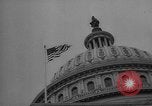
U.S. President Lyndon Johnson signs Civil Rights Act and shakes hands with Martin Luther King at U.S. Capitol in Washington DC.
Civil Rights Bill passed in the U.S. Congress signed by President Lyndon B. Johnson at the U.S. Capitol, Washington DC, United States. The U.S. Capitol and national flag on it. A woman with two children visits the Lincoln Memorial (2 Lincoln Memorial Cir NW, Washington, DC 20002). The U.S. President Lindon B Johnson along with other U.S. Congressmen during the signing of the Civil Rights Act of 1964. President Johnson signs the bill and shakes hands with Martin Luther King.
CRITICALPAST.COM: About Us | Contact Us | FAQs - How to Order | License Agreement | My Account | My Lightboxes | Shopping Cart | Advanced Search | Featured Collections | Website Terms & Conditions | Privacy Policy ©2026 CriticalPast LLC.
License Agreement |
Terms & Conditions |
Privacy Policy
©2026 CriticalPast LLC.