


 Francais
 Deutsch
 Italiano
Refine Your Search
US-Gliders- stock footage and images
- Showing 349 to 354 of 21920 results more
more Hide
Hide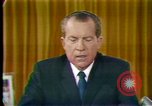
U.S. President Nixon speaks about programs of U.S. withdrawal from Vietnam, during his silent majority speech from the White House.
News special report about U.S. President Richard Nixon's 'Silent Majority' speech from the White House about Vietnam War. President Nixon addresses the nation from an office in the White House. He speaks of U.S. programs in future and replacement of all U.S. ground forces by South Vietnamese forces. He denies a fixed timetable of U.S. withdrawal and about Paris Peace Talks. He says that if violence from North Vietnam continues, the U.S. can take strong steps. He appreciates the concern of young Americans to restore peace. He calls to get united for the existence of peace. He recalls the efforts of former President Woodrow Wilson to reassure world peace during World War I
U.S. soldiers in England, install wire cutters on U.S. jeeps before shipping them to France, during World War II.
U.S. soldiers of the 87th Chemical Battalion (mortar) make field modifications by installing wire cutters on army jeeps, at the D-Day Marshalling Area Camp in Shiphay, Torquay, (Devon) England during World War 2. U.S. soldier paints an angle iron vertical post (wire cutter) fastened on bumper of a jeep. He pastes U.S. flag on the windshield and writes OK in chalk on the front bumper. Line of modified jeeps travel along road after completing check ups. Soldiers use hack saws to cut pieces of metal and hand drills to put holes in bumpers where angle iron wire cutters will be fastened. They use files to take sharp edges off the angle irons. A soldier slips washers and bolts on an angle iron and tightens them with an adjustable wrench. (Note: These angle iron vertical rods, mounted on a vehicle front bumper, were meant to protect jeep occupants by catching and cutting wires that might be strung across roads to injure or kill unprotected drivers of open vehicles, such as Jeeps.)
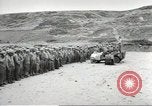
U.S. 1st Army conducts memorial ceremony, at site of first U.S. cemetery, Omaha Beach, Normandy, France, in World War II
Memorial Ceremony (including Roman Catholic Mass) for fallen U.S. troops, held on June 10, 1944 during World War 2. The location is Omaha Beach, St. Laurent sur Mer, Normandy France, where the U.S. 1st Army established the first American military cemetery in France, during World War II. U.S. troops line the area. An altar is set up on the hood of a jeep parked in the sand. An Army Colonel standing in rear of the jeep reads from a notebook. Soldiers all stand with heads bowed. Among them are African American soldiers of the 320th Battalion. A Chaplain's assistant sits at a keyboard instrument next to the jeep. A Roman Catholic Army Chaplain in white clerical robes conducts a mass. Numerous grave markers can be seen in the distant background marking graves of soldiers who died in the invasion of Normandy. Several French civilians stand with the soldiers, who bow heads in prayer. The Chaplain administers holy communion to kneeling soldiers. A French civilian woman places flowers near recent temporary grave markers of U.S. fallen (stakes bearing their dog tags). A color guard stands with American flag, as squad of riflemen fire gun salutes. Three French civilians stand by the flowers. U.S. Army bugler blows taps. All present salute the fallen. Some individual soldiers walk to the markers of their friends.

U.S. Marines using flame throwers against Japanese, Chinese troops during Sino-Japanese War, aftermath mass suicide of Japanese
A film titled 'The San Jose Project' gives an introduction of chemical warfare tests carried out by U.S. Army on San Jose Island, Panama during World War II. Film opens with scenes of U.S. troops battling Japanese on Pacific islands during World War II. Tank mounted flamethrower being used to burn Japanese from caves. Backpack style handheld flamethrower being used by U.S. Marine at mouth of a cave. A Japanese soldier emerges from a cave and is shot by American soldiers. Scene changes to China, where Chinese troops march near fields during the Sino-Japanese War before World War II. A wounded soldier carried by Chinese troops. Scene changes again to Mariana Islands during World War 2. Piles of bodies of Japanese civilians and soldiers at base of a cliff from which they jumped to commit suicide rather than be captured or killed by American forces. A Japanese civilian jumping off of a cliff. Japanese civilians at waters edge jumping into water.
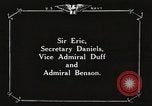
Sir Eric Geddes and U.S. Secretary of Navy Josephus Daniels visit the U.S. Naval Academy in Annapolis, Maryland.
First Lord of the British Admiralty Sir Eric Geddes visits the U.S. Naval Academy in Annapolis, Maryland towards the end of World War I. Sir Eric Geddes, British Admiral Alexander Duff, U.S. Secretary of Navy Josephus Daniels and U.S. Navy Admiral W.S. Benson walk out of a building at the Naval Academy followed by other U.S. and British Navy Admirals. The group of officers descend the steps of the building. Bancroft Hall dormitory and Mahan Hall of the U.S. Naval Academy.
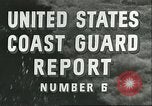
Training of U.S. Coast Guards at the U.S. Coast Guard Academy in the United States.
A documentary film titled 'Along our Shores' on domestic activities of coast guards in the United States during World War II. U.S. Coast Guards march in formation. Ships underway at sea. A man looks through binoculars. U.S. fleet underway. Coast guards aboard a landing craft. They wade ashore. U.S. Navy Fleet Admiral Ernest Joseph King seated at his desk with an official. He discusses with the official. He takes out the annual report on the progress of the U.S. Navy. Officials aboard a ship. The coast guards walk on a pier. They are trained at the U.S. Coast Guard Academy. They study modern warfare techniques. A sign outside a building reads: 'United States Coast Guard Training Station'. Coast guards aboard a ship. Officials instruct and train them. Men row a boat with oars. Coast guards fire guns at a target.
CRITICALPAST.COM: About Us | Contact Us | FAQs - How to Order | License Agreement | My Account | My Lightboxes | Shopping Cart | Advanced Search | Featured Collections | Website Terms & Conditions | Privacy Policy ©2026 CriticalPast LLC.
License Agreement |
Terms & Conditions |
Privacy Policy
©2026 CriticalPast LLC.