


 Francais
 Deutsch
 Italiano
Refine Your Search
US-Gliders- stock footage and images
- Showing 391 to 396 of 21920 results more
more Hide
Hide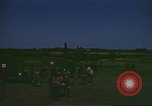
U.S. airfield as seen from the window of a U.S. 8th Air Force B-17 as it taxis across a field in England during World War II.
U.S. 8th Air Force B-17 Flying Fortress bombers in England during World War II. A U.S. airfield in England seen from the side of the window of an airplane as it taxis across a field near hangars. A P-47 fighter aircraft seen on the field. U.S. airmen stand around. Airmen and U.S. Army Air Force officers walk around as a B-17 taxis to a parking area.
U.S. soldiers detonate dynamite and a U.S. Army Air Force C-47 Skytrain drops supplies in a Burmese jungle during World War II.
U.S. transport aircraft drop supplies in Burma during World War II. Chinese soldiers dig a hole in a jungle with hand tools for a charge of dynamite. Kachin native workers look up. The workers extend hands upwards as a U.S. Army Air Force C-47 Skytrain transport aircraft drops parachute supplies. U.S. gunner Walter Dawson stands behind a machine gun. U.S. soldiers place dynamite in the hole. Smoke rises as the dynamite explodes. A Chinese soldier stands.
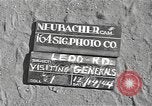
U.S. Army engineer Colonel Lewis A. Pick and U.S. General William Edward Raab arrive and view Ledo Road during World War II.
Ledo Road in Burma is viewed by U.S. Army Generals during World War II. U.S. Army engineer Colonel Lewis A. Pick and Commanding General Services of Supply U.S. China-Burma-India Theater of Operations William Edward Raab Covell arrive in an army transport plane. They are greeted by U.S. Army engineer Colonel Joseph Green and Lieutenant Colonel Harold A Whittier. Generals in jeep being driven on Ledo Road. Generals view Ledo Road.
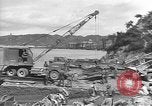
U.S. Corps of Engineers rebuilds bridge while U.S. troops engage the enemy during the Korean War
U.S. Army Corps of Engineers use a mobile crane and other construction equipment to rebuild a bridge during the Korean War. Closeup of engineers standing on the edge of a newly built section of the bridge. Wheels of the mobile crane are nearby. They lower a cable as an inflatable boat arrives carrying steel sections for the construction. The boat and its cargo is pulled in and tied up to the existing structure. Scene shifts to a dirt road, where several Patton tanks are clustered near a large tent. Tank crews are checking their guns and equipment. Closeup of Lieutenant General James Van Fleet, newly appointed Commander of the U.S. Eighth Army, at the construction site. Closeup of a Patton tank with crew members visible, as it passes the camera. Its main gun is wrapped in tarpaulin covering. Next, a Patton tank is seen crossing a pontoon bridge. U.S. troops firing an M20 75mm recoilless rifle at enemy positions from a temporary hillside base. American troops firing a mortar. Scene shifts completely to Korean refugees fleeing the battlefields. They and their belongings are loaded into trucks, along with food and other supplies. Closeups of some of the refugees. A column of trucks filled with refugees is seen making its way along a dirt road. United Nations troops investigate possible infiltrators from the North, They are seen searching and questioning some. A sign at one area reads: "65th PW Cage. Keep Out." Some in the prisoner area are seen being interrogated and writing answers to questions.
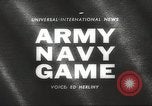
A large crowd gathers to watch a football game played between the U.S. Army and the U.S. Navy teams in Philadelphia.
A college football game played between the U.S. Army and the U.S. Navy teams in Philadelphia. Cadets and midshipmen from the military academies gather in a large number in a grandstand. The players stand in formation on the field. U.S. President John F. Kennedy tosses the coin. The game in progress. Highlights include several passes by future Heisman Trophy winning quarterback Roger Staubach. People cheer and applaud. President Kennedy seated in the grandstand, where he switches seating from the Navy side to the Army side halfway through the game. He cheers for the teams. Roger Staubach throws for two touchdowns, runs for one, and keeps the ball on a run inside the five yard line for another touchdown. The U.S. Navy Midshipmen team wins the game 34-14.
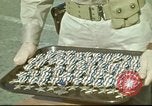
U.S. Army Lieutenant General Emmons decorates officers and men of the U.S. Submarine Trout (SS-202)
View of trays containing silver stars and other U.S. military decorations. U.S. Army Lieutenant General Delos C. Emmons, commanding general of the Hawaiian department, decorates the officers and men of the submarine USS Trout in ceremonies held at Pearl Harbor, in recognition of their successful performance of a mission for the war department in enemy controlled waters in World War 2. At the left is Lieutenant Commander Frank W. Fenno, captain of the Trout. Assisting the general is Lt. Col. E.B. Whisner, secretary of the general's staff. View of Army band and honor guards on dock. U.S. Navy officers in ranks behind Army Color Guard. Standard bearer carrying General's flag. Scene shifts again to deck of the USS Trout. The General's three-star flag flies from the Trout's mast. (Note: The mission of the Trout was to deliver anti-aircraft ammunition to the U.S. forces defending Corregidor. Fenno's sub was called on to deliver the ammunition because surface ships and aircraft were unable to penetrate the tight Japanese defenses. The mission was classified as "top secret." The USS Trout delivered the munitions and then brought back more than 6 tons of Philippine gold and 630 bags of silver, as ballast. Commander Fenno was awarded the Navy Cross and the Distinguished Service Cross, by the United States Army, and the officers and enlisted men of the Trout each received the Silver Star for successfully completing this unusual and dangerous mission. The USS Trout received a Presidential Unit Citation.)
CRITICALPAST.COM: About Us | Contact Us | FAQs - How to Order | License Agreement | My Account | My Lightboxes | Shopping Cart | Advanced Search | Featured Collections | Website Terms & Conditions | Privacy Policy ©2026 CriticalPast LLC.
License Agreement |
Terms & Conditions |
Privacy Policy
©2026 CriticalPast LLC.