


 Francais
 Deutsch
 Italiano
Refine Your Search
US-Gliders- stock footage and images
- Showing 3973 to 3978 of 21929 results more
more Hide
Hide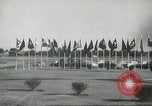
Infantry soldiers learn handling and firing of weapons at the U.S. Army Infantry School in Fort Benning, Georgia.
The U.S. Army Infantry School at Fort Benning in Georgia, United States. 'Follow Me' statue in front of the school. An infantry soldier fires a rifle. An officer instructs soldiers during a training fire course. Under expert instructions the soldiers learn the handling of weapons and firing them at fixed and changing targets. A soldier learns to detect a target and fire from different positions. The infantry soldiers learn to fire machine guns and use hand grenades.
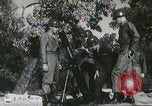
Infantry soldiers learn to fire mortars and recoilless rifles at the U.S. Army Infantry School in Fort Benning, Georgia.
The U.S. Army Infantry School at Fort Benning in Georgia, United States. Infantry soldiers learn to load and fire mortars. An officer instructs the soldiers how to use recoilless rifles. The soldiers fire the rifles.
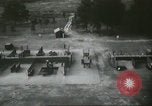
An instructor evaluates a problem solving task performed by a team at the U.S. Army Infantry School at Fort Benning in Georgia.
The U.S. Army Infantry School at Fort Benning in Georgia, United States. Aerial view of the U.S. Army Infantry School. During a problem solving task, a team of soldiers is given a task to rescue an injured pilot. Observers watch as the team works. The team places a stretcher over a rope. They place the injured on the stretcher. An instructor evaluates the work and leadership qualities of the soldiers. Men at other end pull the stretcher. An officer takes a class of soldiers. Soldiers advance through a field during tactical exercises. They load and fire artillery. Tanks advance. Paratroopers jump from aircraft in flight. An aircraft lands on a field and soldiers advance through a battlefield.
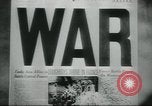
New U.S. infantrymen learn to fire rifles, make trenches and advance on a battlefield, in preparation for going to war in France
Training of U.S. Army infantrymen in the United States. A newspaper headline reads ' infantrymen arrive in France'. The infantrymen are taught to advance on a battlefield. Recruits in New York's Rainbow Division are seen marching in the mud, at Camp Mills, Long Island, They undergo physical training at the camp. They learn to fire rifles and dig trenches. They inhabit a tent city at the camp. Scenes of Rainbow Division soldiers on a chow line at Camp Mills. After basic training, the soldiers board ships and trains for France. Loved ones give them a sendoff. Upon arrival in France, they are given a warm welcome.They resume training in France, until they are ordered to the Front. Scenes of U.S. infantry in trenches wearing gas masks and firing rifles. Tanks advancing across the trenches. View of the 7th Regiment World War I memorial statue in Central Park, New York City.
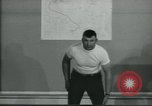
U.S. Army Airborne soldiers jump from aircraft in flight and descend on the ground during their training in the United States.
U.S. Army Airborne soldiers undergo a training in the United States. An instructor briefs the soldiers on the training mission. The soldiers board U.S. Air Force C-130 aircraft with their parachutes. The aircraft taxi and take off. The instructor gives last minute instructions. Paratroopers jump from the aircraft in flight and descend on the ground.
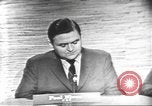
During a presidential election debate in Washington DC, Kennedy mentions the reasons for the decline of U.S. power and prestige.
The second Kennedy-Nixon Presidential Debate in Washington DC, United States. Paul Niven of CBS asks Democratic candidate Senator John F Kennedy whether he blames President Eisenhower and Vice President Nixon for the decline of American power and prestige in the last eight years. Kennedy disagrees with Nixon's statements regarding increase in American power and prestige. He talks about Nixon's experience in the administration and inability of the administration in not meeting its responsibilities which has led to decline in American power against that of the Communists. Republican candidate U.S. Vice President Richard M Nixon states that he has participated in discussions leading to decisions in his administration. He compares his programs with those of Kennedy. He also compares the economic progress of the U.S. in the Truman Administration with that of in the Eisenhower Administration. He concludes and asks Kennedy to differentiate his own programs from programs adopted by the Truman Administration
CRITICALPAST.COM: About Us | Contact Us | FAQs - How to Order | License Agreement | My Account | My Lightboxes | Shopping Cart | Advanced Search | Featured Collections | Website Terms & Conditions | Privacy Policy ©2026 CriticalPast LLC.
License Agreement |
Terms & Conditions |
Privacy Policy
©2026 CriticalPast LLC.