


 Francais
 Deutsch
 Italiano
Refine Your Search
US-Gliders- stock footage and images
- Showing 3979 to 3984 of 21929 results more
more Hide
Hide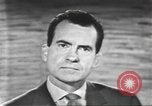
Kennedy and Nixon comment on decisions taken in favor of the U.S. during a presidential election debate in Washington DC.
The second Kennedy-Nixon Presidential Debate in Washington DC, United States. Paul Niven of CBS asks Republican candidate U.S. Vice President Richard M Nixon whether the decisions made so far for the U.S. were right. Nixon says that his decision during the Korean War was right. He disagrees with Kennedy that American prestige is at an all time low. He talks about the average income, daily meal and lifestyle of the Americans. He concludes and states that its his responsibility to correct Kennedy if he misstates. Democratic candidate Senator John F Kennedy disagrees with Nixon and gives the testimony of Senator George Aiken that majority of the Americans did not have income to afford a decent diet. He lays importance on a balanced budget.
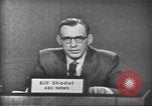
John F Kennedy and Richard Nixon contrast costs of their party platforms during a presidential election debate in the U.S.
The third Kennedy-Nixon Presidential Debate in the United States. Douglass Cater of Reporter magazine asks Democratic candidate Senator John F Kennedy to comment on costing of party platforms calculated by U.S. Vice President Nixon. Kennedy states that he believes in a balanced budget and an unbalanced budget is warranted during a recession or a national emergency. He comments on the cost of his budget and compares it with that of Nixon. He talks about high interest-rate policy that has added huge amounts to interest on debt. He talks about a different monetary policy to reduce the interest-rate burden. He talks about the bill passed by the Congress for the medical care for the aged. He says that more money would be spend on aid to education, housing and defense in his programs. Republican candidate U.S. Vice President Richard M Nixon comments on Kennedy's medical care for aged program under social security. He talks about the cost of his agricultural program and points out resulting rise in food prices. He concludes and states that following Kennedy's program would lead to inflation.
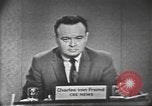
The third presidential election debate between Senator John Kennedy and U.S. Vice President Nixon in the United States.
The third presidential election debate held between Democratic nominee Senator John F. Kennedy and Republican nominee U.S. Vice President Richard Nixon in the United States. ABC news correspondent Von Fremd questions Vice President Richard Nixon about exodus of four billion dollars of gold in past three years from the United States. Vice President Nixon responds stating that there should be balanced budget in the country and increase in exports from the United States. He further says that the U.S. must support programs abroad for economic and military assistance. Senator Kennedy speaks about oil depletion. He further talks about gold. He says that United States have to maintain balance of trade, sound monetary and fiscal policy and control over inflation.
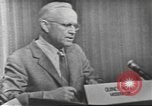
Vice President Nixon gives his closing statement during the fourth presidential election debate held in New York, U.S.
The fourth presidential election debate held between Democratic nominee Senator John F. Kennedy and Republican nominee U.S. Vice President Richard Nixon in New York, United States on 21st October 1960. ABC news correspondent Quincy Howe speaks during the debate and asks Vice President Richard Nixon to give his closing statement. Vice President Nixon opposes Senator Kennedy's statement that American is standing still. He says more houses and classrooms have been built, there has been a progress in civil rights and progress in field of slum clearance in Eisenhower's Administration which is more than in the previous administration. He says the United States should extend freedom to the world. He says that there were eleven dictators in Latin America in 1953 and now there are only 3 left. Nixon also talks about free government in Africa. He says that America will move ahead with the kind of leadership that we can provide in these years ahead. Correspondent Quincy speaks. He says that the opening statements by both candidates ran eight minutes each. The closing statements ran four minutes, thirty seconds. The order of speaking was reversed from their first joint appearance, when they followed the same procedure. A panel of newsmen questioned each candidate alternately. The first discussion dealt only with domestic policy. This one dealt only with foreign policy. As members of a new political generation, Vice President Nixon and Senator Kennedy have used new means of communication to pioneer a new type of political debate.
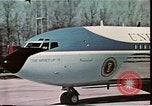
U.S. President Richard Nixon and his wife Pat Nixon are greeted by Chinese officials in the PRC (People's Republic of China).
U.S. President Richard Nixon visits the PRC (People's Republic of China). A U.S. Air Force VC-137C SAM 27000 aircraft taxis at Peking Airport. A reception for President Nixon at the airport. President Nixon emerges from the aircraft with his wife Pat Nixon. The President is greeted by Chinese officials. Dignitaries leave the aircraft followed by President Nixon. President Nixon and others arrive at Chairman of the Communist Party of China Mao Zedong's residence.
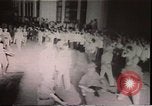
North Vietnamese guards flank U.S. prisoners who are marched through a waiting crowd in Hanoi, Vietnam.
U.S. prisoners of war are marched in Hanoi, Vietnam during the Vietnam War. U.S. prisoners are marched by North Vietnamese soldiers along a street. The prisoners march along the street lined up by screaming spectators. The prisoners are handcuffed in pairs and they wear numbered shirts. One pair of handcuffed Americans wear the numbers 399 (Edward Alan Brudno) and 381 (WIlliam Micahel Tschudy) on their backs. A crowd of North Vietnamese surround soldiers carrying an unconscious injured American captive. The soldiers try to hold back the crowd. One soldier waves a pistol in one hand as he helps carry the American captive with the other. Photographers take pictures as the soldiers place the captive American in a covered truck and drive away through the crowd.
CRITICALPAST.COM: About Us | Contact Us | FAQs - How to Order | License Agreement | My Account | My Lightboxes | Shopping Cart | Advanced Search | Featured Collections | Website Terms & Conditions | Privacy Policy ©2026 CriticalPast LLC.
License Agreement |
Terms & Conditions |
Privacy Policy
©2026 CriticalPast LLC.