


 Francais
 Deutsch
 Italiano
Refine Your Search
US-Gliders- stock footage and images
- Showing 4477 to 4482 of 21929 results more
more Hide
Hide
Emergency operating procedures including ejection and landing of the U.S. Navy T2V-1 SeaStar.
Emergency operating procedures of the U.S. Navy T2V-1 SeaStar. The aircraft in flight. Simulation of ejection procedure. Pilot in the cockpit and view of gauges and flight controls. Pilot places his feet in the stirrups, sits erect in the seat with head braced against head rest. He pulls the emergency bail out cord, disconnects oxygen hose at the mask connection, and pulls down face curtain handle firing the canopy and ejecting the seat. He pulls the auxiliary canopy jettison handle and turns on the canopy open switch. In case this procedure fails, the pilot demonstrates a back up including adjustment of canopy interlock release handle, pulling of the face curtain to eject the seat through the canopy. Air start: The pilot moves the throttle to off position. View of altimeter as pilot lowers the plane to maximum altitude for an aircraft and assumes a glide. He drains the tail pipe of residual fuel and places the plane in a shallow dive. He adjusts the battery generator switch and holds position. Landing: A stylized illustration of the landing pattern depicts adjustment of glide path and approach. The plane approaches the runway, maintains speed, decreases altitude, retracts landing gear and flaps, and touches down.
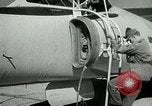
Pre-flight landing gear and cockpit inspection of the U.S. Air Force F-102A Delta Dagger interceptor aircraft.
Pre-flight inspection of the U.S. Air Force F-102A Delta Dagger interceptor aircraft. The plane on the runway. Crewmen nearby. The crew chief inspects the landing gear including ground safety pins, tires, landing light and high pressure air gauge. He checks for hydraulic and fuel leaks. Inspection of the armament door. The pilot climbs up to the cockpit, raises the canopy and inspects the seat belts and shoulder harness. He gets into the seat and inspects the switches and oxygen pressure. On the outside, he examines the flexi glass and wind shield. He climbs down.
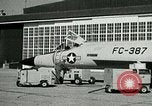
Pre-flight inspection of the U.S. Air Force F-102A Delta Dagger interceptor aircraft.
Pre-flight inspection of the U.S. Air Force F-102A Delta Dagger interceptor aircraft. The crew chief checks the air intake surfaces, nose boom, dome and holes in the tip. He inspects the forward electronic compartment, fluid tank, filler cap and access door. He checks the landing gear including tires, nose steering unit, taxi light and nose gear door. Inspection of the battery, ground safety pins, circuit breaker panel, armament door, turbine blades, hydraulic reservoirs and gauges. Inspection of the wing surfaces, wing tips and position light. The tail inspection includes the skin, navigation light, vertical stabilizer and rudder, speed brake area, tail pipe nozzle and drag chute area. The crew chief climbs onto the plane and inspects the upper surface, dorsal fin, fuselage panels, fuel intake covers and the fuse. He then climbs back down.
Pre-flight inspection including power on checks of the U.S. Air Force F-102A Delta Dagger interceptor aircraft.
Pre-flight inspection of the U.S. Air Force F-102A Delta Dagger interceptor aircraft. Plane on the runway. Crew chief performs power on checks in the cockpit. He climbs into the cockpit and inspects the lights, switches and gauges. Two crewmen check the engine compartment for fuel leakage under the plane. They close the panel after inspection and sign off the forms. The plane on the runway.
Loading and firing of Falcon air to air missiles from a U.S. Air Force F-102A interceptor aircraft. in United States.
Loading and firing of Falcon air to air missiles from a U.S. Air Force F-102A Delta Dagger interceptor aircraft. Several men load Falcon missiles into an F-102A at Holloman Air Force Base, New Mexico. Three contractor representatives going over graphs and charts in a conference room. The representatives going up steps of the Convair General Office Building at San Diego, California. Two Convair technicians check electrical connections and firing circuit of a Falcon missile on flight line at Holloman AFB. They load a Falcon onto launcher of a F-102A and insert the ignitor into the motor. The rockets are drawn into the aircraft and the bay doors closed. The F-102A taxis on flight line and takes off. F-102Ain flight, bomb bay doors open. The Falcon missiles are extended and fired in two salvos of three each. F-102A flying to the right.
U.S. Air Force F-102A Delta Dagger external wing tank vibration tests at Edwards Air Force Base in California.
U.S. Air Force F-102A Delta Dagger external wing tank vibration tests at Edwards Air Force Base in California. Several men take an external wing tank from the back of a pickup truck and carry it inside of a hangar. An F-102A with its landing gear mounted on spring-supported platforms inside a hangar. Technicians install accelerometers mounted on wooden blocks. The aircraft equipped with external wing fuel tanks undergoes vibration tests. Electro-magnetic shakers are attached to the wing tips of the aircraft with the vibration visible on the nose of the fuel tank during low-frequence oscillation. Three engineers check oscillograph recordings made during the vibration tests. The F-102A, equipped with two external wing tanks painted black and white, in flight. External fuel tank under the left wing. The aircraft flying to the left, jettisons external fuel tank visible beneath the wings of the aircraft. Two technicians install a shaker underneath the wing of an F-102A. A F-102A taking off. F-84F chase plane and F-102A flying to the right. F-102A rolling down the runway after touchdown, nose gear touches down.
CRITICALPAST.COM: About Us | Contact Us | FAQs - How to Order | License Agreement | My Account | My Lightboxes | Shopping Cart | Advanced Search | Featured Collections | Website Terms & Conditions | Privacy Policy ©2026 CriticalPast LLC.
License Agreement |
Terms & Conditions |
Privacy Policy
©2026 CriticalPast LLC.