


 Francais
 Deutsch
 Italiano
Refine Your Search
US-Gliders- stock footage and images
- Showing 5725 to 5730 of 21998 results more
more Hide
Hide
U.S. Marine Corps film and photograph scenes in World War 2, and film making in USA during war.
Film 'Sunset in the Pacific' shows United States Marine Corps photographers taking pictures and filming motion pictures in the Pacific Theater during World War II. Night view of a huge explosion. Two photographers shoot still pictures from behind a rock. Marines advance on beachhead. Combat cameraman with a 35 mm movie camera crawls over ground and into a trench. Flood waters flow through a valley, smashing into homes and shacks. Photographers shoot stills with speed graphic. Movie studio camera operator using 35mm motion picture film camera on platform or boom to capture motion picture film images of a American Legion Parade in New York City. Legionaries march with the American flag in hand. Two camera operators film couples dancing in a ballroom, on what appears to be a Hollywood movie set. Band plays in the background. Sailor watches as chief photographer explains working of 35mm movie camera.
U.S. 1st Marine Division training on assault course, under fire, in Australia during World War II.
1st U.S. Marine Division undergoes training at Wagga Wagga Island in Australia during World War 2. Australian Wirraway trainer airplanes fly low over the training ground assault course. Marines advance on an open field. They approach bayonet training dummies, thrust and fire at the dummies. Explosion occurs, raising dust, as they exit the bayonet area. They jump over low barbed wire obstacles. A pair of Wirraway aircraft fly over at treetop level.More explosions occur in the field as Marines arrive at barbed wire obstacles that they must crawl under.They encounter more dummies to bayonet; climb over wooden walls; and rope ladders. A huge explosive charge is set off raising lots of earth near the trainees. Medical team examines someone injured.
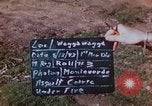
Marines of U.S. 1st Marine Division cross rope bridge during training at Wagga Wagga, NSW, Australia, in World War II.
U.S. 1st Marine Division undergoes training at Wagga Wagga Island in New South Wales, Australia, during World War 2. Marines cross rope bridges over a small stream. Explosion near them throws water into the air.. Wirraway trainer airplane flies low overhead. Marines wait in line to cross the rope bridge.
U.S. Lieutenant General Geoffrey Keyes inspects German small arms in Italy during World War II.
German soldiers surrender arms to U.S. troops in Italy during World War II. German soldiers turning in arms to the United States Army. German nurse in uniform speaks with two soldiers. United States Lieutenant General Geoffrey Keyes and other officers stand in front of German ammunition dump. General Keyes inspects rifles and small German arms. Damaged buildings with heap of debris in the foreground.

American occupation troops collect military uniforms and weapons from German population, at end of World War II. U.S. troops display Nazi plundered treasure in a salt mine.
German civilians in a city on the Elbe River, gather around a poster containing Law Number 5, issued by the Military Government-Germany (American Occupation forces). It announces the dissolution of the Nazi party. Next, a German Army medic talks to an American, near a huge pile of German military uniforms, military equipment, and accessories. Civilians including former German soldiers throng a town square, adding items to the pile. A woman pulls uniform items from her wash basket. An American soldier talks with a German woman as bystanders watch and listen. A man and boy look at a small rifle before the boy throws it on the pile. View from above of the square with people crowded around the pile of castoffs in its center. Women placing officers' swords on the pile. Complete change of scene shows a U.S. soldier from the 3rd Army, in a salt mine, in Merkers, Germany, on April 15, 1945. He is perusing Nazi seized and stolen jewelry, cutlery, and precious metal trinkets in a case. Another soldier looks at a bar of gold and displays it for the camera. Many wrapped gold bars are behind him. German currency bank notes are seen in the hands of a soldier. Numerous packages of currency sit in the background. American soldiers show some of the stolen art works also hidden in the salt mine. Among the seized paintings seen is "Wintergarden," by French impressionist painter Edouard Manet.
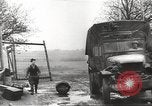
U.S. 4th Armored Division Commander Col. Hayden Sears forces German civilians to visit the Ohrdruf Concentration Camp in Germany (WW2)
The liberation of the first Nazi concentration camp Ohrdruf near the end of World War II. On April 6, 1945, troops from U.S. Combat Command A, 4th Armored Division, commanded by Colonel Hayden Sears forced local town's people to tour the camp. Captured Nazi German officials get out of an army truck. A German Major (Doctor) also accompanies the group. Dead bodies on ground. Nazi officials are forced to watch heaps of bodies found inside a room. Burned bodies of Polish, Czechoslovakian, Russian, German Jews and political prisoners. The policy of requiring local German officials to view every captured concentration camp began with this episode. The rationale was the "They will never be able to say they didn't know what happened here." (Col Sears as reported by his son.)
CRITICALPAST.COM: About Us | Contact Us | FAQs - How to Order | License Agreement | My Account | My Lightboxes | Shopping Cart | Advanced Search | Featured Collections | Website Terms & Conditions | Privacy Policy ©2026 CriticalPast LLC.
License Agreement |
Terms & Conditions |
Privacy Policy
©2026 CriticalPast LLC.