


 Francais
 Deutsch
 Italiano
Refine Your Search
Ubon AirForce Base Thailand 1967 stock footage and images
- Showing 2269 to 2274 of 5487 results more
more Hide
Hide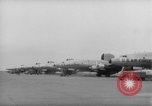
USAF RC-12lD Picket ship on ramp, men receive outdoor briefing and officers board aircraft at a base in the United States.
The life of crew of a United States Air Force RC-121D Warning Star Picket ship in the United States. A line of six RC-121D Picket ships along the ramp. RC-12lD Picket ship on ramp with engines running. View of the the radar dome. The nose section of the aircraft. A canvas covered truck. Crew members alight from the truck and walk towards the aircraft. Men take stations in front of the aircraft for outdoor briefing. Several views of the men during the briefing. An officer gives the briefing. Men dismissed and they wa1k towards the aircraft. Men climb aerostand and board the aircraft. Officers carry briefcases and board the aircraft.
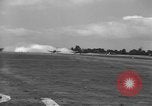
P-47Ds of the 362nd Fighter Group at forward operating base in France during World War II
Two P-47D aircraft raise considerable dust as they make a formation takeoff from Advanced Landing Ground, A-12, at Lignerolles, France, during World War 2. They are painted with white invasion stripes Change of scene shows P-47D, tail number 42-27603, of the 362nd Fighter Group, 378th Fighter Squadron, parked on stiffened steel mesh (Sommerfeld Tracking) at the field. The aircraft is under armed guard. Its tail wheel appears to be sunk below the steel mesh. A motorcycle is parked beside the aircraft. Airmen walk around the airplane, looking at battle damage that is seen on leading edge and aileron of its right wing. Two holes are seen in the fuselage below the cockpit. A Military policeman examines the holes in the fuselage. Camera shows accidental closeup of steel mesh on the field that appears to be the square-mesh track variety (SMT). Glimpse of a P-47D making a dusty takeoff.
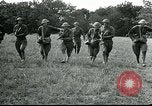
Army soldiers in training at a base in the U.S. during World War I
U.S. soldiers training in the United States during World War 1. Several soldiers run across a field, towards the camera. Two of them carry light machine guns. A bugler leads a group of soldiers towards a mess tent where they are served food,into their mess kits. They eat standing, at long tables. Army Post Brass band marches and plays. Horses and mules in a corral at Army post.
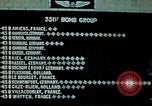
U.S. 351st Bomb Group is briefed before a bombing mission at the RAF base in Polebrook, Northamptonshire, England .
U.S. 351st Bomb Group at RAF Station Polebrook, Northamptonshire, England during World War II. A display board of the U.S. 351st Bomb Group, at RAF Station Polebrook, England, shows 15 principal targets and the number of times they've been struck by B-17s of the Group. The most missions were flown against Schweinfurt, Germany (25 times) and second most, against Hanover, Germany (17 times). Another recent status board records missions against Amiens and Evreux,and Romilly, France; Stuttgart, Germany; and Brussels,Belgium.Swastikas indicate German aircraft shot down during these raids. A C-45 aircraft lands and parks at the field. Major General Ira C. Eaker,Commander 8th Air Force, steps from the plane for a visit with the 351st Bomb Group. He proceeds to the briefing room, in a Quonset hut. Four Officers of the Group pose. View of heavy bombs in the bomb dump. Views of bombs hung wing racks of a B-17 to increase its bomb load. Bombs being transported on motorized dollies. Airmen writing in chalk on a bomb. It reads: "From the boys K of C #92 Jim, MH." Fliers at nighttime in their Quonset hut quarters. One writes a letter. Others trying to sleep, as sounds of aircraft engines are heard. Officer opens door of quarters and wakes crew members, telling them breakfast is at 3AM and briefing at 4AM. Briefing officer asks fliers to guess what the target of the day will be. Several make suggestions. The briefing officer removes a cover from the mission map, revealing target deep in Germany. The fliers respond with good-natured boos. Commander gives final instructions.,
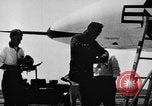
First test flight of the Douglas F5D-1 Skylancer aircraft at Edwards Air Force Base, California
The first Douglas F5D-1 Skylancer aircraft (BuNo 139208) at Edwards AFB for its maiden flight on April 21, 1956, with test Douglas Aircraft test pilot Robert O. Rahn at the controls. Test pilot Rahn climbs aboard the aircraft, which is painted in U.S. Navy colors. After several views of pilot, Bob Rahn, in the cockpit, the scene shifts to the airplane on takeoff roll. It takes off smoothly accompanied by a T-33 chase plane. The F5D climbs out steeply and is next seen in level flight cruise configuration. The sequence concludes with the F5D on final approach and landing, with T-33 flying in parallel. The aircraft touches down smoothly and rolls out in a nose high attitude, seeming to almost drag its tail, but not quite. Photographers record the landing from the side of the runway. Reportedly the test flight was smooth overall and the aircraft easily exceeded the speed of sound on this, its first flight. (Note: The U.S. Navy cancelled the F5D Skylancer order, after only several aircraft were built. Two were eventually acquired by NASA.)
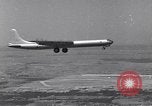
A U.S. Air Force B-36 Peacemaker bomber aircraft lands at Carswell Air Force Base in Texas, United States.
XB-36 first flight on August 8, 1946, at Fort Worth, Texas, with Convair Chief test pilot Beryl Erickson and copilot Gus Green, at the controls. The XB-36 flying over airfield, with landing gear extended. Views from side and below. Views from above, from the side, from below and from the rear, as it flies some distance from the field, with gear still extended. XB-36 on final approach crossing a river, and touching down on first part of runway as it lands.
CRITICALPAST.COM: About Us | Contact Us | FAQs - How to Order | License Agreement | My Account | My Lightboxes | Shopping Cart | Advanced Search | Featured Collections | Website Terms & Conditions | Privacy Policy ©2026 CriticalPast LLC.
License Agreement |
Terms & Conditions |
Privacy Policy
©2026 CriticalPast LLC.