


 Francais
 Deutsch
 Italiano
Refine Your Search
Ubon AirForce Base Thailand 1967 stock footage and images
- Showing 2599 to 2604 of 5487 results more
more Hide
Hide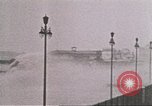
U.S. Air Force 920th Weather Reconnaissance Group hurricane hunting operations from Keesler AFB in Biloxi, Mississippi
Rough sea and strong winds blow due to a hurricane. Heavy surf washes over a pier and trees bow over in strong hurricane force winds. View of entrance sign at Keesler Air Force Base where weather forecasting and hurricane hunting operations done. Personnel of U.S. Air Force 920th Weather Reconnaissance Group seen receiving teletype information about a hurricane, and plotting hurricane position and course on paper. View of a WC-130 aircraft in flight on the hurricane hunting operation. Pilot and navigator seen on board as they approach and fly into the hurricane to gather data. The WC-130 seen again in clear skies returning to base.
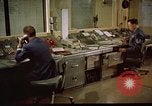
Air Force personnel receive and decode messages; sound an alert; deploy bomber aircraft during drill in the United States.
Nuclear weapon safety strategies employed by the United States Air Force during the Cold War. Shows aircraft alert training drills related to launch of nuclear weapons. U.S. Air Force personnel work on the controls in a control room of an air base. Men answer phone calls. An alert order being received in a coded language. An alarm being sounded and airmen scramble and run from their rooms and billiards table to the aircraft at the base. Crew members enter waiting bomber aircraft and put on their flight gear and breathing apparatus. Controllers decode the message separately and then compare it. Aircraft commanders being instructed. A cocoa alert being sounded and aircraft taxi along a runway. Scene shifts to aerial view of a U.S. Air Force B-52 bomber aircraft in flight, which narrator indicates is among aircraft that are airborne at all times and prepared to proceed to a target. View of pilot and copilot in the cockpit of the B-52 bomber aircraft. Aerial view of B-52 aircraft banking to right side. View of different crew members such as bombardier and navigator in B-52 aircraft as they separately confirm interpretation of an incoming message. View of Republic F-105 Thunderchief aircraft parked readying for takeoff on runway. Another fighter aircraft preparing for takeoff (F-11 ?). A surface missile being readied for launch. A missile being launched from an underground missile silo, taking off and emitting a fiery flare.
General MacArthur arrives and inspects Allied forces at the war front in New Guinea during World War II.
A USAAF B-17 bomber taxis in after landing at Vivigani Airfield on Goodenough Island in New Guinea. General MacArthur steps from the aircraft and is greeted by the American Air Base Commander. Closeup of General MacArthur. Next, a jeep carrying him and several others is seen from the rear as it drives over roads literally hacked from the jungles. Views of friendly native tribesmen, engaged by the Allies, carrying supplies toward the front. as Australian troops march along side them. View of rough water tumbling in a river and native bearers crossing it on a suspension bridge. View from above of long line of New Guinea native bearers moving along a path. Back at Vivigani Airfield , MacArthur greets some of the American fliers who have been attacking Japanese shipping from there. His B-17E, tail number 41-12633, ("Sally") is parked in the background. General MacArthur salutes and heads to his B-17 (that will take him to 7-Mile Drome near Port Moresby). View of a USAAF B24 Liberator bomber taxiing on the airfield. Another B-24 (named "Connebb's Speciab" is being loaded with bombs. Crew of a B-24 getting briefed as they stand under the wing of their aircraft. A pilot sticking his head out of the cockpit window. A B-24 airborne after takeoff. View from B-24 of a Japanese ship in sea below. Gunners inside the B-24 strafing the ship as the B-24 flies low over it. Bombs dropping during the Aircraft' second pass over the Japanese ship. View of the bombs exploding at port and starboard of the ship. View of clouds and then interior of the B-24 as crew members converse on their way back to their base.

British RAF bombers of No 2 Group bomb the Philips Electrical works at German-occupied Eindhoven, Holland, during World War II.
Film starts wirh slate reading: "R.A.F. Blasts Holland." At an Royal Air Force (RAF) base in England, United Kingdom, ground crewmen work on a British Supermarine Spitfire aircraft. Closeup of RAF pilot in cockpit of an airplane. Closeups showing fires burning and severe destruction of the Philips Electrical works at Endoven, the Netherlands, in aerial photographs taken during a bombing attack by RAF 2 Group, on December 6, 1942. Animated map illustrates the flight path of the attacking bombers from England, across the North Sea and the German occupied Holland, to Endoven. View of a de Havilland Mosquito bomber with propellers turning and then one of a Mosquito bomber in flight overhead. View from a warship of several RAF 2 Group aircraft flying low over the North sea. Glimpse of a Mosquito bomber flying low enough to affect the ocean surface. View from another aircraft in the formation, of a Mosquito bomber underway low over the water. View of a pilot in a cockpit, wearing learher helmet with earphones and an oxygen mask. View from aircraft approaching the coast of Holland, with two others already low above the mainland. More views of the bombers flying extremely low over Holland. View from a bomber showing agricultural land and the Philips Electrical works at Endoven, dead ahead. German flak guns fire and the bombers return fire by strafing the target building. The camera aircraft pulls up climb above the building and maneuvers over a river and city. Scene shifts to views from a high altitude group of RAF 2 Group, over the target. Views of their bombs bursting on target complex, causing fires and heavy smoke. Scene shifts, again to the bomber aircraft recovering at their home base in England. (Narrator states that 12 aircraft did not make it back.) View of a mosquito bomber crash landed. A severely damaged Lockheed PV-1 Ventura bomber. A crash landed Douglas A-20 Havoc bomber. Air crews conversing after arriving back from the mission. (Note: Losses to 2 Group were heavy, with 14 aircraft brought down by flak and enemy fighters, a 20% loss rate. Three more aircraft crash-landed on returning to England. Fifty-seven aircraft had been damaged and needed repairs.)
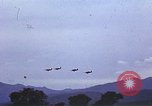
U.S. P-47s in formation over Corsica, France during World War II.
United States P-47 aircraft in flight in Corsica, France during World War II. U.S. Army Air Forces P-47 aircraft in flight. P-47s in formation. Aerial views of the Corsica coastline. An aircraft approaches Alto Air Base. Runway at the air base.
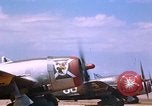
USAAC 57th Fighter Group P-47s take off and fly in formation over Corsica, France during World War II.
United States Army Air Corps (USAAC) P-47 aircraft in flight over Corsica, France during World War 2. P-47s of the 66th Fighter Squadron, 57th Fighter Group taxi at Alto Air Base. Nose of the P-47 aircraft. Airman hammers a nail onto a post, putting finishing touches on the Officer's club. Officers in Control tower at Alto Air Base. A dozen P-47s of the 66th Fighter Squadron take off and join up in three flights of 4 each overhead. Wing tank and belly tank of an aircraft. P-47 aircraft returning in formation. P-47s peel off for landing. Lt Col Gilbert O. Wymond, commander of the 65th Fighter Squadron, in the cockpit of his P-47 "Hun Hunter XIV." Airmen wash in outdoor improvised shower.
CRITICALPAST.COM: About Us | Contact Us | FAQs - How to Order | License Agreement | My Account | My Lightboxes | Shopping Cart | Advanced Search | Featured Collections | Website Terms & Conditions | Privacy Policy ©2026 CriticalPast LLC.
License Agreement |
Terms & Conditions |
Privacy Policy
©2026 CriticalPast LLC.