


 Francais
 Deutsch
 Italiano
Refine Your Search
Ubon AirForce Base Thailand 1967 stock footage and images
- Showing 2773 to 2778 of 5487 results more
more Hide
Hide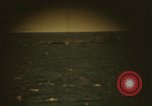
Captured Japanese submarines I-14 and an I-400 class sub are sunk off the coast of Oahu Hawaii after the end of World War II
View of two captured Japanese submarines taken from a periscope off the coast of Oahu Hawaii, soon after the end of World War II. (U.S. Navy records of this footage state that the two submarines shown are of the RO-26 and RO-51 class, but this does not appear to be true based on observation of the images). The first submarine is unidentified. The second submarine shown in the periscope view is the Type AM Imperial Japanese Navy submarine I-14. Closer periscope view then shows I-14 painted on the side of the submarine tower. Large explosion as submarine I-14 is hit by a torpedo from the USS Bugara (SS-331). Japanese submarine I-14 is seen sinking slowly. Next shot shows Japanese I-400 class submarine in the distance, and then up close through periscope. This is likely I-401 or I-400. Final portion of clip shows view from surface of water as I-400 class submarine sinks, after being torpedoed. This is most likely the May 31, 1946 sinking of Japanese submarine I-401 by the USS Cabezon (SS-334), but could possibly be the June 4, 1946 sinking of submarine I-400 by the USS Trumpetfish (SS-425). A HO3S helicopter flies overhead as the I-400 class submarine sinks.
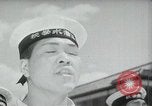
Japanese sailors exercise and Naval officers during a ceremony.
Japanese naval officer exercises with sailors in training. Japanese sailors play a game. White clothes hang in line. Group of Japanese Navy sailors take bath in bathing area. Japanese students write in class room. View of cherry blossoms. Naval officers salute during a Japanese Navy training graduation or deployment ceremony. One of the officers marches forward. Barracks in the background at Japanese Navy training base
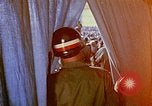
Sammy Davis Jr. and USO troupe entertains troops at Can Tho Army Airfield during Vietnam war
Sammy Davis Jr. on tour with a USO Troupe, entertaining American troops at Can Tho Army Airfield in Vietnam. A U.S. Army military policeman peeks through a curtain aside a stage, where Sammy Davis Jr. is performing as part of a USO tour entertaing troops during the Vietnam War. Davis stands onstage, backed by women dancers who move rhthmically as he speaks or sings into the microphone. Camera shifts to spot at back of large audience seated in a hangar at the base. Musicians and other members of USO troupe are seen onstage in distance. View of soldiers seated outside the hangar applauding the performances. View from behind audience. Sammy Davis Jr. seen onstage in distance. Soldiers watching from atop a raised platform, outside the hangar. Several views of audience clapping rhythmically to beat of music sung by performers. Some soldiers taking moving pictures of the event, from outside the hangar. Huge overflow crowd of soldiers watching from outside the hangar. Glimpse of Sammy Davis Jr. singing, accompanied by musicians. More audience shots.
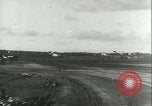
U.S. Army forces reclaiming and salvaging damaged aircraft for reuse during World War 2.
Damaged aircraft landing during World War 2. A B-24 Liberator with non-functioning landing gear comes in for a landing and slides on a runway. A B-25 aircraft comes in for a landing and landing gear partially fails. Pilot controls plane as it skids to a stop. A B-25 bomber aircraft on runway during takeoff suddenly pitches forward and nose crashes into ground. Air Force technicians at Davis-Monthan Air Base near Tucson Arizona cannibalize and reuse serviceable parts of various aircraft They assemble airplane tails, gas tanks, oil radiators and oxygen tanks. Technicians reclaim other parts from the aircraft that can be reused.
Toronto Police War Veterans Association "Church Parade" and ceremony honoring fallen of World War I
Toronto Policemen participate in annual "Church Parade" to honor fallen from World War 1. The Police Pipe Band leads the parade past the City Hall Branch of the Dominion Bank, at Queen and Bay Streets. They are followed by uniformed policemen wearing white gloves.The Pipe band continues along tree-lined section of street. Police official on horseback leads the uniformed police officers. A contingent of mounted police take part in the parade. An elderly man in Police uniform stands with three elderly officials, in top hats, in front of the Toronto City Hall, where members of another police band in uniform, stand, at ease, conversing. Spectators are gathered under a flagpole. A Color Guard of police officers stands at attention. The four elderly gentlemen are assisted in placing a floral wreath at the base of the World War I memorial at the City Hall. Inscription: "To Our Glorious Dead" is seen on the monument. The four men stand as the police band plays music.
First Major League Baseball All Star Game; Ruth's home run gives American League a 4-2 victory
Newsreel clip on Major League Baseball's first-ever All-Star Game in 1933 at Chicago's Comiskey Park. As title card notes, a home run by Babe Ruth (not seen in this clip) would propel the American League to a victory over the National League. Game footage: Joe Cronin of the Washington Senators flies out to end the third inning. Lon Warneke of the Chicago Cubs pitches for the National League. In the top of the fifth inning, Wally Berger of the Boston Braves grounds out to first. View of some of the 47,595 fans in attendance. In the bottom of the fifth, the Yankees' Babe Ruth takes a ball and a brushback pitch, then hits a single, running to first in his distinct "pigeon-toed" style. With Ruth on first, Warneke strikes out Lou Gehrig of the Yankees. (Note numerous photographers on the field.) Al Simmons of the Chicago White Sox hits a single, but Jimmie Dykes of the White Sox grounds out to end the inning. In the top of the sixth inning, Lefty O'Doul of the New York Giants grounds out to first. Pepper Martin of the St. Louis Cardinals grounds out with Lon Warneke on third, scoring Warneke. With bases empty, Frankie Frisch of the Cardinals hits a home run. Final score would be 4-2, AL
CRITICALPAST.COM: About Us | Contact Us | FAQs - How to Order | License Agreement | My Account | My Lightboxes | Shopping Cart | Advanced Search | Featured Collections | Website Terms & Conditions | Privacy Policy ©2026 CriticalPast LLC.
License Agreement |
Terms & Conditions |
Privacy Policy
©2026 CriticalPast LLC.