


 Francais
 Deutsch
 Italiano
Refine Your Search
Ubon AirForce Base Thailand 1967 stock footage and images
- Showing 2911 to 2916 of 5487 results more
more Hide
Hide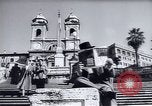
Comprehensive overview of Rome, Italy, covering some notable architecture and various commercial industries and activities of Romans.
An Italian documentary about Rome, Italy. Opening scene shows people going up and down the Spanish Steps in Rome, Italy (Italian: Scalinata di Trinità dei Monti). The steps ascend a steep slope between the Piazza di Spagna at the base and Piazza Trinità dei Monti. At the top is the Trinità dei Monti church (Piazza della Trinità dei Monti, 3, 00187 Roma RM, Italy). A man sits on a concrete pillar reading Time magazine. A man sips an espresso in front of the Pantheon (Piazza della Rotonda, 00186 Roma RM, Italy), with obelisk and fountain on the Piazza della Rotonda in front of it. People patronizing shops along Via del Corso. A woman tries on a fashionable dress in a designer boutique, as the proprietor stands nearby. A woman looking closely at necklaces in a jewelry store window. A woman customer trying on jewelry at a shop. Woman takes off ring from finger. Closeups of her hands with rings on them. Elegant, jeweled necklace displayed in a shop window. Neon signs in entertainment district at night. Two women in a bar. Behind them is the bartender, and on the wall is a large reproduction of the Reclining Venus, by Venetian painter Giorgione. A doorman at the entrance to a night club. Inside, patrons crowd the floor, dancing to rhythmic Latin music. Tourists partying inside the night club. Abrupt change of scene shows smoke rising from the stack of a steel plant. Inside men are seen working near a furnace. Sparks fly from welding. The welder seen working over a huge metal part. Next, women and a man are seen handling armfuls of wool. Other women operate a spinning machine creating thread from the wool. View inside a dress maker shop where a woman removes a dress from a form. Several women are busy making dresses in the shop. Supervisors examine the works in progress. A shoemaker is seen working at his bench. Customers in a shop look at new woolen blankets. People doing banking at a teller's window. The teller annotates a customer's bank book. A group of well-dressed men and women mount motor scooters and proceed to a park where many other scooters are parked. Sports fans fill the area around a soccer stadium. Some are buying tickets at booths. Crowds enter the stadium. View of stadium filled with fans. Players run on the field as fans applaud in the stands. It begins to rain, and fans pull up coat collars. Most of them raise umbrellas.
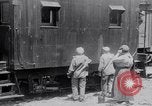
British women take on men's jobs on the homefront during World War I
Women in the industrial workforce on the homefront in Britain during World War 1. Opening scene shows several British women in working garb painting a railroad car. Other women perform manual labor alongside railroad box cars in a rail yard near a factory, as two women pass them pushing a small flatbed rail car loaded with steel rail parts. Change of scene to outdoors, where women are felling trees. Two in foreground are using a grinding wheel to sharpen an axe, while behind them, two push on a tree while two others use a long two-handled saw near its base. They jump clear as the tree falls. Women wielding axes to cut trees, elswehere in the woods. Two women with a two-handled saw, making final cuts on a standing tree, and stepping out of the way as it falls. A woman painter on a scaffold supported by block and tackle rigging four stories high on the side of a city building.
French Army engineers work on various projects during World War I
French Army engineers at work in World War 1. Several maneuver in a small boat at a waterfront. Others manual operate a pile driver to set a post in the water for a dock. Officers look on as a group of Army engineers works to repair a wooden bridge made of many supporting members and cross braces. Change of scene to French engineers strengthening and stabilizing the base of a high bridge over a river. New sequence shows a pier with boats tied up and high water in river behind. Scene shifts to engineers working on a low level bridge over a river. A team of horses pulls construction equipment over the bridge. A bombed out high railroad bridge is seen in the background. (WWI. WW1)
35th anniversary of Wright Brothers' first flight. Advances in travel due to rail and airplane. Howard Hughes' round the world flight.
Film notes 35th anniversary of Wright Brothers' first flight and reviews history of transportation and advances in transportation brought about by railroad and aircraft. An animated map of the United states before the advent of mechanized transport methods. It illustrates the difficult and long overland journey to travel from the East Coast to the West Coast. Travel by horse and wagon over the Santa Fe Trail in 1849 is recreated in a brief film clip. Next, a locomotive is shown pulling a passenger train at high speed along a railroad at the base of a mountain. Animated map charts fairly direct path from Coast to Coast, taking only 4 days by railroad. Next a nearly straight course is traced across the map illustrating the path of an airplane taking only seven and a half hours for the journey. Change of scene shows aerial view of Howard Hughes' Lockheed 14 Super Electra Special, Model 14-N2 ( NX18973), christened "New York World's Fair 1939," in flight over New York harbor with the skyline of Manhattan, New York City in the background. Camera follows the plane as it passes over lower Manhattan. The Empire State building is seen prominently with other skyscrapers below the aircraft. This was filmed, on July 14, 1938, as Hughes and his crew were returning from Minneapolis, Minnesota, to Floyd Bennett Field, on Long Island, at the conclusion of their around-the-world flight (circling the Northern Hemisphere) from July 10 - July 14, 1938.
Retired Officers' Luncheon at Bolling AFB celebrating the 35th Anniversary of the 1929 record endurance flight of the Fokker C-2 Question Mark.
Film opens showing a display case in the Bolling Air Force Base Officer's Club, containing a model of the Atlantic-Fokker C-2A aircraft flown by pilots of the U.S. Army Air Corps, in January, 1929 when they set an endurance record of more than 150 hours sustained flight. Below it is a Wright J-5 Whirlwind R-790 engine that powered the flight. Next a large poster is shown commemorating the 35th anniversary of the feat (1929 to 1964). It contains photos of highlights from that event. Next, the retired officers pass the display of model and engine as they descend stairs and enter dining room. Most are in civilian clothes. But several attendees are active duty officers in uniform. Major Sidney Kubesch, pilot on record-breaking B-58 flight from Tokyo-to-London, pauses to stand and look at the display case. General Nathan Twining; General Ira Eaker seen briefly at the display case. At end of clip, General Carl Spaatz stands alone, looking at the display.
Luncheon at Bolling AFB celebrating the 1929 flight endurance record of Fokker airplane named Question Mark, and 1963 speed record of a B-58 bomber.
Opening scene shows large group of retired Air Force officers seated at a number of tables in the Bolling Air Force Base Officers' Club. Closeups of General Carl Spaatz, Lieutenant General Ira Eaker, Lieutenant General James Ferguson (Deputy chief of staff for research and development at Headquarters Air Force), and Major Sidney J. Kubesch (who, in October 1963, was aircraft commander of the B-58 bomber that set a speed record, flying 8,028 miles from Tokyo to London in 8 hours, 35 minutes and 20.4 seconds). Old time aviators, Colonel Harry Halverson and aviation mechanic, Sergeant Roy Hooe, who both flew on the Question Mark, are also seen. Closeup of a model B-58 Hustler bomber sitting on a luncheon table. Closeup of a model of the Fokker C-2A "Question Mark" next to old log book. ( This clip also shows two unidentified women participating in the luncheon.)
CRITICALPAST.COM: About Us | Contact Us | FAQs - How to Order | License Agreement | My Account | My Lightboxes | Shopping Cart | Advanced Search | Featured Collections | Website Terms & Conditions | Privacy Policy ©2026 CriticalPast LLC.
License Agreement |
Terms & Conditions |
Privacy Policy
©2026 CriticalPast LLC.