


 Francais
 Deutsch
 Italiano
Refine Your Search
Ubon AirForce Base Thailand 1967 stock footage and images
- Showing 2917 to 2922 of 5487 results more
more Hide
Hide
Retired veteran aviators share Luncheon at Bolling AFB celebrating Air Force record-setting flights in 1929 and 1963.
A large group of retired Air Force officers are seen seated at a number of tables during a luncheon celebrating the 35th anniversary of the 1929 endurance record setting flight of the Fokker C-2A aircraft named "Question Mark." The event is in the Bolling Air Force Base Officers' Club. Closeup of General Carl Spaatz, addressing the group from a podium. Colonel Harry Halverson and aviation mechanic, Sergeant Roy Hooe, who both flew on the Question Mark, are listening, along with Major Sidney J. Kubesch (who,in October 1963, was aircraft commander on the B-58 bomber that set a speed record, flying 8,028 miles from Tokyo to London in 8 hours, 35 minutes and 20.4 seconds). Lieutenant General Ira Eaker addresses the group next. Closeup of him and of General Spaatz tilting his head to hear. The audience applauding. Sergeant Roy Hooe then addresses the group. The clip ends as the luncheon ends and the participants socialize.
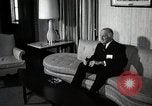
General Carl Spaatz, Colonel Harry Halverson, General Ira Eaker and Sergeant Roy Hooe talk to Major General Brooke Allen about the 1929 flight of the "Question Mark."
General Carl Spaatz, Colonel Harry Halverson, and General Ira Eaker, seat themselves on a couch in the Officer's Club at Bolling Air Force Base, during a gathering of retired Air Force officers celebrating the 35th anniversary of the 1929 record-setting endurance flight by Air Force crews, of the Fokker C-2A airplane named "question mark." Closeup of them conversing. Closeup of aviation mechanic, Sergeant Roy Hooe, who flew on the Question Mark. Major General Brooke Allen (Commander of Headquarters Command at Bolling AFB) holds a model of the "Question Mark" and discusses it with the others. View of the 5 men seated around a cocktail table discussing the 1929 endurance flight.
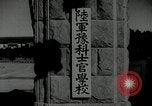
Emperor Hirohito visits an Officer's Training School in Japan during World War II
Motorcade of Imperial limousines with motorcycle escorts proceeds through gates of an officer's training base in Japan, during World War 2. Emperor Hirohito, on a white horse, is accompanied by other mounted military officers as he rides past officer candidates drawn up in formation. The emperor salutes the candidates. A number of officer candidates in white uniforms, and steel helmets, carrying rifles, demonstrate their skills running through an obstacle course, including a high barrier that must be scaled, as senior officers watch. Several candidates demonstrate gymnastic skills, performing giant swings on horizontal bars. The emperor stands alone, observing, as other candidates perform stunts across various barriers.
U.S. Aircraft carriers carry air war to Japan. Gun camera footage of bombing and strafing of Japanese shipping and airfields (WW2)
U.S. aircraft carriers in the Sea of Japan. Launch of carrier-based missions to attack Japanese shipping and airfields in World War II. Aircraft readying on carrier deck including F6F Hellcats, TBF Avenger, and SB2C Helldivers. Scenes of attacks by U.S. aircraft on Japanese targets in Tokyo Bay, seen via gun camera footage. U.S. Navy fighter aircraft returning to land on carrier have accidents. One lands but overshoots and runs off the end of the deck and into the ocean, striking another aircraft on the way. Another fighter aircraft is seen landing on a carrier deck but the supplemental fuel tank beneath it detaches and explodes and the plane erupts into flames. The burned pilot is rushed to safety by crews and firefighting crews battle the blaze. Scenes of dead American sailors and airmen being buried at sea.
A 1942-1943 film report to the American public about the progress of World War II in Europe and the Pacific.
Opening slate at start of film reads: "1942--1943 The Turn of the Tide." A column of British armor enters Bengazi, Libya, led by several troops in tankettes. Next seen are a Lee Medium Tank, M3 followed by an infantry tank, a jeep, another infantry tank and another Lee M3 Medium tank. Closeup of local people greeting the troops with upraised hands giving the "V" for victory sign. Another Lee M3 tank passes close by the camera. Black smoke is rising in the background. Scene changes to a half sunken ship near another burning in the harbor. Another view of this from further away above port buildings. Closeup of three smiling British soldiers leaning over a cartoon on a tank, of Winston Churchill (As a bulldog smoking a cigar and wearing a cap with the word "Victory" written on it). A crumpled captured flag with swastika on it. British Field Marshal Bernard Montgomery stands atop a vehicle (unseen) and looks through binoculars. Below, a column of British supply vehicles is making its way along a path in the desert. Two tanks coming toward the camera through sand. Animated map shows Nazi territory being threatened by the Allies from the Mediterranean, the USSR, and the English Channel. Views of Soviet infantry advancing against German forces in the snow of winter on the eastern front. Soviet troops firing updated 76-mm divisional gun model 1902 hidden in woods. Shells exploding in snow-covered field as Soviet BT series tanks advance. Various Soviet artillery firing from fixed gun batteries and from woods. A shell striking in distance. Fallen German soldiers lying on snowy field. Makeshift battlefield crosses marking graves of fallen German soldiers. German steel helmets lined up in the snow. A sign, posted on a birch tree, lists the names and birth dates of 16 German soldiers from the 3rd Panzer Division (3Pz-Pi-BH.39) buried at this site on November 28, 1941. Scene shifts to Joseph Stalin addressing Soviet troops in Red Square, Moscow, Russia. All the soldiers in formation seem to be singing (unheard). Film switches to animated map again. This time delineating the Eastern front being pressed by the USSR, and showing area of the 2nd Soviet winter offensive in 1943. Change of scene from Europe to the War in Asia, against Japan, shows General Douglas MacArthur after arriving by a B-17 bomber at a Pacific island American base. He ascends a steep hill in a jungle area, accompanied by other officers. Closeup of MacArthur. American infantry moving in single file in New Guinea, as a field piece fires a round in the direction they are headed. U.S. artillerymen load shells into a 105mm howitzer gun. A fire burns as mop-up operations begin on New Guinea. An Australian soldier is seen firing a Bren gun in jungles. Other Australian soldiers fire a mortar that explodes, raising earth and dust. More views of shells exploding near Allied soldier advancing. A soldier with fixed bayonet makes a fake charge toward the camera. Views of Japanese prisoners of war guarded in an outdoor compound. Japanese dead soldiers on Guadalcanal. An animated map shows new battle lines in the Pacific, closing in on Japan, with pressure from China, the USSR, and the Pacific islands being captured by the U.S. Arrows are added showing new pressure from American naval fleets and from British and American bombers out of Australia and captured islands.
French troops in trenches and tending to wounded during World War I
A group of French soldiers is seen standing in a trench during World War 1. Several make their way along the trench to the hulk of a German tank, turned on its side. Camera pans the exposed bottom of the overturned tank with one tread visible. Two French soldiers stand next to it. Several fallen German soldiers are seen on the ground nearby. Next, four French medical corpsmen are seen carrying a wounded soldier at shoulder height on a litter. Two soldiers move body of fallen comrade using a two-wheeled cart. Change of scene to French soldiers near their trenches at base of a steep hill, partially covered with boards. Several soldiers walk past them transporting fallen on a cart. Wounded being assisted as they leave a damaged building, possibly serving as a field first aid center. Several French soldiers standing near a comrade with a bandaged foot who leans on a large board. Behind them are shell or bomb-damaged buildings.
CRITICALPAST.COM: About Us | Contact Us | FAQs - How to Order | License Agreement | My Account | My Lightboxes | Shopping Cart | Advanced Search | Featured Collections | Website Terms & Conditions | Privacy Policy ©2026 CriticalPast LLC.
License Agreement |
Terms & Conditions |
Privacy Policy
©2026 CriticalPast LLC.