


 Francais
 Deutsch
 Italiano
Refine Your Search
Ubon AirForce Base Thailand 1967 stock footage and images
- Showing 3649 to 3654 of 5487 results more
more Hide
Hide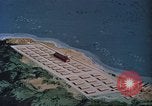
The ability of a biological warfare agent pathogen to spread and medical defense against it in the United States.
A training film based on medical defense against chemical warfare and biological warfare, in the United States during the Cold War. Animation depicts the ability of a biological agent to survive as an aerosol spray. An aerosol spray containing disease producing agents spreads in a building which is a part of harbor installations. Animation depicts spread of pathogens through pipelines. U.S. Medics carry biological warfare casualties into a hospital, where a sign out front reads, "Quarantine." Patients on hospital beds are treated in a group ward area with many hospital beds, orderlies, and nurses moving about.
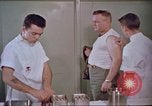
Selection of micro-organisms for possible use as biological warfare agents in the United States.
A training film based on biological warfare. U.S. soldiers get immunization shots in a hospital in the United States. Animation depicts vaccinations for diseases like small pox, yellow fever, tetanus and botulism and shows how immunity is overcome by a biological agent if the exposure is by an airborne route. Several drug bottles. A patient being treated in a hospital. He lays in a hospital bed and receives an innoculation shot. Shows how the biological agent is resistant to any drug to achieve greatest affect. An officer examines pathogen samples at his desk. A technician at an instrument works over a pathogen. Ability of pathogens and other viruses to grow in large quantities is tested in determination of its availability. The technician at various plant equipment used for bacteriological work. Shows how different laboratories and plants are converted into biological warfare production centers and how stabilization of biological agents can be done after mass production. Technicians at various instruments and plant equipment. The technicians preserve the biological agents.
Historical references of chemical warfare in the U.S. show an ancient Greek war and the use of a smoke screen.
A film in the U.S. based on historical references of chemical warfare. U.S. soldiers march on a road near a battlefield during World War I. American soldiers setup and fire a World War 1 mortar. Smoke rises from explosions on the battlefield. Series of drawings follows: A drawing depicts an ancient Greek war in which poison gas was used. A drawing depicts usage of 'smoke screen' as a weapon in 1701 by King Charles XII of Sweden which effectively shrouded his forces moving across the Duna River against Russia. A drawing depicts laboratory tests being made by a person in the ancient times.
Chemical Warfare Service laboratories at Edgewood Arsenal, Columbia University and the Massachusetts Institute of Technology.
A film based on chemical warfare tests in the United States. Shows usage of poison gas on the Allies by the Germans in France during World War I. Casualties of chemical warfare being evacuated. The U.S. Capitol Building and the Washington Monument in Washington DC. Brief aerial view of White House. Establishment of U.S. Army Chemical Warfare Service on July 1st , 1920 shows a sign which reads 'Office of the CHIEF Chemical Warfare Service'. Chief of the Chemical Warfare Service Major General William N. Porter at his desk. Various processes carried out by the Chemical Warfare Service. The Edgewood Arsenal Laboratories in Baltimore. Samples of gas are analyzed by technicians. Chemical warfare laboratories at Columbia University and the Massachusetts Institute of Technology.

Bombs being manufactured at various chemical warfare arsenals and depots in the United States during World War II.
A film based on chemical warfare and incendiary bomb arsenals and depots in the United States during World War II. Headquarters of the Edgewood Chemical Warfare Arsenal in Maryland. Technicians at work building incendiary bombs in a plant. Plants for the production of mustard gas bombs in the Edgewood Arsenal. A line of mustard gas shells in production. The Pine Bluff Arsenal in Arkansas. View of production facilities at the Rocky Mountain Chemical Warfare Arsenal in Denver, Colorado. Incendiary bombs being manufactured by war production workers in the arms factory. The Deseret Chemical Warfare Depot located in Utah. 70,000 mustard gas barrels in a munitions dump. Eastern Chemical Warfare Depot located at the Edgewood Arsenal. Bombs being hoisted. Gulf Chemical Warfare Depot shows crated bombs being loaded on flat cars.
Commuters employed with the U.S. State Department of Agriculture board a ferry in Long Island to reach the PIADC.
A film based on the Plum Island Animal Disease Center( PIADC ) off Long Island, New York. Commuters employed with the U.S. State Department of Agriculture board a ferry in Long Island. Animated map highlights the PIADC established for study of foreign animal diseases. The map shows locations of laboratory, dock area, administrative area, animal holding area and research buildings. Research units in the research building. Security fences around the building. The coast of Plum Island showing installations.
CRITICALPAST.COM: About Us | Contact Us | FAQs - How to Order | License Agreement | My Account | My Lightboxes | Shopping Cart | Advanced Search | Featured Collections | Website Terms & Conditions | Privacy Policy ©2026 CriticalPast LLC.
License Agreement |
Terms & Conditions |
Privacy Policy
©2026 CriticalPast LLC.