


 Francais
 Deutsch
 Italiano
Refine Your Search
Ubon AirForce Base Thailand 1967 stock footage and images
- Showing 3655 to 3660 of 5487 results more
more Hide
Hide
Technicians carry out tests on foot and mouth disease virus at the Plum Island Animal Disease Center in Long Island, New York.
A film based on the Plum Island Animal Disease Center in Long Island, New York which is dedicated to study of foreign animal diseases. Animated map of the United States of America depicts the New England region of the U.S. affected with foot and mouth disease of animals during year 1870 and Mexico and Canada affected by epizootics in 1946 and 1952 respectively. A technician stores animal foot and mouth disease virus in a laboratory freezer.
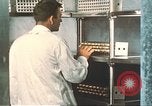
Research animals herded in research building at the Plum Island Animal Disease Center in Long Island, New York.
A film based on the Plum Island Animal Disease Center in Long Island, New York which is dedicated to study of foreign animal diseases. A technician works with bacteriological incubators to grow tissue cultures. Technicians inoculate a culture with foot and mouth disease virus of animal. The technicians carry out this procedure in a safety hood. Cattle are used as research animals and are held in quarantine for two weeks. Animals enter a research building after the quarantine period is over. The animals are herded through different doors in the building. A man dumps food for the animals in a chute. The cattle feed is processed in a hammer mill. Air passes through filters. Glass block openings in the research building. A guard patrols the area in a radio equipped vehicle. A fisherman's boat goes away from Plum Island coast. Two wire fences to isolate the area. A technician handles supplies.
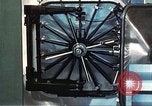
A scientist examines the internal organs of a dead animal at the Plum Island Animal Disease Center in Long Island, New York.
A film based on the Plum Island Animal Disease Center in Long Island, New York which is dedicated to study of foreign animal diseases. Incoming supplies and equipment needed to carry out research are admitted through autoclaves to achieve sterilization. Technicians at different machines handle glassware and other equipment to be used for the research. Scientists expose research animals to foot and mouth disease virus in an isolated room. The virus is injected below the tongue of the animals. A man takes out the internal organs of a humanely destroyed cattle. The scientist lays down his knives and wears rubber gloves. He examines the internal organs of the cattle during the post-mortem. The animal carcass is placed into an incinerator. A technician wearing red clothing operates the incinerator. The carcass burns in the incinerator.
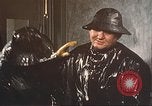
Precautions taken by personnel against foot and mouth virus of animal at the PIADC in Long Island, New York.
A film based on the Plum Island Animal Disease Center( PIADC ) in Long Island, New York which is dedicated to study of foreign animal diseases. Removal of animal virus in a laboratory shows personnel in special rubber clothing inside an animal isolation unit. The rubber is disinfected with lie solution. Caustic solution in rinsed off in a shower. Clothing is cleaned using a brush. A man cleans the room with the lie solution. Sewage passed through welded lines to sewage decontamination building. Three holding tanks receive sewage. Sewage is heated to sterilizing temperature and discharged outside the laboratory. An officer inside research buildings looks at a light blinking on a central trouble panel. A technician takes a look at the diagram of the layout of the building and instructs over a telephone. A technician approaches an overheated motor. He inspects equipment of air control system of the laboratory. Technicians work on machines in a machine shop. A patient being treated in a first aid room. Service area for cleaning and sterilization of glassware and a laundry in the research building. A man cleans his nasal and throat passages, scrubs his hands and takes a shower. Employees board a bus. A guard looks through binoculars.
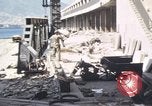
Damage in the port of Messina, from U.S. bombing during World War II
U.S. soldiers in bomb-damaged port facilities at Messina, Sicily, during World War 2. A U.S. Army Technical Sergeant wearing a holstered sidearm, walks past an overturned railroad locomotive. He stops and picks up an abandoned Italian Breda 30 light machine gun. He checks the weapon's action and holds it up in firing position. Another U.S. soldier rummages amongst abandoned Italian small arms. The Tech Sergeant climbs aboard an abandoned port utility tug vehicle. The camera focuses on the side profile of the vehicle. A crane on a railway is seen near a damaged ship. Chunks of concrete pier are seen and damaged port machinery. A small fire burns at the base of a hill near a rail line at the port.
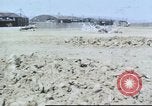
U.S. soldiers inspect wreckage of enemy airplanes on a captured airfield in Sicily, Italy during World War II.
Airfield damage in Sicily, Italy, from Allied "Operation Husky" and associated bombings by USAAF (United States Army Air Forces) 86th Fighter Bomber Group airplanes during World War II. A U.S. soldier inspects wreckage of enemy airplanes on captured Fontanarossa Airport, Catania, Sicily. Wrecked aircraft include: Fiat G 50 fighter bomber from 378° squadriglia; A Macchi 202, Breda built XII sr AS belonging to 91° squadriglia, 10° gruppo, 4° stormo ct. (The 91° squadriglia was commanded by ten. Mecatti. 4° stormo ct was based in three airstrips in the "Piana di Catania" and fought fiercely and bravely against Allied air offensive just before and during "Operation Husky.") U.S.soldier removes long ammunition belt from an airplane. The soldiers inspect airplanes in a hangar,One of the German fighter planes in the hangar has a painted picture of "Minnie Mouse", riding atop a bomb, and wielding a battle axe. Close up of the picture is shown.
CRITICALPAST.COM: About Us | Contact Us | FAQs - How to Order | License Agreement | My Account | My Lightboxes | Shopping Cart | Advanced Search | Featured Collections | Website Terms & Conditions | Privacy Policy ©2026 CriticalPast LLC.
License Agreement |
Terms & Conditions |
Privacy Policy
©2026 CriticalPast LLC.