


 Francais
 Deutsch
 Italiano

Refine Your Search
United States 1982 stock footage and images
- Showing 859 to 864 of 34981 results more
 Hide
Color Sound
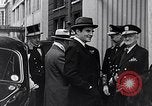
U.S. SECNAV Franklin Knox visits U.S. Admiral Harold Stark and British Vice-Admiral Sir Bertram H Ramsay in London during World War II
Franklin Knox, U.S. Secretary of the Navy (SECNAV) shakes hands with U.S. Navy Admiral Harold Stark, Commander of U.S. Naval Forces in Europe, British Vice-Admiral Sir Bertram H Ramsay, and other British and American naval officers, after visiting them in Stark's headquarters at 20 Grosvenor Square, London, England, during World War 2. Secretary Knox enters a car. Scene shifts to an RAF airfield where Secretary Knox stands with Admiral Stark and two military aides,near the wing of a U.S. Army Air Forces C-47 airplane. Stark and Knox stand together and then Knox bids Stark goodbye, as he prepares to board the C-47 airplane. Admiral Stark salutes as Secretary Knox climbs aboard the plane. Admiral Stark and aides wave goodbye as the aircraft taxis out. Several members of British Women's Auxiliary Air Force (WAAF) walk across the airfield ramp, as the C-47 taxis out for takeoff
U.S. soldiers in England, install wire cutters on U.S. jeeps before shipping them to France, during World War II.
U.S. soldiers of the 87th Chemical Battalion (mortar) make field modifications by installing wire cutters on army jeeps, at the D-Day Marshalling Area Camp in Shiphay, Torquay, (Devon) England during World War 2. U.S. soldier paints an angle iron vertical post (wire cutter) fastened on bumper of a jeep. He pastes U.S. flag on the windshield and writes OK in chalk on the front bumper. Line of modified jeeps travel along road after completing check ups. Soldiers use hack saws to cut pieces of metal and hand drills to put holes in bumpers where angle iron wire cutters will be fastened. They use files to take sharp edges off the angle irons. A soldier slips washers and bolts on an angle iron and tightens them with an adjustable wrench. (Note: These angle iron vertical rods, mounted on a vehicle front bumper, were meant to protect jeep occupants by catching and cutting wires that might be strung across roads to injure or kill unprotected drivers of open vehicles, such as Jeeps.)
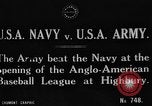
United States Army wins the Anglo American Baseball League game against the U.S. Navy team at Highbury in London, England.
Baseball game of the Anglo American Baseball League at Highbury in London,England, during World War 1. United States Navy and United States Army teams enter the field. United States Navy Admiral William Sowden Sims throws the first pitch. Spectators cheer the teams. Army wins the game beating Navy.
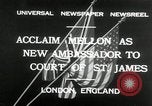
Former U.S. Secretary of Treasury Andrew W Mellon takes charge as new U.S. ambassador to England
Andrew W Mellon former U.S. Secretary of Treasury leaves a ship and arrives at Waterloo railway station in London England. Steam locomotive pulling passenger cars pulls into the railroad station. People welcome Secretary Mellon in the station. Mellon is escorted by the guards. He proceeds in a car to the American Embassy where he greets British dignitaries including Sir Patrick Duff. Mellon takes charge as U.S. new ambassador to the nation.
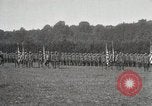
U.S. General Hunter Liggett reviews the U.S. 2nd Division and U.S. General Ely and General Hunter decorate troops in France.
U.S. General Hunter Liggett reviews the U.S. 2nd Division forces in Dolcourt, France during World War I. U.S. Second Division troops stand in a squad. The troops hold a United States flag and a U.S. Marines flag. The soldiers stand at attention. A military band plays different instruments. General Liggett reviews the division. The General and a U.S. officer salute. The military band in the background. The troops march with guns on their shoulders. A U.S. officer stands and looks. General Hunter, U.S. Gen. Hanson Edward Ely and a French officer decorate Second Division troops in Chateau-Thierry. A medal is pinned up on the uniform of a U.S. soldier. Horse carts behind the troops.

U.S. General Curtis LeMay being greeted by U.S. General Paul Harkins and U.S. Brigadier General Rollen Anthis on arrival in Vietnam.
U.S. General Curtis LeMay in Vietnam during Vietnam War. Boeing VC-135A taxis on field. U.S. General Curtis LeMay emerges from Boeing VC-135A and being greeted by U.S. General Paul Harkins and U.S. Brigadier General Rollen Anthis. U.S. officers walk accompanied by South Vietnamese officers. U.S. officers leave in car.
CRITICALPAST.COM: About Us | Contact Us | FAQs - How to Order | License Agreement | My Account | My Lightboxes | Shopping Cart | Advanced Search | Featured Collections | Website Terms & Conditions | Privacy Policy ©2026 CriticalPast LLC.
License Agreement |
Terms & Conditions |
Privacy Policy
©2026 CriticalPast LLC.