


 Francais
 Deutsch
 Italiano

Refine Your Search
United States 1982 stock footage and images
- Showing 865 to 870 of 34981 results more
 Hide
Color Sound

U.S. President Harry S. Truman decorates 14 U.S. Marines and sailors in Washington DC, United States.
U.S. President Harry S. Truman decorates men in Washington DC, United States for heroism in World War II. U.S. Marine Corps flying ace Lieutenant Colonel Pappy Boyington with the Medal of Honor. President Truman decorates a group of 14 Marines and Navy men for heroism above and beyond the call of duty. President Truman decorates a group of men including Sergeant Harold Russell, sailor Mate Whalen and Private Lucas. U.S. Army Chief of Staff General George C. Marshal and U.S. Navy Chief of Staff Fleet Admiral Ernest Joseph King congratulate the men who received the honors.
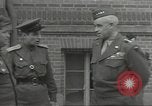
U.S. 2nd Armored Division tanks fire salute during official transfer of U.S. section of Berlin to U.S. towards end of World War II.
United States occupation of Berlin, Germany after World War II. U.S. General Omar Bradley meet and greet Soviet officer and his staff. General Bradley, U.S. Commander-General First Airborne Army of Berlin District Major General Floyd L Parks, Commander-General of French troops in Berlin Major General Duschesne, Deputy Commanding Officer of the Russian troops in Berlin Major General Nicholei Nicholeiovitch Barinov at attention and salute. General Barinov at microphone as he addresses the assemblage. U.S. flag flies from top of a building at Adolf Hitler Barracks. Salute being fired by tanks of the U.S. 2nd Armored Division. Soldiers of Soviet 5th Army lined up.
Blood transfusion to U.S. Marine; casualties of U.S. and Japanese forces; U.S. forces rest and regroup after Eniwetok Island battle
Wounded U.S. Marines on the beach in Eniwetok Island (sometimes spelled Eniewetok or Enewetak). Blood plasma being administered to wounded soldiers in open field and camp. Dead U.S. Marines. View of Eniwetok Island after battle. Men sitting on the beach and swimming. Dead Japanese soldiers. Damaged Japanese equipment including tanks. Bomb craters on the air strip are filled. Native people of the island. U.S. Marine prepare to leave the island. A marine pats a dog. U.S. Marine leaving the Eniwetok Island. (World War II period).
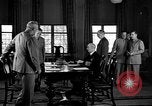
The chiefs of the U.S. Army, the U.S. Navy and the U.S. Air Force at a conference in Quebec, Canada.
Chiefs of Staff at a conference in Quebec, Canada. U.S. Army General George Catlett Marshall Jr. ; U.S. Air Force General Henry Harley Arnold; U.S. Navy Admiral William Daniel Leahy ; Fleet Admiral Ernest Joseph King, Commander in Chief of the United States fleet and others sitting around a conference table.
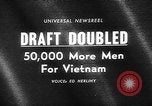
U.S. President Lyndon Johnson's speech on his decision to increase U.S. forces in Vietnam; in Washington DC, United States
U.S. President Lyndon Johnson's Washington Press Conference address on his new policy for Vietnam. President's wife Lady Bird Johnson and daughter Lynda Bird Johnson Robb in attendance. Members of the press seated in the room and take down notes. President Lyndon Johnson addresses the press. The President says that he wishes to convey to Communist powers in Vietnam that the United States cannot be defeated by 'force of arms or by superior power.' The President states that he has spoken to Commanding General Westmoreland has assured him that whatever his needs are, they will be met. He says that U.S. troop numbers in the Vietnam War will be increased from 75,000 to 125,000. Additional forces will be needed later which will be sent. Brief shots of young men recruits in the United States standing in line for the draft, taking tests, and taking the oath as soldiers. The President says that he welcomes the concerns of any nation.

U.S. President Richard Nixon addresses people in the United States on withdrawal of remaining U.S. troops from Vietnam.
Television broadcast of U.S. President Richard Nixon's speech from the White House in Washington DC, United States on the withdrawal of remaining U.S. troops from Vietnam on 29th March 1973 during the Vietnam War. The White House. The Seal of the President of the United States. The President talks about that period of the Vietnam War when he joined the office and speaks about the program he initiated to end the war. He says American prisoners are on their way from Vietnam and people of South Vietnam are now free to choose their government. He says North Vietnam is not complying with few provisions of the Peace Agreement. He says that they should honor all those American soldiers who died during the Vietnam War. He refers to the difficult days of the war including the moratorium to end the war which was organized on October 15, 1969 when millions of Americans took day off from work and schools to participate in local demonstrations against the war. Nixon refers to the period of April 1971 when he ordered attacks on Communist bases in Cambodia. He talks about the period of May 1972 when he ordered air strikes in North Vietnam and the period of December 1972 when he ordered more air strikes.
CRITICALPAST.COM: About Us | Contact Us | FAQs - How to Order | License Agreement | My Account | My Lightboxes | Shopping Cart | Advanced Search | Featured Collections | Website Terms & Conditions | Privacy Policy ©2026 CriticalPast LLC.
License Agreement |
Terms & Conditions |
Privacy Policy
©2026 CriticalPast LLC.