


 Francais
 Deutsch
 Italiano
Refine Your Search
United States 1982 stock footage and images
- Showing 919 to 924 of 26494 results more
more Hide
Hide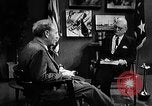
Lieutenant General Ira Eaker talks about his transfer to the Philippines during an interview in the United States.
An interview of United States Air Force Lieutenant General Ira Eaker conducted by Dr. Maurer in the United States. General Eaker talks about his most interesting experience when he was transferred to the Philippines in 1919. He talks about his work at Rockwell Field. The Commander was Colonel Henry Arnold and executive officer was Major Carl Andrew Spaatz. He was among a few regular officers. Colonel Arnold selects one officer to recruit a squadron for the Philippines. Arnold and Spaatz asked his recommendation for the purpose. Then he recruited 60 people and took them to the Philippines. They prepared their aircraft. He says that while flying back from Manila Bay, he was not able to control his airplane because of the clouds and other problems. Then he with other officer started to work out on a system where they could fly in the clouds. They flew with some instruments to prevent any accidents due to the clouds.
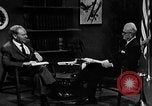
Lieutenant General Ira Eaker talks about his experiences in the U.S. Air Force during an interview in the United States.
An interview of United States Air Force Lieutenant General Ira Eaker conducted by Dr. Maurer in the United States. General Eaker talks about experiences of World War II. He talks about his experience of working with General Henry Arnold and Carl Andrew Spaatz. He talks about the utility of the static warfare, the possibility of razing enemy ammunition factories and preventing ammunition from arriving at battlefield. The Air Force has given several opportunities to the individual. An individual learns flight test, flying experimentation and other things. The Air Force should have better airplanes, more powerful engines and better equipment to achieve better possibilities.

Sailors undergo anti aircraft tracking drills aboard a ship underway at sea in the United States.
A film titled: 'Life at Sea' on the life of U.S. Navy sailors aboard ships. United States Navy ships in a harbor in the United States. A signalman near a signal light. The U.S. flag flying atop a flag pole. Sailors aboard ships. U.S. Navy Cruiser USS Macon (CA-132) underway at sea. An officer looks through binoculars. A Captain standing on a bridge with sailors. A sailor looks through binoculars. The sailors get ready for anti aircraft tracking drills. Sailors seated at a table. Ships underway. Men at an information center for tracking any enemy aircraft. They track the enemy aircraft and report to battle stations. They get ready for action. They look through binoculars. They aim anti aircraft guns as the aircraft fly in formation overhead. Men in a radio room keep in touch with the rest of the navy. The sailors aim the guns.
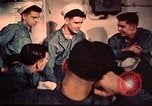
US Navy sailors are shown training films and they work aboard a ship underway at sea in the United States.
A film on the life of United States Navy sailors aboard ships in the United States. Some sailors talking amongst themselves. Other playing solitaire cards. A ship underway at sea. The ship underway at night. The sailors sleeping in their beds. They wake up early the next morning and get ready. An officer wakes sailors from their beds. They shave. Young sailor with no beard puts on shaving cream anyway. Newspapers on board ship being printed at ship print shop. The sailors read the newspapers. They stand at attention. Officers inspect them. A classroom session for the sailors. Machinists attend a mathematics class. An officer instructs them. The sailors are shown training films. The training films give them information about how to acquire more efficiency in jobs. A sailor welds a metal. Carpenters at work in workshop. Sailors paint railings on deck. Coffee is poured into a mug. Electricians have coffee. Some of the sailors buy things such as pens and perfumes from the ship's store. A sailor collects clothes from a laundry. Other sailors having coffee and soda drinks and refreshments.
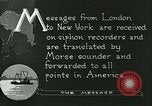
Men operate telegraph keys and an automatic perforator and transmitter in the United States.
A film on technological advancements in the United States. Messages from London, England to New York, United States are received on siphon recorders and are transmitted by a Morse sounder and are forwarded to all points in America. A man operates a telegraph key. A recorder in operation. Students are trained at a training school at a cable station. Manual sending and receiving of a duplex to and from England. A man with earphones receives messages. A man places a record on a machine. An automatic perforator and transmitter sends 100 words per minute. Operators at keyboards. A tape is fed through a machine.
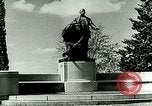
Contributions of African Americans in various fields in the United States.
(See also clip 65675078146 from different film transfer). Famous African American men and women citizens in the United States. Clip opens with of Booker T. Washington at Tuskegee University. Scene in a laboratory with African American scientist and inventor George Washington Carver, as an elderly man, working with another scientist in the laboratory. African American judge of New York city court. African American explorer Matthew Henson is seen looking at a globe (he was with Admiral Peary planting the American flag at the North Pole in 1909), and an unnamed African American surgeon at work in an operating room in New York. Next scene shows famous "father of the blues" musician and composer W.C. Handy (William Christoper Handy) smiling. Next is seen the financier and publisher of the Amsterdam News, Dr. C.B. Powell (Clilan Powell) greeting three uniformed African American women during a World War 2 war bond drive, and handing them a check (close up is shown) for 25,000 dollars, dated January 4, 1942, for the war bond drive. It is from the account of the Victory Mutual Life Insurance Company which Dr. Powell also owned. The check is signed by C.B Powell and Philip M.H. Savory (Dr. Savory was co-owner of the New York Amsterdam News). The next scene shows Elise Johnson McDougald, better known as Gertrude Elise Ayer, who was the first black full-time public school principal after the consolidation of New York City schools in 1898. She was also a noted woman writer during the Harlem Renaissance. She is seated in her office at her desk, likely in P.S. 119 in Harlem, since this is approximately year 1945 and she was at P.S 119 at that time. Her name plaque is visible on the front center of the desk. Principal Ayer smiles as a woman delivers a document to her. Next is seen the African American historian, author, and professor, Lawrence D. Reddick, serving in his role as the curator of the Schomburg Collection of African American Literature. In an art studio is seen the famous African American sculptor and painter Charles Alston, at work on a sculpture. Next scene shows the famous African American contralto singer, Marian Anderson, receiving a bouquet of flowers and smiling after a performance. This transitions to a view of African American orchestra conductor Dean Dixon leading an orchestra in a performance of Beethoven's 9th Symphony. Several views of different sections of the orchestra performing under Dixon's direction. Clip closes with brief shots of campuses of several historically black colleges and universities in the United States like Howard University, Hampton, Tuskegee, Fisk, Prairie View. An American college football game underway at the stadium of one of the colleges.
CRITICALPAST.COM: About Us | Contact Us | FAQs - How to Order | License Agreement | My Account | My Lightboxes | Shopping Cart | Advanced Search | Featured Collections | Website Terms & Conditions | Privacy Policy ©2026 CriticalPast LLC.
License Agreement |
Terms & Conditions |
Privacy Policy
©2026 CriticalPast LLC.