


 Francais
 Deutsch
 Italiano

Refine Your Search
United States 1982 stock footage and images
- Showing 913 to 918 of 34981 results more
 Hide
Color Sound

American reaction to Communist leaders questioning American goals and leveling charges of U.S. imperialism
Animated earth revolving. A massive crowd gathering. World leaders speaking at lecterns, such as Nikita Khrushchev speaking and pointing forcefully, U.S. Ambassador to the United Nations Adlai Stevenson II addressing the UN, Fidel Castro making a speech during the Cold War. Two Soviet politicians standing on a stage with one speaking into microphones. Palmiro Togliatti, the Secretary-General of the Italian Communist Party (PCI), addressing a crowd. Unidentified man in round glasses addresses crowd. A Chinese or North Vietnamese communist man reads a speech in front of a microphone, a Soviet flag is seen behind him. Soviet leader Nikita Khrushchev shaking his fist and speaking forcefully to a group. “U.S. WANTS COLONIES” written on explosive speech bubble with a newspaper in the background. Anti-United States propaganda in various newspapers around the world. A Soviet political cartoon showing a U.S. police officer barring an African American child from entering an American school and the officer holds a sign that reads, «Только для белых» ("Only for Whites"), referencing Jim Crow laws and racial segregation in the United States. Another Soviet cartoon shows a helmet-wearing U.S. man in a tuxedo. The helmet has the word "espionage" (translated) on the mouth. In front of it he holds a mask with olive branches for peace and text translated to "Control without disarmament." A third cartoon shows a sea monster wearing a U.S. with a dollar symbol on it opening its jaws to consume an island with the flag of Cuba on it. Frank McGee, the narrator of the film, is seen sitting on an armchair. He places his newspaper aside and addresses the viewers urging them not to ignore the charges which he says are lies. Muskets in the forest in a dramatization of the American Revolutionary War. Feet of British soldiers walking on paths. Rifle barrels of Revolutionary soldiers appearing through trees, partially hidden. A rifle butt hits the ground. Musket barrels moves closer. A man blows into a barrel. Flintlock rifles at the ready. Rifle trigger pulling. A musket falls to the ground.
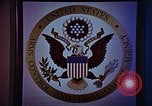
A review of U.S. efforts, Post World War II, to place atomic weapons under international control.
Film opens showing logo of the U.S. Arms Control and Disarmament Agency. Glimpse of several U.S. warships, ostensibly disarmed after World War II, berthed together. View on deck of one, from under triple guns. Aircraft being destroyed in explosions after the war. A troop transport ship returning American servicemen back home at the end of World War 2. Views of the deck jammed with servicemen waving to loved ones who are waving back to them from a dock. Bernard Baruch giving a speech at the first session of the United Nations Atomic Energy Commission, at Hunter College, New York In presenting a proposal for International control over the spread and development of nuclear weapons and technology, He begins: "We are here to make a choice between the quick and the dead." (The proposal was rejected by the Soviet Union.) View of the United Nations building in Manhattan, New York City. Delegates at a UN session in the building. Boys and girls in a typical U.S. school class room. Younger children being weighed and measured in school. The teacher smiling and watching as happy children leave the school building at the end of school day. Another view, from across the East River, of the UN building in New York, with other Manhattan skyscrapers and buildings behind it on a sunny day. Flags of the United Nations on display outside the UN building. Views of the U.S. Capitol building in Washington, DC. President Lyndon Johnson addressing a joint session of Congress on November 27, 1963. Behind him are seated President pro tempore of the U.S. Senate, Carl Hayden, and Speaker of the United States House of Representatives, John William McCormack. A submarine traveling on the surface of the water. An American B-52 Strategic bomber in flight. An American Atlas ICBM descending into a launch silo slowly. View of the missile as it goes down into silo and as silo cover slowly moves into place to cover nuclear missile. A sunset view over ocean water.
Marshals seize produce with high amount of pesticide; farmers treat fields and orchards with pesticides in the United States
A combine harvesting wheat in the United States. Workers picking peaches from an orchard. A ‘Fruit Growers Express’ railroad train transporting produce by rail. Trucks carrying fruits driving on highway during day and at night. A Union Pacific railroad train leaves a train station with many train cars carrying produce. Grain is processed by a machine and piped into a storage hold for shipment. A barge sails past a flour milling plant. A Western Fruit Express wagon stands beside rail tracks. Sign in car front window reads “Deputy U.S. Marshal”. Marshal attaches a “Monition” notice to the seized Western Fruit Express wagon due to a pesticide violation. Film subject introduced as "The safe use of pesticides...Follow the Label." A man offloads crates of produce seized by the United States Marshal. Two farmers discover an infestation of caterpillars in their fields. The farmers inspect leaves from their infested crops. A Food and Drug Administration (FDA) inspector examines produce from a seized rail car due to presence of excessive pesticide residue applied by the farmer to get rid of caterpillars discovered late in the harvest. The FDA inspector carries samples taken from seized produce. The FDA inspector writes on the paper bag containing samples and seals the bag with tape. An African American scientist examines samples of produce for illegal pesticide content. A syringe is inserted into a machine for chemical analysis. An FDA District Director makes a call from his office. A General Counsel speaks to an FDA District Director over the phone. A United States District Court arrest warrant against seized illegal produce. A judge signs the arrest warrant and hands it over to a marshal. A farmer drives a tractor and parks in front of a shed. A farmer looks at pesticides inside the shed. The farmer grabs a pack of pesticide and placed it at the back of the tractor. Farmer drives a tractor sprayer to treat pesticide on a field. Sacks of pesticide inside a shed. Camera zooms into a pesticide sack to show warning that reads “DO NOT USE WITHIN 10-DAYS OF HARVEST’ which the farmer violated. United States marshals seize produce from a Great Northern Railway cargo. The seized cargo is buried in a landfill. United States Marshals oversees the destruction of seized produce. A bulldozer covers the produced with rubble and soil. Animation depicting a caterpillar and various bugs superimposed over farm pests and crops. A praying mantis feeds on a bug. A farmer wearing protective gear including goggles and gas mask or respirator drives a tractor sprayer in orchard as he applies pesticide, herbicide, or insecticide. Boy and girls exiting a school house. Children running out from school at the end of day. Farmers harvesting carrots. Tractor plowing to expose pests. A farmer releases wasps to control pests. A farmer breeding resistant variety crops. A farmer prepares pesticide inside a shed. An old weighing scale tilting. Farmer opens hose to fill water into the tank of a sprayer. The farmer pours pesticide powder into sprayer. Sprayer treats orchard with pesticide.
U.S. Marine Corps raise American flag on Mount Suribachi in Iwo Jima during World War II; and original statue unveiling at Quantico in 1951.
A film titled 'Uncommon Valor' about the raising of the U.S. flag by U.S. Marines on Iwo Jima, Japan during World War II. United States naval fleet underway off the coast of Iwo Jima. U.S. Army Air Forces aircraft in flight. U.S. 4th and 5th Division Marines disembark from a ship and get onto landing crafts as they head towards the Iwo Jima shoreline. Marines land ashore and advance inland. They raise the American flag on Mount Suribachi. A newspaper boy sells newspapers on a street in the United States. A picture of the raising of the flag on Mount Suribachi. View of sculptor Felix De Weldon as he carves a sculpture of the flag raising event. Scenes from the unveiling and dedication ceremony of the original limestone statue on November 10, 1951, at the Marine Corps base in Quantico, Virginia, for the 176th anniversary of the founding of the Marine Corps. (The version of the statue seen in this footage had been placed in front of the Navy Department Building at the intersection of Constitution Avenue and 19th Street Northwest, Washington, D.C on 10 November 1945. It features 9 foot figures at 1.5 times life size scale. This sculpture was moved to Quantico Marine Base on 17 November 1947. It had been originally constructed by De Weldon of Indiana limestone, cement, and sand due to a lack of bronze during the war. At the time of its move to Quantico in 1947, the statue had deteriorated due to weather. Also, coats of paint to give the look of bronze had hidden much of the detail and had to be removed. Felix de Weldon supervised the repairs at Quantico before the statue was officially dedicated at the main entrance of Quantico on 10 November 1951, as seen in this ceremony). Officers lined up at the ceremony and many guests in the audience. A parking lot seen in the distance behind the assembled crowd. Cover sheets being removed as the war memorial is unveiled at Quantico.
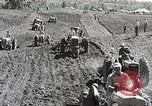
Marshall Plan aid relief to Europe after World War 2; U.S. military participation in NATO operation in Europe
American farmers on farmland with several tractors operating on the field. American men and women work to clear rocks and stones from a farm field. Group of rural neighbors in America working together to construct a barn building (raise a barn). They build the barn and wield hammers. Ships at dock with Marshall Plan food supplies from United States to Europe for post-war recovery after World War 2. Elevated view of main city square in Copenhagen, Denmark soon after World War 2. Busy roads with vehicle, pedestrian, and street car or trolley cars running on roads around the Liberty Memorial obelisk, on Vesterbrogade opposite the Grand Central Station. Crane lifting supplies for rebuilding effort beside some buildings in Copenhagen. Man in Europe cuts grass with a scythe or grass whip. American troops board ships to Europe to join NATO troops in Europe maintaining peace after World War 2. Close up view of group of American NATO forces marching in close ranks. U.S. military forces at NATO Naval headquarters in Norfolk,Virginia. Officer salute at a flag ceremony. Wide view of massive group of U.S. Navy sailors at attention during a ceremony in Norfolk. U.S. Naval fleet in Atlantic ocean. U.S. Navy jet fighter aircraft takes off from Carrier in Atlantic ocean. Camera view as planes take off from camera, and then view from rear facing camera in aircraft as plane takes off from aircraft carrier deck. View of the world's first atomic powered submarine, the U.S. Navy's USS Nautilus (SSN-571). The submarine at sea from an aerial view, and view from submarine of water breaking over its surface. American long range Boeing B-47 Stratojet aircraft parked at airfield. Personnel in control tower flashes light signals to waiting aircraft. A B-47 taxis for take off. American pilots exit personal equipment storage building of 306th Bombardment Wing at MacDill Air Force Base, Florida, and head to their aircraft for a mission. B-47 Stratojet plane taking off.
Role of the Jeep in U.S. military operations during World War II.
A U.S. Army Air Forces (USAAF) Waco CG-4A-WO glider is seen descending and landing in a grass field. Upon touchdown, its front pops open and and an army jeep drives out. USAAF C-47 aircraft are seen next, offloading jeeps pulling small artillery pieces, and infantry who move rapidly from the parked aircraft. Jeeps traversing a high hump in a dirt road. A jeep towing an M-3 Antitank Gun 37mm, and others driving through underbrush and bouncing over rough road while towing 37mm guns and trailers. Soldiers stepping from jeeps to set up machine guns. American soldiers playing a game of horse and rider, during a break in duties. Soldiers setting up mortars. Jeeps driving through bodies of water. Two M4A1 (76)W Sherman tanks, with cast steel hulls, drive into a stream. Troops setting up several 37mm guns on a river bank. Two soldiers in a communications jeep. Army officers perusing a map laid out on the hood of a jeep. U.S. field artillerymen using periscopic binoculars on tripods, to spot and direct gunfire. Military vehicles, including jeeps, moving across desert terrain. Artillery crews firing M59 (M2 Long Tom) 155mm guns. A Douglas A-26 Invader aircraft flying overhead. Jeeps in various roles, bouncing along in the desert and laying smoke screens. Jeeps equipped with M3 anti-aircraft guns and others with stretchers for wounded affixed to their sides. U.S. Army Ford GPA "Seep" amphibious jeeps plunging into water and continuing on as boats. A jeep production and assembly line in a U.S. factory showing stages of assembly and finished jeeps driving out of the plant into yards containing hundreds of them. A convoy of jeeps driving over a bridge, and others carrying a U.S. military brass band in a parade in England. A Hollywood actress (Gloria Swanson?) being lifted into a jeep by several men. Glimpse of an unidentified actress with an American soldier, in a jeep. Hollywood stars, Stan Laurel and Oliver Hardy clowning in the front seat of a jeep with Desi Arnaz and two women riding in the back. Several jeeps carrying these and other Hollywood personalities during a war bond parade in Washington DC. The Capitol looming in the background as the jeeps move away from it toward the camera. Jeeps being prepared for transport to overseas destinations. Jeeps being partially disassembled and loaded into wooden crates and placed on rail cars for transport. Jeeps being hauled by cranes and placed aboard ships. Landing crafts mechanized (LCMs) transporting infantry and vehicles, including jeeps. An M4A1 Sherman tank driving out of a landing craft into surf. A jeep being driven onto beach at Adak,in the Aleutians,from a landing craft of the USS J.Franklin Bell (AP-34), in 1942. In 1943, this transport ship was reclassified as APA-16.) American troops with jeep on a South Pacific island in World War 2. A soldier on motorcycle, skids in mud on road in North Africa, and jeeps drive past him. American soldiers ride camels and some drive in a jeep near the Great pyramid and Sphinx in Egypt. Jeeps seen in China, with Generals Joseph Stilwell and Claire Chennault. One parked next to a Flying Tiger P-40 airplane. Soldiers in a jeep in Alaska, next to a tent and sign pointing to "Tokyo." Local tribesmen literally carrying a jeep, on long poles, across a river in Timor. General Douglas MacArthur, accompanied by staff officers, being driven in a jeep along a jungle road in New Guinea, past a line of local tribesmen. Wendell Wilkie, serving as Ambassador-at-large, during the war, speaks to U.S. officers in a jeep. Britain's King George VI in a jeep followed by another carrying Queen Elizabeth. President Franklin D. Roosevelt riding in a jeep to review troops. He removes his hat as they pass the American flag. Sign on a building in North Africa reads "Bizerte." General George S. Patton, standing in a jeep during a victory parade in North Africa. Soldiers at an outdoor religious service during the war with the hood of a jeep serving as a make shift altar.Various views of jeeps driving with soldiers in them.
CRITICALPAST.COM: About Us | Contact Us | FAQs - How to Order | License Agreement | My Account | My Lightboxes | Shopping Cart | Advanced Search | Featured Collections | Website Terms & Conditions | Privacy Policy ©2026 CriticalPast LLC.
License Agreement |
Terms & Conditions |
Privacy Policy
©2026 CriticalPast LLC.