


 Francais
 Deutsch
 Italiano

Refine Your Search
United States 1982 stock footage and images
- Showing 943 to 948 of 34981 results more
 Hide
Color Sound
Recap of slavery, the Civil War, and job integration in the United States, in the context of the civil rights movement.
African American and white children swim and play in an integrated swimming pool in the United States in the 1960's. A black man beside a white man working on an integrated engine car assembly line. A black shoe shine man. A black street sweeper. Narrator indicates that African American workers are in increasingly skilled jobs and supervisory positions. A black draftsman in an officer environment. A black bank manager gives an application to a black woman. Huey Newton leads the Black Panthers in a protest. Stills portray trade and transport of African American slaves. Stills show the Civil War in the United States, and aftermath of war showing blacks voting and as politicians during reconstruction. Footage of African American people working on farms in cotton fields picking cotton, including boy and girl child laborers picking cotton. Footage of a Rust Cotton Picker machine in operation as African American workers watch. American troops, including African American soldiers of the U.S. Army 369th Infantry "Harlem Hellfighters", marching in victory parade in the United States after returning from World War 1. View of segregated African American soldiers in the parade in New York City cheered by parade attendees. Brief scene with Henry Johnson on the side of the parade route being congratulated by civilians. (Johnson and Needham Roberts received the Croix de Guerre for exceptional heroism). Black and white workers entering or exiting a factory during World War 2. Black American troops and Tuskegee Airmen pilots in segregated units during World War 2. The Tuskegee pilots in uniform gathered together during a briefing on an airfield. View of U.S. military forces comprised of white and black personnel, integrated beginning in 1947. A white officer gives binoculars to a black soldiers.
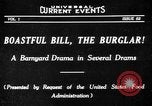
A German who tries to steal away a pig from an American farm is attacked by the U.S. Navy.
U.S. National Food Administration animated save food campaign in the United States during World War I. A man at a farm. Pigs and chicken at the farm. The man leans against a wooden fence with a wind mill in the background. A donkey symbolizing U.S. Army and a goat symbolizing U.S. Navy at the farm. A German man tries to steal away a pig from the farm but the United States Navy symbolized by the goat attacks the man. The American man empties out a bag brought by the German with the donkey, the goat, pigs and chickens in the background.

Liberty Bond printing workers exit building; Liberty Bond drives in the United States during World War I.
From a film on "Where and Why Liberty Bonds are made." created during Liberty Bond drives in the United states during World War 1. American flag superimposed as U.S. Army soldiers march in background. Liberty Bond printing workers exit the Bureau of Engraving and Printing in Washington DC during a lunch break. A streetcar passes by on 14th Street SW in Washington DC, in front of the Bureau of Engraving and Printing. A large crowd gathers during a Liberty Bond drive as they carry banners that read "Damn the torpedoes, Go ahead -Farragut ". White coated waiters in a U.S. Navy sailor mess hall carry large trays of food from kitchen to mess hall, where sailors are seen eating the meal, seated at long tables. A line of new U.S. Navy recruits pass by a high counter and receive their sailor uniforms. U.S. Army soldiers march on a crowded street as they prepare to go to war in Europe during World War 1.
Scenes contrast between life in United States and that in totalitarian states
Statue of Liberty. Picnic for union workers. Sign reads, "Amalgamated Shirts and Pajama Workers of America, Local 343 Picnic" College graduation ceremony. Americans voting. Signs read, "Polling Place. Stalls open 6 A.M. - Close P.M." and "No Loitering or Electioneering Between This Point and The Poll." A woman enters a curtained voting stall to vote. Aerial view of early U.S. interstate highway exchange. Suburban neighborhood development in California, with elevated view of houses in suburbs. A pastor performs a wedding ceremony in a church. An American family picnics on bank of a stream. Students at a U.S. college campus. Parishioners coming out of a church. U.S. Congress in session. U.S. Capitol building exterior with tree branches. In contrast: Military parade in Communist East Germany, with tanks. A sign reads: "Peace, Prosperity, good fortune" (in German). Civil unrest in various countries, possibly Hungarian Uprising or Hungarian revolution in Hungary in 1956: People during a riot or demonstration and a city bus is seen crashing through trees and into a building on a busy downtown city street; Street riots; protest gatherings. Contrasting scenes: Peaceful U.S. metropolitan street scene; Farmer plowing field with tractor; Cowboys herding steers; driver in tanker truck with "Cyclone Rocket" logo on the door, welders at a shipyard.

United States Army soldiers use sound deception to deceive the German in Film 'Sonic Deception'.
Film 'Sonic Deception' shows the use of sounds to deceive the enemy (sometimes described as the "Ghost Army" in World War 2). Dramatization shows United States troops crossing river in small boats and arriving on beach. They establish beachhead on river bank and defeat German troops located there, having arrived by suprise. Film recounts through actors how a German spy at a German army corps headquarters informs about the presence of United States tanks and trucks. Film demonstrates how sound recordings were used by U.S. soldiers to create false impression of troop activities including bridge building and tank and vehicle movements, in order to serve as a decoy and mislead Germany enemy forces about U.S. Army activities. Dramatization shows German officials consulting and looking at maps. German soldier looks through binoculars and informs officials through phone. Tanks cross a bridge and artillery on field. Actual scenes of front gate of Army Experimental Center station headquarters at Pine Camp in Great Bend, New York (upper New York State). U.S. Army soldiers are shown recording via microphone the sounds of actual bridge construction at the center. The microphone routes to a recording truck where a turntable for pressing recordings is running, creating a phonograph recording of the bridge building decoy sounds. Recording of other sounds is shown, including sound of a bulldozer at work, sounds of men unloading trucks, and sounds of tanks crossing a bridge. Soldier is seen selecting a phonograph record from the Army Experimental Station Library.

California's Governor Earl Warren is appointed as the Chief Justice of the Supreme Court by Eisenhower in the United States.
California's Governor Earl Warren appointed to the U.S. Supreme Court in the United States. United States President Dwight Eisenhower appoints California's Governor Earl Warren as the Chief Justice of the U.S. Supreme Court. Earl Warren walks along with Californians to occupy the nation's top judicial post. He smiles. U.S. Supreme Court Chief Justice Warren presides over history making decision by the highest tribunal for many months.
CRITICALPAST.COM: About Us | Contact Us | FAQs - How to Order | License Agreement | My Account | My Lightboxes | Shopping Cart | Advanced Search | Featured Collections | Website Terms & Conditions | Privacy Policy ©2026 CriticalPast LLC.
License Agreement |
Terms & Conditions |
Privacy Policy
©2026 CriticalPast LLC.