


 Francais
 Deutsch
 Italiano

Refine Your Search
United States 1982 stock footage and images
- Showing 949 to 954 of 34981 results more
 Hide
Color Sound
United States Army troops communicate with field telephones in the front (WW2)
'Your Job in the Signal Corps' discusses the importance of communication lines in the army during World War II. A sign on the door of the office of a Major General. U.S. Major General H. G. Ingles, Chief Signal Officer speaks about the U.S. Army Signal Corps and their role in all the three divisions of army. Major General Ingles speaks from his office. A soldier on top of a moving tank. Tanks in a field. Mechanized units in a field during a war. The troops communicate from the field. U.S. Army Air Force aircraft in flight and view of pilot and copilot in cockpit. Bomb bay door opens. Soldier on aircraft operates bomb sight device. Bombs fall from bombers and hit the ground. Artillery is fired. A U.S. soldier reads a map and talks over a field phone. Gun crew fires artillery. Railway gun firing. U.S. Navy guns firing from ship. A boat lands on a beach head. Troops walk in a jungle. A soldier blows a whistle. Allied soldiers fire a bazooka on a moving German armored vehicle. Soldier sends a morse code transmission using a telegraph machine. A soldier calls with a telephone. Another soldier uses the radio for communication. Carrier Pigeons and rockets are also used to stay in touch. A hand fires a signal rocket. A messenger hand delivers a message. Officers making calls from their desks, field telephones and telephones on trees.
Reduction in time taken to cover distance between places due to the development of air power in the United States.
A film titled 'Make America first in the air' on the development of air power of the United States. Animated map of the U.S. with a line from New York to Kansas. A covered wagon train of settlers moving west along desert terrain, depicting the Santa Fe Trail of 1849. Mountains in the background. Animated map of the U.S. with a line from New York to Kansas, and continuing through New Mexico and Arizona to California. Railroads decreased the time taken to cover the distance between the places to four days. A train using a steam locomotive moves to the right along a double track. Animation over a map of the U.S. with a line from New York to California. Airways further reduced the time taken to cover the distance to 27 hours. A U.S. Army Air Service Fokker T-2 aircraft in flight.
Passengers board a Larsen JL-6 transport aircraft and men load cargo in an early model aircraft in the United States.
Aircraft are used for different purposes in the United States. Passengers climb the stairs and into an early model bi winged, twin engined passenger airliner. Passengers exit an early model touring car and get into a U.S. Navy Larsen JL-6 transport aircraft. A pilot gets into the cockpit of the passenger aircraft. The aircraft taxis and takes off. Passengers getting in and out of the cabin of an early model seaplane. An Aeromarine West Indies Airways U.S. and Cuban mail service amphibian, which is a converted U.S. Navy TN-1O airship, in flight over water. Passengers looking out of the windows of the converted TN-1O airship. Men load cargo into the cockpit of a United States Army Air Service Curtiss JN-6 aircraft.
A modified Airco DH-4 aircraft loaded with mail sacks in flight in the United States.
Aircraft are used for different purposes in the United States. The U.S. Air Mail Service makes use of commercial aviation. Workmen place mail sacks in the front cockpit of a U.S. mail service modified Airco DH-4 aircraft. A pilot in the back cockpit. The aircraft takes off. Animation shows a small aircraft going over a line on a map from New York across the United States. An early model U.S. mail service aircraft in flight. Animation of a small airplane traveling along a line on a map from New York to San Francisco. Chicago, Omaha and Cheyenne highlighted on the map.
Training Movie about U.S. Navy air crewmen and gunners of TBF Avenger aircraft.
U.S. Navy Training film' Air Crewmen of the Navy'. A U.S. Navy pilot named Lieutenant Grant Evans, played by Hollywood actor Robert Stack, enters a building. 'KTWM' written on the building. He is interviewed. Both men sit across the table. He talks about air crew of the U.S. Navy. He describes his work. A Navy Grumman TBF Avenger aircraft is inspected. The Navy pilot meets his crew members. Other planes in the background. The men talk to each other. The air crew climbs the plane and takes off. The pilot reaches the 'Naval Air Gunners School'. The gunners are trained. U.S. Navy Captain presents U.S. Navy aircrew wings to the trainees. Planes in flight. Planes land on flight deck.
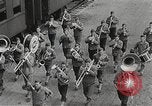
US Army soldiers and heavy equipment transported by railroad trains in the United States, bound for war front in World War 2
Activities of the United States Army in the United States during World War II. A U.S. Army band from the 407th Engineer Battalion playing musical instruments and marching. U.S. Army soldiers board railroad trains at a railroad station for transportation toward the war front. A railway steam locomotive pulling train cars. M4 Sherman tanks are seen on them as well as M2A4 (Mae West) tanks sitting partially turned with their guns out of sight away from the direction of travel.Browning M1919 .30 caliber machine guns are seen in their extra turrets. Army trucks and other military vehicles are also aboard the supply trains. The supply train moves through American countryside. Two women seated under hair dryers converse about the war in a beauty shop or beauty parlor. U.S. troops on troop transport railroad trains at night. Interior of a train car. American soldiers read books, sleep, and some play dice. An African American porter watches the game. A chaplain speaks to the soldiers. Civilians buy newspapers at a news stand. Headline on newspaper reads "London Expects Invasion of Europe at Any Hour" (before the upcoming Normandy Invasion of France in June 1944.)
CRITICALPAST.COM: About Us | Contact Us | FAQs - How to Order | License Agreement | My Account | My Lightboxes | Shopping Cart | Advanced Search | Featured Collections | Website Terms & Conditions | Privacy Policy ©2026 CriticalPast LLC.
License Agreement |
Terms & Conditions |
Privacy Policy
©2026 CriticalPast LLC.