


 Francais
 Deutsch
 Italiano

Refine Your Search
United States 1982 stock footage and images
- Showing 997 to 1002 of 34981 results more
 Hide
Color Sound
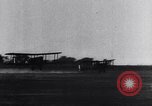
United States Army Air Service being built up before America's entry into World War I
While World War 1 was already underway in Europe, before the United States Air Service began to build up. Two U.S. DeHavilland DH-4 aircraft taking off. A formation of DH-4s in flight. A DH-4 upside down on the ground with soldiers all around it, including one sitting on a rock. Airplanes attacking a barrage balloon aloft, which burns and plummets to earth trailing dark black smoke. A candidate United States pilot undergoing physical testing. He is placed in a spinning chair and spun at high speed. Another pilot candidate performs a visual test with an array of lights on a panel being lit. Prospective Army pilots in U.S. Army uniforms marching and on a flight line with JN-4 Jenny training aircraft. Cadet turns propeller of a Curtiss JN-4 training airplane and the engine starts. Formation of DH-4 aircraft in flight. Lumberjacks in American northwest area of Oregon or Washington state felling a giant spruce tree after cutting it with a two man saw in the Cascade mountain forests. Massive Logs being transported by railroad to logging mills for eventual use in airplane factories. Men and many women war production workers busy working at an American airplane fabricating plant or factory during World War 1.
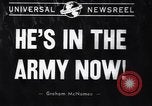
16 million men register themselves in United States for the WWII draft, and President Roosevelt addresses from White House.
As World War II heats up, 16,500,000 men between ages 21 to 36 register themselves throughout the United States, signing up during the first peacetime conscription in U.S. history. (This was triggered by passage of the Selective Training and Service Act of 1940, also known as the Burke-Wadsworth Act, the genesis of "Selective Service.") Opening scene shows men lining up to register for the draft before the United States entered World War 2. Views of men filing out their registration forms. At 00:22 famous prize fighter, Barney Ross, is being registered. (He jokes that the registrar shaking his hand has too strong a grip.) At 00:34 Hollywood cowboy Gene Autry is seen registering. Close up view of street signs at Chinatown intersection of Bayard Street and Mott Street in New York City. Sign below it notes "School Street. Drive Slowly. Make no unnecessary noise." Line of many registrants of Chinese-American descent waiting in line, and processing paperwork. Scene changes to another area of the city, where a line of mostly African American men wait outside a registration building. Some cheer and wave for the camera. A police officer at the entrance hustles them inside, pulling some of them along. View of the exterior of the White House in Washington DC. United States President Franklin D Roosevelt addresses the nation's men of draft age, telling them that the call up of 800,000 men for training in year one, and less than one million men in each subsequent year, is a program of defensive preparation only. Roosevelt says to the registrants that "Democracy is your cause. The cause of youth." ( Note: clip is silent except for President Roosevelt speaking at the end.)
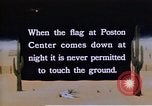
Japanese Americans lower the U.S. flag, soldiers drive in armored vehicles, and Nisei soldiers train for combat operations (WW2)
Japanese Americans lower the United States flag at Poston War Relocation Center (internment camp) in Arizona, during World War II. They fold the flag carefully. Elevated view looking down on armored vehicles and tanks during a military parade in the United States. Nisei (second generation Japanese-American) U.S. Army soldiers of the 442nd Regimental Combat Team seen in training for combat operations, at a military base in the United States. Slate notes that their slogan is "Go For Broke" and quotes a soldier as saying, "We have more to fight for than you do. Of course, we fight for our country, America, but we are also out to redeem the name of our race." Japanese- American soldiers navigate an obstacle course in Army training.
Isolationist versus interventionist sentiments of people in the United States regarding America entering World War 2
Americans express their views about United States entering into World War II after the Pearl Harbor attack. Anti-war isolationist and interventionist views are presented. Senator Gerald P. Nye advocates in favor of an arms embargo. Urging against American involvement in war, Senator Burton K. Wheeler cautions that war mongers and interventioners or intervention advocates control most of the avenues of propaganda. Wendell Willkie speaks advocating unity of purpose in America and importance of assisting the threatened democracies of Europe with war materiel and supplies. Next, Senator Joshua B. Lee of Oklahoma strongly urges support for lend-lease and "setting in motion an industrial blitzkrieg (of war materiel) that will make it possible for England to blast Hitlarism from the face of the earth." View of Congress meeting in the U.S. Capitol chamber. Anti-war college aged students protests against involvement in war and picket at the White House in Washington D.C.,United States. Adjacent to them are other protestors picketing against the peace advocates, with signs like "Americans are against subversive organizations picketing the White House" and "We Americans protest Communists picketing the White House. A women's organization advocating peace or protectionism or isolationism is seen wearing all black. They pull down black veils over their faces in a show of unity against war and the possible loss of American boys to war. An outdoor rally of a fascist organization meeting in America. Also scenes from a German American Bund meeting in 1939 at Madison Square Garden in New York City. Speaker at the meeting is Fritz Julius Kuhn who watches as a protestor leaps on the stage and is subdued by guards. Scenes shown from various other protests in the United States during the same era, including labor strikes and lockouts, and a group holding a rally in favor of equal rights or civil rights, with a woman holding a sign "Did Lincoln Free the Slaves?"

An elderly man shares the memories of his grandfather who immigrated to United States in early times.
Describes immigration to America. Faces of persons superimposed on flowing water. Statue of Liberty. Announcement and scenes of U.S. Customs processing at Kennedy Airport in New York City. Immigrants from Sicily, Italy at the airport. Two men going through immigration at the airport. People greet each other. Man fixes photographs on Alien Registration Cards. Narrator states, "Aliens today, Citizens in 5 years time. The process is almost automatic." Car driven on road in suburban neighborhood stops at a house. Map of United States. Paintings of different cities of United States in early times. Old man is interviewed and he speaks about his grandfather who migrated to the United States in the 19th century from England. Walking stick of his grandfather and letters written by grandfather.
Signal Corps weekly film reports sent to Photographic Center and used in training films for U.S. troops during World War II.
The role and contribution of the U.S. Army Signal Corps in combat and war. Amphibious landings of the first wave of Allied troops including Signal Corps Units in Normandy, France on D Day during World War 2. The Joint Assault Signal Companies (a Signal Corps Unit that accompanies the soldiers on every beach landing) go ashore in Normandy. Soldiers in landing crafts approach the beach. Landing crafts anchored along the shore line. A U.S. flag on the beach. Crafts approach the beach. U.S. Army Signal Corps combat photographers using motion picture cameras to film the battle that ensues on the beach and in the fields. Gun fire and explosions in the battlefield, filmed by combat cameraman. Allied aircraft in flight. Airmen load weekly film reports of the war in all Theaters made by Signal Corps officers from a van into an aircraft. The films are sent to the Photographic Center in New York. A soldier assembles the films. Technicians organize and arrange the films. They place the film reels onto racks. The film content is used to make training and orientation films for the U.S. troops. Troops watch the films in order to cut down the training period, and stay informed about the order of event in other Theaters of Operation. The films include 'Why We Fight' and 'The Fighting Men' series. Clips and recordings from these films.
CRITICALPAST.COM: About Us | Contact Us | FAQs - How to Order | License Agreement | My Account | My Lightboxes | Shopping Cart | Advanced Search | Featured Collections | Website Terms & Conditions | Privacy Policy ©2026 CriticalPast LLC.
License Agreement |
Terms & Conditions |
Privacy Policy
©2026 CriticalPast LLC.