


 Francais
 Deutsch
 Italiano
Refine Your Search
United States 1982 stock footage and images
- Showing 991 to 996 of 26494 results more
more Hide
Hide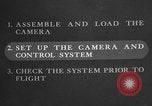
A camera and control system is set up and the system is checked prior to a flight in the United States.
Functions of aerial camera with its units are demonstrated in the United States. Setting up the camera and control system shows a CAS-2A aerial camera on a bench. Diaphragm and parallax angles are set. Lens cover is removed. Electrical cable is connected to the camera. Photographic conditions are set on control panel. Exposure control, footage remaining, computer and scanner dials are set. Focal length and depression angle are adjusted on power unit. Correlating dial is set on photographic recorder. System check prior to the flight: control panel, power switch is turned on. Ground speed and altitude dials are set. The camera is turned on. Light intensity dial is set. Scanner lens cover is removed. A demonstrator waves a hand in front of the scanner lens. Film speed is observed by watching the pivot on the cassette. After confirming the correct operating of the camera all switches are turned off.
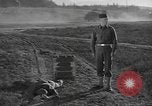
Wrong methods of instruction chosen by instructors during a training of the soldiers in the United States.
Training of U.S. soldiers in the United States. An instructor should consider several points before instructing the soldiers. A group of soldiers seated in a field. An instructor instructing them. Traffic moving past on a road nearby. The soldiers are not able to understand due to noise. Another instructor speaking to the soldiers lined up. A unit working nearby. A smoke screen is laid for the training of the soldiers. The other unit gets disturbed. One more instructor instructing the soldiers. The soldiers seated on the ground. The instructor instructing the soldiers about M-1 rifles by reading from a manual. Some of the soldiers sleeping. (World War II period).
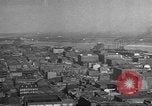
Men work in a factory and iron ore is transported to industries in the Midwestern United States.
Industries in the Midwestern United States. Aerial view of industrial and manufacturing buildings. Men punch in to a time clock using punch cards in a time clock. Men operate machines in a factory that makes machine parts. Coal transported in rail cars. A giant crane shovel loads iron ore in hopper cars in northern Minnesota. Hopper cars transport ore to shipping area at Lake Superior. Barges at docks on Lake Superior. Aerial view of barge underway on Lake Superior, still near land port. Side view of locomotive engine of Illinois Steel Company South Works, with conductor leaning out window, as it pulls away carrying iron ore. View inside plant as iron ore is converted to iron and then to steel for use in industries. Ships underway in inland waters. Close up view of black locomotive train engine in marshaling yard as it moves slowly. A rail worker is climbing on a side ladder of the moving train. View from behind train of hopper cars as it departs the marshaling yard. Trucks at a loading dock area. A United Air Lines DC-3 aircraft parked at an airfield. Passengers ascend ladder into the DC-3. The DC-3 United Airlines aircraft taxis, and number NC 25613 is seen under its left wing. Animated map show rail network, concrete highways and air network in the Midwestern United States.
U.S. Vice President Nixon talks about the foreign policy of America prior to presidential elections in the United States.
The fourth presidential election debate between Democratic nominee Senator John F. Kennedy and Republican nominee U.S. Vice President Richard Nixon on 21st October 1960 in in New York, United States. News correspondent Quincy Howe speaks prior to the fourth Kennedy-Nixon presidential debate. Mr. Howe reads out the rules and conditions under which the candidates will proceed. He says that Senator Kennedy will make the second opening statement and the first closing statement. Vice President Nixon speaks about the present issue in the United States which is keeping peace without surrender. The peace which is threatened by international communist movements. Nixon says that the United States has to learn from mistakes made in past. He relates to this by mentioning the period of the Iron Curtain in Europe and during the Korean War. Nixon says that situation in President Dwight Eisenhower's administration is reversed. He says that the United States made errors in the past in misjudging the Communists, applying same rules of conduct that are applied to the leaders of the free world. Nixon mentions East-West Paris summit conference of 1960 and Eisenhower's policy regarding Formosa Strait (Taiwan). Nixon speaks that that United States should increase its military strength to high level regardless of what potential opponents have and if any surprise attack is launched, the United States can destroy their war-making capacity. Nixon further says that American policies of military strength, economic strength, and diplomatic firmness will keep the peace without surrender.
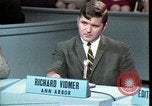
Richard Nixon appears in a television program, Michigan, United States.
Presidential candidate Richard Nixon appears in front of a panel of citizens in a program, Michigan, United States. The television program is named 'Man in the arena'. A panel sits in the center of the studio. Audience seated in the studio. A member of the panel Richard Vidmer asks him questions about the demonstrations in university campus, United States. Nixon answers that disagreement cause progress. He states that the demonstrations should not be an instrument of violence and destruction. Audience applauds Richard Nixon as he answers in the arena.
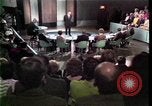
Richard Nixon answers questions of a panel of citizens in a television program, Michigan, United States.
Presidential candidate Richard Nixon appears before a panel of citizens in a program, Michigan, United States. The television program is named 'Man in the arena'. The panel sits in the center of the studio. Audience seated in the studio. A dermatologist seated in the panel asks Richard Nixon a question about medical care. Richard Nixon talks about his stand on health insurance and medical care. He states that United States is short of hospitals and doctors. Audience applauds Richard Nixon as he answers in the arena.
CRITICALPAST.COM: About Us | Contact Us | FAQs - How to Order | License Agreement | My Account | My Lightboxes | Shopping Cart | Advanced Search | Featured Collections | Website Terms & Conditions | Privacy Policy ©2026 CriticalPast LLC.
License Agreement |
Terms & Conditions |
Privacy Policy
©2026 CriticalPast LLC.