


 Francais
 Deutsch
 Italiano
Refine Your Search
United States 1982 stock footage and images
- Showing 1027 to 1032 of 26494 results more
more Hide
Hide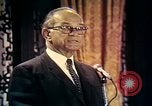
William J Fulbright, Chairman,Foreign Relations Committee, talks about the attitude of Senators in United States.
Debate on the 'Role of Congress in Foreign Policies' between John C Stennis and William J Fulbright in United States organized by American Enterprise Institute. Senator William James Fulbright, Chairman, Foreign Relations Committee discusses about the attitude of Senators to support the Congress. He says that he does not recall any incident when congress has rejected President's decision on any issue. He gives an example of an issue regarding war. He said that it is the responsibility of Congress to present a different view to President and the Senators have a collective wisdom on a particular issue. He states that better relations on non military grounds must be practiced. A comparison with policies and powers of other countries must be done. Fulbright says that no Senator has contested with the President on any issue.
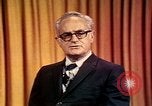
Moderator Peter Lasigor concludes and restates issues raised by Stennis and Fulbright in United States during a debate.
Moderator concludes debate on 'Role of Congress in Foreign Policies' between John C Stennis, Chairman, Armed Service Committee and William J Fulbright Chairman, Foreign Relations Committee in United States organized by American Enterprise Institute. The Moderator Peter Lasigor says that Stennis and Fulbright disagree on the issue of Congress's role in foreign policy. Stennis has said that the Congress has contributed in making 40 mutual treaties and plays a crucial role in making Foreign Policies. Stennis states the resolutions passed on the issues of Cuba, Berlin and others. Lasigor says that both of them agree on the point of reassessment. The points Fulbright raised were about the war making functions and deprivation of senate from the agreement on war issues.
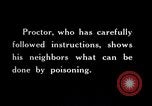
Dramatization: Proctor tells the effect of poisoning the farm and the increased yield in United States.
Dramatization: Calcium arsenates spray to combat Boll Weevils in United States. Proctor talks with his neighbors about the effect of poisoning the farm. Men and women poison the farm. Proctor stands nearby. He stands near a large pile of cotton with other men and states that the yield results from poisoning the farm. He says that poisoning increases the yield by 915 pounds seed cotton per acre.
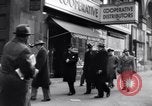
British and American working men on exchange visit meet with labor representatives in the United States (WW2)
Four British working men and their four American counterparts on an exchange visit to the United States enter a building in World War II. They are seen inside, seated at a table opposite representatives of American labor organizations including the American federation of Labor (AFL), the Congress of industrial Organizations (CIO) and the Railroad Brotherhood. During the meeting, one of the American workers states that they had just returned from England. One of the American labor representatives asks the English workers what they think about these exchange visits. They respond in support of them, and note they had an similar exchange with Russians as well. They also discuss international labor unity and its importance in winning the war. The British contingent note that they need more time to meet rank and file American workers to make any assessments. The subject of women filling jobs in war industry was viewed as affecting the lives of all women during the war and afterwards.
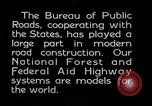
Rebuilt roads benefit the farmers and city people in United States.
The importance of roads and highways in the development of United States. The Bureau of Public Roads cooperated with the States to build the National Forest and Federal Aid Highway system. An early automobile driven on an early road. The car makes its way trough the slush and muck. An automobile driven on a rebuilt road. Farmers and city people benefit alike. Cars driven on a road amidst farms. A car crosses a bridge. Farmers separate seed on a seed separator as truck drives away hauling bags of seed. Trucks transport hay bales and sacks of grain from the farms to the city. Farmers load cartons onto a truck. Logs on a van. A truck transports wooden planks.

Arms race between United States and the Soviet Union; Arms Control and Test ban Treaty.
Teletype machines in Washington DC and in Moscow, used for rapid communication between the two countries during Cold War. Scene of buildings with golden dome in Moscow, Soviet Union. U.S. Navy officers view a document on a teletype hotline machine. Scene of fountain and White House behind it in Washington Dc. United States Secretary of State Dean Rusk, Russian Foreign Minister Andrei A Gromyko as they sign a Nuclear Test Ban Treaty. Soviet Premier Nikita Khrushchev toasts with others include British statesman Edward Heath.
CRITICALPAST.COM: About Us | Contact Us | FAQs - How to Order | License Agreement | My Account | My Lightboxes | Shopping Cart | Advanced Search | Featured Collections | Website Terms & Conditions | Privacy Policy ©2026 CriticalPast LLC.
License Agreement |
Terms & Conditions |
Privacy Policy
©2026 CriticalPast LLC.