


 Francais
 Deutsch
 Italiano

Refine Your Search
United States 1982 stock footage and images
- Showing 1057 to 1062 of 34981 results more
 Hide
Color Sound
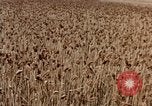
Marshals seize produce with high amount of pesticide; farmers treat fields and orchards with pesticides in the United States
A combine harvesting wheat in the United States. Workers picking peaches from an orchard. A ‘Fruit Growers Express’ railroad train transporting produce by rail. Trucks carrying fruits driving on highway during day and at night. A Union Pacific railroad train leaves a train station with many train cars carrying produce. Grain is processed by a machine and piped into a storage hold for shipment. A barge sails past a flour milling plant. A Western Fruit Express wagon stands beside rail tracks. Sign in car front window reads “Deputy U.S. Marshal”. Marshal attaches a “Monition” notice to the seized Western Fruit Express wagon due to a pesticide violation. Film subject introduced as "The safe use of pesticides...Follow the Label." A man offloads crates of produce seized by the United States Marshal. Two farmers discover an infestation of caterpillars in their fields. The farmers inspect leaves from their infested crops. A Food and Drug Administration (FDA) inspector examines produce from a seized rail car due to presence of excessive pesticide residue applied by the farmer to get rid of caterpillars discovered late in the harvest. The FDA inspector carries samples taken from seized produce. The FDA inspector writes on the paper bag containing samples and seals the bag with tape. An African American scientist examines samples of produce for illegal pesticide content. A syringe is inserted into a machine for chemical analysis. An FDA District Director makes a call from his office. A General Counsel speaks to an FDA District Director over the phone. A United States District Court arrest warrant against seized illegal produce. A judge signs the arrest warrant and hands it over to a marshal. A farmer drives a tractor and parks in front of a shed. A farmer looks at pesticides inside the shed. The farmer grabs a pack of pesticide and placed it at the back of the tractor. Farmer drives a tractor sprayer to treat pesticide on a field. Sacks of pesticide inside a shed. Camera zooms into a pesticide sack to show warning that reads “DO NOT USE WITHIN 10-DAYS OF HARVEST’ which the farmer violated. United States marshals seize produce from a Great Northern Railway cargo. The seized cargo is buried in a landfill. United States Marshals oversees the destruction of seized produce. A bulldozer covers the produced with rubble and soil. Animation depicting a caterpillar and various bugs superimposed over farm pests and crops. A praying mantis feeds on a bug. A farmer wearing protective gear including goggles and gas mask or respirator drives a tractor sprayer in orchard as he applies pesticide, herbicide, or insecticide. Boy and girls exiting a school house. Children running out from school at the end of day. Farmers harvesting carrots. Tractor plowing to expose pests. A farmer releases wasps to control pests. A farmer breeding resistant variety crops. A farmer prepares pesticide inside a shed. An old weighing scale tilting. Farmer opens hose to fill water into the tank of a sprayer. The farmer pours pesticide powder into sprayer. Sprayer treats orchard with pesticide.
U.S. Army Infantry in action. Taking prisoners. Negotiating a truce. Operating a tactical nuclear weapon atomic cannon.
U.S. Army troops moving through an enemy town on foot and in vehicles and tanks. U.S. Army infantry taking prisoners during the Korean War. A sign at Prison camp reads: "POW Camp #1, Utilities, Carpenter Shop." American troops process prisoners of war. Each is registered and given a POW identification to be worn at all times. Korean truce being signed at Panmunjom, in 1953. Amphibious assault forces underway at sea and troops wading ashore. A field headquarters in combat zone, where U.S. Army commanders are being briefed by an Intelligence (G2) officer. U.S. Army troops in camouflaged positions. U.S. tanks firing their guns and moving in a line. U.S. Army atomic cannon or nuclear cannon (e.g., M65 or Atomic Annie) firing tactical nuclear explosive shells. Various sized atomic bomb or nuclear bomb explosions from the shells. Army technician monitoring radiation readings on a tank exposed to tactical nuclear weapon effects. An airman hosing down an airplane exposed to radioactivity.
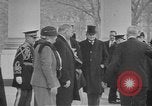
Franklin D. Roosevelt helps Americans to recover from the Great Depression in the United States.
Great Depression scenes and recovery efforts in the United States. U.S. President Franklin D. Roosevelt inaugurated as President on March 4, 1933. Scenes of Roosevelt and outgoing President Herbert Hoover leaving the White House together in a top-down convertible limousine before the ceremony. Roosevelt at the U.S. Capitol building during the inauguration ceremony as President of the United States. Roosevelt delivering the famous line in his speech, "The only thing we have to fear is fear itself." Jobless American men wait in unemployment relief lines to get work or jobs. Men in a bread line. Unemployed man with a large sign "Will take any job." Scenes of families migrating in the United States, with vehicles filled with belongings. Families and children suffering poverty and in makeshift camps and tenement dwellings during migration (usually migration west). Troops and bands march with American flags on Constitution Avenue during the Roosevelt Inauguration parade. Exterior view of U.S. Capitol Building framed by tree limbs. Men in an office empty heavy mailbags filled with letters (presumably to congress and senate). Government officials at a long table working on emergency banking laws in March of 1933. Scene of people flooding into a bank and making a run on the bank to retrieve deposits. President Roosevelt signs Emergency Banking Act in his office on March 9, 1933. View of White House lawn and White House. The CCC (Civilian Conservation Corps) is created to put unemployed young men to work on various conservation projects. CCC boys and men working on planting trees with pick axes and mattocks. Men and women in line to sign up for Emergency Work Relief programs. Officials write down the information for each worker as they are put to work in a variety of projects. Women and men, including white and African American men are seen getting assigned to work projects. A sign "USA Work Program WPA" advertising a suspension bridge work project of the Works Progress Administration in Los Angeles, California. People build roads, bridges and post offices. Cable fed out of a large spool as construction of a suspension bridge is shown. People work in factories. Four steam railroad locomotives preparing to run on parallel tracks. Close up views of railroad train locomotive wheels as they start moving and the train on tracks near factories. Various factory scenes including smokestacks, groups of workers entering factory for work shift and two different closeup views of a steam whistle blowing to mark the start or end of a work shift. A coal mining operation. Automated tools dig coal in shaft. Two coal miners take a break and eat. Crane hoists material at mine. A steel factory and hot molten steel pouring from a ladle.
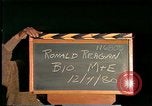
A film sketch about U.S. President Ronald Reagan and tracing his personal history and career leading to the Presidency in the 1980 election.
Opening scene shows U.S. President Ronald Reagan holding a little girl, and then standing with officials and Secret Service agents, as he prepares to enter a car. Closeup of him smiling. Closeup of President Reagan signing his autograph for spectators in a crowd. Next, Reagan and his wife Nancy are seen on November 4, 1980 waving to supporters at the Century Plaza Hotel, celebrating his election victory as the 40th U.S. President. The President elect says a few words of thanks to them. Views of the crowd cheering. Adopted son, Michael Reagan holds his son Cameron as he and his wife, Colleen Reagan, join Ronald and Nancy Reagan on the stage, followed by daughter Patricia Reagan and son Ron Reagan. The crowd cheers the President elect and his family. At this point the film begins showing images about Ronald Regan's life, starting with baby pictures; his parents; Tampico, Illinois, where he was born; Dixon, where he is seen in a school picture and with boyhood friends. A photograph of "Dutch" Reagan President of his High School Class. Reagan in photo with other members of the Eureka College football team, in Eureka, Illinois. The seal of the college. Pictures of Reagan with college classmates and teammates. Reagan posing in bathing suit when he was swimming team coach. Young Reagan, after graduation, as a sports announcer, sitting at a microphone labeled: "WHO" in Davenport, Iowa. The broadcasting tower of that radio station. A Track and field event taking place. Reagan posing with a pipe in his mouth, at the WHO radio station in Des Moines, Iowa. A baseball game in progress before a full stadium of spectators. In 1937, a Chicago baseball team is seen boarding a ship to a Spring training camp in California. (Narrator states Reagan accompanied them.) Aerial view of buildings at the First National Studios (home of Warner Brothers) in Hollywood. Ronald and Nancy Reagan, circa 1952, being applauded at a gathering when he was President of the Screen Actors Guild. Views of Reagan in U.S. Army uniform. A U.S. Army C-47 aircraft taking off from a field under attack, with fires burning and smoke rising (possibly during Japanese December 7, 1941 attack on installations in Pearl Harbor, Hawaii). U.S. Airmen standing on a ramp next to a Douglas C-47B-1-DL transport aircraft (tail number: 43-16145). What appears to be a ViP version of a B-50 aircraft parked on a ramp with an honor guard at the stairway. Ronald Reagan, in uniform, signing up for active duty. Later, Captain Reagan, U.S. Army Air Forces, is seen with other uniformed men at a gathering in Warner Brothers studios. The entrance of Paramount Pictures studios in Hollywood. A large group of studio employees walking between buildings. Reagan speaking, as President, of the Screen Actors Guild, at an outdoor gathering. Actor Robert Young and film industry executives stand nearby. Reagan, as Chairman of the Motion Picture Industry Council, addresses a dinner gathering of that organization. He is also seen testifying before he House Committee on Un-American activities Committee (HUAC) on October 23, 1947.
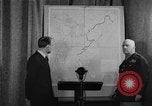
General Hugh Drum and James M. Landis, Civil Defense Chief, announce Proclamation restricting movements of civilians in U.S.
World War II restrictions on movements of civilians in the Eastern United States, are referenced by U.S. Army Lieutenant General Hugh Aloysius Drum, Commander of the Eastern Defense Command, and Mr. James M. Landis, Director of the U.S. Office of Civil Defense. They look at a large map showing the U.S. Eastern states and coast, from Maine to Florida. General Drum discusses Public Proclamation number 4 issued by the War Department, and urges citizens to read it. (It is posted in U.S. Post Offices and describes restrictions on the movements of citizens near war plants and beaches.) General Drum speaks of a uniform system of controls needed for U.S. Civil Defense. James M. Landis, Director of the Office of Civilian Defense, adds his comments about the importance of Civil Defense measures.
Y-12 atomic production facility; Trinity Shot atomic text explosion in the United States; Truman speaks about atomic secrets.
Atomic bomb production and its use in the United States. Doctor Ernest O. Lawrence experiments with the cyclotron at the University of California, Berkeley. View of the exterior and interior of the cyclotron. An animated diagram shows the results of the splitting of the uranium atom. Diagram shows a nucleus, electrons and protons. Atomic structures of Helium, Lithium and Uranium. A diagram of the creation of barium and krypton, and the release of atomic energy. Aerial and ground views of Y-12 atomic energy testing, uranium enrichment, and manufacturing plant at Oak Ridge, Tennessee created during Manhattan Project. Workers walking on the grounds of the the plant. The Trinity Shot first atomic explosion is shown near Los Alamos, New Mexico on July 16, 1945. Flash of explosion and a cloud of smoke rises as seen from U.S. Army cameras 6 miles away. Two other views of the explosion are seen from other camera positions while narrator explains the effects. U.S. President Harry S. Truman speaks of the need to keep the secrets of the atomic bomb among the U.S., the U.K, and Canada, alone, until they find successful techniques to control the bomb and protect the world from total destruction. He indicates that he will work the the U.S. Congress in the effort and make the power a force for world peace. Truman asks that God guide the U.S. in how to use the technology in His ways and for His purposes. (World War II period).
CRITICALPAST.COM: About Us | Contact Us | FAQs - How to Order | License Agreement | My Account | My Lightboxes | Shopping Cart | Advanced Search | Featured Collections | Website Terms & Conditions | Privacy Policy ©2026 CriticalPast LLC.
License Agreement |
Terms & Conditions |
Privacy Policy
©2026 CriticalPast LLC.