


 Francais
 Deutsch
 Italiano

Refine Your Search
United States 1982 stock footage and images
- Showing 1063 to 1068 of 34981 results more
 Hide
Color Sound
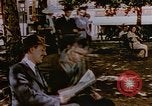
Aspects of U.S. industry including public information, agriculture, transportation, and water power.
Excerpt from film entitled "Power Behind the Nation." It opens showing glimpse of two men on a park bench, discussing a newspaper article, followed by views of men at work in a radio broadcasting studio. Next is shown a Western theme film set being constructed for a motion picture, at a Hollywood film studio back lot. Closeup of Director and crew filming a western movie with an actor on horseback as he rides up to a wooden building on the film set displaying a Dance Hall sign. Next, a director and film crew are seen working on an elaborate set with a chorus of women in white gowns. Scene shifts to film makers watching a finished movie production dealing with colonial era America (ostensibly an educational film). Another film is seen being made at a set resembling a European town. Next, views of American farms are shown with various crops under cultivation, including fruit orchards. Farm machinery is seen in use, including tractors, harvesters, and combines. Grain is shown being harvested and processed in the field, and cotton being picked. Closeup of cotton bolls on the plants. Men are shown collecting sap from sugar maple trees in the northeast U.S. for making maple syrup. In the U.S. Northwest, a flock of sheep is seen grazing in a field. A herd of cattle are shown in the Southwest, U.S. A field of grain is shown and then a section of crops irrigated by small ditches. Then a large man-made irrigation canal is seen. View of a ramshackle building and yard in a desert. Women harvesting vegetables from irrigated plants. Apples being sorted by machine. A pair of steam locomotives pulling a railroad train and a diesel locomotive pulling freight cars, all ostensibly carrying fresh produce to market. Several shots of railroad freight trains in different settings. A truck moving along a country road. A tugboat working beside a large ocean-going cargo ship on a river in the U.S. More shots of ships and inland canals. A ship passing under the Golden Gate Bridge in California. An aircraft under construction. Passengers deplaning from a Continental Airlines DC-3 passenger airplane parked on a ramp. A prototype U.S. Navy Lockheed XR6O-1 Constitution aircraft taking off. (Only two R6V aircraft were made, Bureau Numbers 85163 and 85164.) A Sikorsky helicopter in flight. Closeup of Captain in cockpit of a TWA Boeing Stratoliner airplane as it taxis out of parking place. Industrial buildings close to a river with water flowing below a dam. The Grand Coulee Dam on the Columbia River in the U.S. state of Washington.
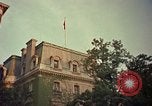
Nikita Khrushchev hosts a banquet at the Soviet Embassy in Washington DC while on a visit to the United States.
Soviet Premier Nikita Khrushchev on a visit to the United States. Exterior of the Soviet Embassy in Washington DC. People at a formal banquet hosted by Mrs. And Mr. Khrushchev. U.S. Vice President Richard Nixon and his wife arrive for the banquet. U.S. President Dwight D. Eisenhower and his wife also arrive. They pose with dignitaries. Khrushchev in a railroad towards New York. Soviet Ambassador to the U.S. Mikhail A. Menshikov and U.S. Ambassador to the Soviet Union Llewellyn E. Thompson with him. The train rushes past rivers, farms, factories, towns and market places. We see his train passing through a station in Newark New Jersey. Mr. Khrushchev waves to people from the window of the train. Khrushchev's motorcade escorted by police escorts rolls through the streets in New York. People on the side of the streets to watch. Mr. Khrushchev addresses people at mayor's luncheon. He talks about peace and relations between the Soviet Union and the U.S. People applaud. New York Governor Nelson Rockefeller welcomes him.
Boxers fight in a ring. A U.S. Army Master Sergeant speaks about fire power and research. He points at models of missiles
The "Big Picture" public film by the U.S. Army. In it Master Sergeant Queen speaks about the use of fire power by the U.S. Army in defense of the United States. Boxers fight in a ring. Spectators cheer for the boxers. One boxer is knocked down and counted out. Then scene shirfts to U.S. Army Master Sergeant Queen speaking about the defensive fire power of the U.S. Army being like a "knock out punch.". He points to models of missiles on his desk, including models of a U.S. Hermes A-3 Missile and what appear to be a Cruise missile and an air defense missile.
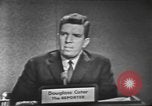
Kennedy and Nixon comment on nuclear disarmament before summit conference during a presidential election debate in the U.S.
The third Kennedy-Nixon Presidential Debate in the United States. Douglass Cater from Reporter magazine asks Democratic candidate Senator John F Kennedy about what sort of prolonged period does he envisage before there could be a summit conference and if he thinks that there could be any new initiatives on the grounds of nuclear disarmament during that period. Kennedy answers and talks about the need of strengthening of U.S. conventional forces and increasing missile production. On the question of nuclear weapon disarmament he states that the new administration should renew negotiations with the Soviet Union. He disagrees with the present administration's efforts regarding nuclear controls and general disarmament. He states that if he would get a chance he would make efforts to provide for control of nuclear weapons testing and begin general disarmament levels. Republican candidate U.S. Vice President Richard M Nixon mentions about his speech on this subject. He disagrees with Kennedy's statement that the administration is not making any effort because this is the highest level of operations in the whole State Department which is under the President himself. Roscoe Drummond from New York Herald Tribune asks Vice President Nixon about defending Quemoy and Matsu islands. Nixon answers and states that the U.S. should not deal with dictators and should not indicate which particular area it would defend. He gives the examples of the Korean War and World War II where the U.S. made a mistake. He says that Kennedy should change his position in this regard and not encourage the Chinese Communist and Soviet aggressors to react. Kennedy says that the treaty with the Republic of China excludes Quemoy and Matsu from the treaty area. He states that the treaty only includes defending of Formosa (Taiwan) and the Pescadores. He concludes that the U.S. should meet its commitments and raise war if the Chinese Communists attack the Pescadores and Formosa.
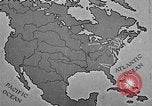
British film intended to acquaint British people with United States landscape, rail transportation, and farming history.
British World War 2 era film showing scenes in the United States from earlier in the 1900s. Film opens showing 19th Century animated map of the United States. It traces the development of the railroads in the U.S. It shows rail lines reaching the Missouri River by the year 1860. (Narrator states this took 250 years to happen.) But in another 10 years, the map shows the Union Pacific and other rail lines extending two the West Coast, and U.S. commerce shifting, from North-South movement, to East-West (with an animated steam locomotive moving across the map). Chicago is highlighted as the greatest railway junction in the world (the "Piccadilly Circus" as the British narrator describes it). View of a late 1800s model steam locomotive train pulling freight railroad cars on railroad tracks in a desert area of the Western United States. Point of view from camera on moving railroad train pointing straight down at railroad tracks moving by at high speed. Landscape and wide views of the arid Western parts of the U.S. Group of Native American Indians watching a railroad train pass. Construction supplies being offloaded from a train. A wind-driven water pump. Buffalo herds affected by the railroads. Wire fencing installed to control cattle on large Western ranches. Large team of horses pulling late 1800s wheat harvesting farm equipment as it harvests wheat in fields. Views of wheat grains being poured at high volume. Cattle roaming in the high country. Views of Chicago stock yards. A man marking in chalk on a Board of Trade chalk board, indicating the prices of farm commodities including wheat, corn, oats, and rye. Various views of steam locomotives pulling trains throughout the rail network, including some 20th century trains near the end of the film, and some close-up views of wheels turning fast on moving railroad trains.
Election campaign of Richard Nixon-Spiro Agnew in United States.
Richard Nixon-Spiro Agnew election campaign for the office of Presidency in United States. Democratic National Convention. A huge crowd gathered to protest. People stand with the U.S. flags. A sign reads 'Illinois'. Banners read 'Boycott McGovern' and others reflect support for McGovern. Domestic violence in United States. A man holds a pistol. A fire in a building. People protest on streets. A protesting group carries banners. A banner reads 'Independent Socialism'. Another group carries banners reading 'To give aid and comfort to Viet Cong, Treason'. Wreckage on street. United States soldiers in Vietnam. Unemployed citizens and poor people in United States. A man stands in a building. A poor woman with her child. Reflection of light in water. The campaign stresses on choosing the right leader in United States. (Vietnam War period).
CRITICALPAST.COM: About Us | Contact Us | FAQs - How to Order | License Agreement | My Account | My Lightboxes | Shopping Cart | Advanced Search | Featured Collections | Website Terms & Conditions | Privacy Policy ©2026 CriticalPast LLC.
License Agreement |
Terms & Conditions |
Privacy Policy
©2026 CriticalPast LLC.