


 Francais
 Deutsch
 Italiano
Refine Your Search
United States 1982 stock footage and images
- Showing 12697 to 12702 of 26493 results more
more Hide
Hide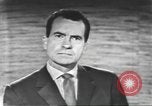
During a presidential election debate in Washington DC, Kennedy and Nixon give their views on the importance of party labels.
The second Kennedy-Nixon Presidential Debate in Washington DC, United States. Harold R Levy of Newsday asks Republican candidate U.S. Vice President Richard M Nixon to comment on the importance of party labels. Nixon answers and talks about Democratic and Republican Presidents. He says that the party label is not important, it is the belief and the leadership qualities of the presidential candidate that are important. He states that it is the people who determine and elect their presidents. He disagrees with Kennedy's statement that his party has not proposed programs. He mentions the programs proposed by his party in fields like education, housing and defense that would lead to the overall development of the nation. Democratic candidate Senator John F Kennedy presents his views and states that party labels are important as they tell about the programs and the candidate. He says that the Democratic party has stood for progress, people's welfare, strong foreign policy and national defense. He compares the approaches used by Democratic presidents with those used by the Republican presidents. He concludes that in the past years the Republicans have opposed housing, care for old age, federal aid to education and minimum wage. Moderator Frank McGee thanks the candidates and mentions future program details.
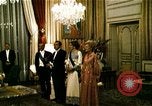
President Richard Nixon poses with Shah of Iran Mohammad Reza Pahlavi for pictures in a palace in Tehran, Iran.
U.S. President Richard Nixon attends a state dinner the Niavaran Palace (Tehran Province Tehran District 1 Niavaran St, Niavaran Square, Iran) in Tehran, Iran. President Nixon, the First Lady of the United States Pat Nixon, Shah of Iran Mohammad Reza Pahlavi and his wife Shahbanou Farah Pahlavi pose for pictures after the dinner. President Nixon, the Shah of Iran, and their wives are dressed in formal wear for a state dinner.
U.S. President Richard Nixon addresses people and speaks about the American music in Nashville, Tennessee.
The opening of the Grand Ole Opry house in Nashville, Tennessee. U.S. President Richard Nixon present with his wife at the ceremony. Nixon addresses the people. He talks about the American music. He states that the country music has a magnificent appeal all across the country. He talks about some of the Hollywood stars, singing some of the more modern music that is hard to understand. He also talks about some of the men who served the United States in Vietnam and were prisoners of war. They were being entertained at the White House. They had been in prison for more than 6 years. He further states that the American music talks about family, it talks about religion, the faith in God that is very important to the country and particularly to the family life. He says that the country music radiates a love of the Nation, patriotism. People applaud as he ends his speech.
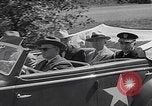
President Harry S. Truman and officials inspect damage in Berlin before the Potsdam Conference (WW2)
United States President Harry S. Truman visits Berlin for the Potsdam Conference at the end of World War 2 in Europe. President Truman, Admiral William D. Leahy, Secretary of State James F. Byrnes, sit in open car to view Berlin in ruins. Berlin buildings and façade are destroyed from heavy bombing. Ruins of the Reich Chancellery (Wilhelmstraße 77 10117 Berlin Germany) is seen. President Truman’s car passes by the Berlin Victory Column or Siegessäule (Großer Stern, 10557 Berlin, Germany). Closer view of the Berlin Victory Column, featuring the Victoria statue on top. Large portraits of President Truman, Russian Premier Joseph Stalin and Prime Minister Winston Churchill on a Russian reviewing stand on Berlin’s Unter den Linden Avenue. President Truman’s convoy approaches the Brandenburg Gate (Brandenburger Tor Pariser Platz, 10117 Berlin, Germany), damaged by heavy bombing. Cars driving on the Unter den Linden Avenue. The Berliner Schloss (Schloßpl. 1, 10178 Berlin, Germany) with significant damage. The Secret Service stand on running boards of President Truman's car. President Truman greets a man from his car. President Truman, Admiral Leahy and Secretary of State Byrnes talking. A huge pile of rubble stands in front of a damaged building. Crowds of men and soldiers surround President Truman and his car. Soldiers with cameras take photographs. Secret Service men running alongside President Truman’s car. President Truman’s car passes by a Nazi-style building, driving into the Autobahn. A Military Police vehicle, which acts as guard, follows behind President Truman's car heading to Potsdam.
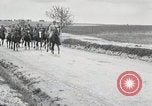
African American soldiers of 369th Infantry, 93rd Division, U.S. Army marching on road in Maffrecourt, France, during World War I
African American soldiers of the 369th Infantry Regiment, 93rd Division ("Harlem Hellfighters"), United States Army, march in formation along a road in Maffrecourt, France, in World War 1. They are led by mounted officers, and a brass band (likely under the direction of band leader Lt. James Reese Europe). Unit leaders salute as they pass the camera. Mules pull several artillery pieces and caissons. Several medics march with stretchers. The U.S. flag is the only one carried by the color guard. No unit colors are seen. The 369th Infantry soldiers wear French helmets because they were assigned to the French Army during the war, as the U.S. Army (American Expeditionary Forces) did not permit African Soldiers in combat.
U.S. Army soldiers guard German SS-Totenkopfverbände (SS-TV) prisoners of war being held near a village.
United States Army soldiers guarding a group of German SS prisoners of war who are being held near a village. Cameraman slate indicates location of "Wittring" (presumably Wittring France, just outside the German border, in the Moselle region), but U.S. government record accompanying the film indicates "Wittring, (?) Germany" (sic). A wheel cart is seen on the street. The German prisoners of war have SS markings on their right lapel and also the SS skull insignia on the cap, identifying them most likely as part of the SS-Totenkopfverbände or SS-TV; also called Death's Head units. (Theories on these captured soldiers include: 1) SS-TV units were primarily in charge of administering the Nazi Concentration Camps in World War II. Hinzert Concentration Camp was possibly the closest camp to Wittring. Perhaps these soldiers came from it or another camp; 2) They may have been part of the 3rd SS Panzer Division. Reportedly, whole platoons and elements of the 3rd SS Panzer division were not following orders and were giving up prior to the Budapest and Vienna battles to avoid Soviet captivity, as early as Jan 1945). Prisoners rub their hands to warm them in the cold. Camera shows a close-up view of one of the prisoners, as an American soldier attaches a Prisoner of War identification tag over around the neck of the prisoner.
CRITICALPAST.COM: About Us | Contact Us | FAQs - How to Order | License Agreement | My Account | My Lightboxes | Shopping Cart | Advanced Search | Featured Collections | Website Terms & Conditions | Privacy Policy ©2026 CriticalPast LLC.
License Agreement |
Terms & Conditions |
Privacy Policy
©2026 CriticalPast LLC.