


 Francais
 Deutsch
 Italiano
Refine Your Search
United States 1982 stock footage and images
- Showing 13693 to 13698 of 26492 results more
more Hide
Hide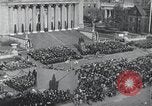
Life of U.S. President Dwight Eisenhower after World War 2; NATO; Columbia University; U.S. President; advisor to Presidents
Dwight D. Eisenhower during presidency of the Columbia University in 1948. Eisenhower walking at a Columbia University graduation ceremony in New York City and speaking to the group assembled. Two years later, views of Eisenhower as NATO supreme commander in Europe. Eisenhower seated in NATO Conference. Citizens in United States prepare signs and urge Eisenhower to run for President. He salutes a parade in 1952 as he begins a run for the Presidency. Pamphlets and posters read 'we need Eisenhower'. An animated cartoon shows a smiling and marching Uncle Sam with an "Ike for President" jingle song playing. Cartoon shows animated citizens and an elephant supporting Eisenhower. Scenes from Republican National Convention, and Nixon and Eisenhower holding their arms up together. Citizens voting, using ballot boxes, and voting machines. A nun votes. Eisenhower casts his vote. People hold U.S. flags and cheer. Signboards and neon lighting on a building track vote tally and proclaim Eisenhower victory in 1952 presidential election. Eisenhower in Korea after the election. He meets and eats with American troops in the field and studies the war effort. South Koreans wave flags on announcement of truce (cease-fire armistice) in Korean War Eisenhower takes presidential oath of office in Washington DC. He signs document for Civil Rights Act of 1957 (voting right act). View of African American students of the "Little Rock Nine" entering a military station wagon under armed troop escort during integration of Little Rock Central High School in Little Rock Arkansas. U.S. Army troops escort the African American students into school. Exterior view of United Nations building in New York. Eisenhower delivers speech on Atoms For Peace. Winston Churchill of Britain and Nikita Khrushchev of the Soviet Union visit Eisenhower in America. Scenes of John F Kennedy inauguration in 1961. Eisenhower with Kennedy and later with President Johnson. In 1968 address to Republican Convention Eisenhower notes risk of growth of Communism.
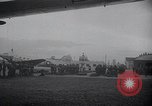
Japanese self defense forces participate in training program, Japan.
Camp Kashi, Kyushu, Japan. Members of U.S. 187th Parachute Maintenance Company train Japanese Self Defense Force paratroops. Japanese instructor and U.S. paratroopers help Japanese paratroopers to don and secure their chutes. They board U.S. Air Force C-46 aircraft. Views through open door of C-46, in flight, show American paratroopers accompanying the Japanese. On ground, drop zone is marked by smoke and one of several American Army advisors talks radiotelephone to coordinate the jump. Onboard the aircraft paratroopers hook up to static line. On the ground, Japanese officers look up towards plane, as troopers emerge and their chutes deploy. As they land, the Japanese paratroops wrap up their chutes and form up into units. Soldier takes his bag and runs. Japanese Self Defense Paratroops march in parade. after training of two weeks: Graduates of training course and officers attend the program. The flags of Japan and United States. Japanese General honors the students of training program by giving them paratroop wings and certificates. U.S. Army Brigadier General and Japanese General salute as new paratroops pass in review. View of Paratrooper's wings. Certificate from Headquarters 187th Airborne Regimental Combat Team. Smiling new Japanese paratroopers.
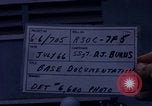
Base Operation buildings and headquarters of Tactical fighter Squadron at Bien Hoa Air Base in Vietnam.
Base Operation buildings and headquarters at Bien Hoa Air Base in Vietnam. Flags of United States and South Vietnam near a building. Air Force personnel pass near around the building. Operations buildings with signs and unit insignias: Headquarter of 3rd Tactical Fighter Wing, 416th Tactical fighter Squadron, Base Operations and control tower. Sign: 'Bien Hoa Base Operations Field Elevation 36 ft, Welcome 23rd VNAF Wing, USAF TAC FTR Wing'. (Vietnam War period).
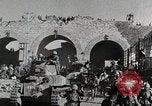
Rape of Nanking during 2nd Sino-Japanese war
Massacres in Nanking during second Sino-Japanese war. Japanese army troops and Type 89 I-Go tanks enter city gates to occupy Nanking, China. they break into a building and take away a Chinese man on a rope tether. Chinese inhabitants confined by the city walls are unable to escape brutal treatment by Japanese soldiers who are seen dragging men, women and children to be shot. Many are herded into a pit where Japanese soldiers standing above, execute them with rifle fire, as others fill the pit with earth, burying any survivors alive. Two Chinese kneeling with arms tied behind them are summarily executed by soldiers with rifles. A Japanese officer follows with a pistol to assure their death. Bodies of dead Chinese civilians litter an alleyway. Many scenes of Chinese killed by Japanese. (Narrator states that Japanese troops murdered 40 thousand men, women and children.) Japanese Field Marshal Count Terauchi Hisaichi is seen stepping from a transport airplane, followed by Field Marshal Shunroku Hata. Count Terauchi looks pleased as he is greeted and exchanges salutes with other officers. Next, the scene reverts, again to the horrors of Chinese peoples' suffering in Nanking, at the hands of the Japanese soldiers. Views of injured and wounded Chinese civilians, at a hospital, in pictures taken by an American Missionary, and smuggled out of china. A woman holding her injured husband as he lies against a cushion in a street. A small child stands near them. Scene shifts to a smiling Field Marshal Shunroku Hata, greeting local commanders, while photographers record the event in background. Views revert to the destruction and human tragedy in Nanking. A picture of Chinese leader, Sun Yat Sen. Chiang Kai-Shek speaking at a podium, and other Chinese political leaders speaking to gathered people, throughout unoccupied China, encouraging them to unite and resist Japanese aggression. Chinese people parading with banners to encourage resistance. Chinese soldiers and political leaders collaborating to raise armies. Chiang Kai-Shek ascending to Political leadership, exhorting Chinese to unite and fight the Japanese. Numerous scenes of rallies calling for unity and resistance. Chinese military officers standing as Chiang Kai-Shek enters a planning session. He sits and then they do. Behind him on the wall is a map of China. Closeup of Chiang as he outlines a strategy to slowly yield territory to Japanese invaders, to buy time for developing and arming Chinese forces. One of his staff goes to a wall map and gestures as he speaks. Next, Chinese soldiers are seen setting dynamite charges and blowing up lines of communication (roads). Chinese people pour petrol on grain fields and set them ablaze. Factory buildings being blown up and similar destruction as China pursues a "scorched earth" policy to hinder the Japanese invaders. Millions of Chinese people on the move to Western parts of China. (Narrator calls this the greatest human migration ever recorded.)
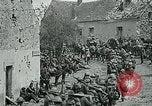
U.S. 4th Infantry troops march into Village of Sergy, France, during World War I
The Aisne Marne Operation in France. United States 4th Infantry troops march around bend of road in Village of Sergy, France. A building with partially destroyed roof at side of road. An American artillery unit is resting at the side of the road with its horses, caissons and artillery pieces. (World War I; World War 1; WWI; WW1)
Troops and artillery of Allied forces advance to Korean area and fire shells on hills of Chorwon in Korea.
United States Combat activities during Korean War in South Korea. Allied units advance in Korea. Troops and artillery advance on road. They go on field. Soldiers carry recoilless rifles. Infantry men fire shells on hills of Chorwon.
CRITICALPAST.COM: About Us | Contact Us | FAQs - How to Order | License Agreement | My Account | My Lightboxes | Shopping Cart | Advanced Search | Featured Collections | Website Terms & Conditions | Privacy Policy ©2026 CriticalPast LLC.
License Agreement |
Terms & Conditions |
Privacy Policy
©2026 CriticalPast LLC.