


 Francais
 Deutsch
 Italiano

Refine Your Search
United States 1982 stock footage and images
- Showing 1399 to 1404 of 34981 results more
 Hide
Color Sound
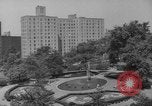
A new planned housing community with various amenities like drug store, theater, laundromat in United States.
Improvement in housing facilities in post war era in United States. A planned housing community in the United States with various facilities like children's parks, baseball fields, a Liggett's drug store, a movie theater and a laundromat laundry facility. The theater marquee advertises Allan Ladd and Loretta Young, "And Now Tomorrow", and "Our hearts were young and gay" with Gail Russell and Diana Lynn. Woman loading clothes into an early model laundromat washing machine. Children play about in the area around the houses and run down from a pedestrian bridge that crosses a road. Ice cream man pushes an ice cream cart with an Eskimo Pie advertisement on the cart. The man rings a bell as children run to the ice cream cart. A woman inside a well ventilated and well lit up house. Men and a woman conduct research about improving housing facilities in United States.
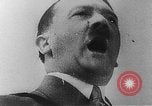
Career of U.S. Air Force General Henry (Hap) Arnold. Advent of World War Two.
Year 1938. Adolf Hitler gives speech. U.S. Army Major General Henry (Hap) Arnold is appointed Chief of the U.S. Army Air Corps. President Franklin D. Roosevelt with General Arnold in an open car, inspecting a new bomber. Sketches of various airplanes proposed to modernize the U.S. Army Air Corps, including Northrup A-17-A; Bell P-39; and Douglas B-23. Views of U. S. Army pursuit airplanes and North American BC-1 training aircraft. Paratroopers jump from C-47 aircraft. A P-38 lightning airplane maneuvers in flight.
Recognition, capabilities and similarities of Japanese Zero fighter plane and United States P-40 Warhawk (WW2)
Recognition and capabilities of Japanese World War II Zero fighter plane. Japanese Mitsubishi A6M Zero in flight. Animated diagram of Zero fighter plane shows its wings, tail and engine. Animated picture of Zero fighter plane and United States P-40 Warhawk. The similarities and differences of both the aircraft is shown. United States P-40 Warhawk in flight. Actor Ronald Reagan dramatizes the experience of mistakenly shooting at a P-40. Officers converse with each other. Pilot looks at pictures of P-40 War Hawk on wall. Airmen discuss the differences and similarities between Japanese Zero fighter plane and the United States P-40 Warhawk. Pilot seated in cockpit of P-40 Warhawk. Airmen ask questions of Ronald Reagan. Pilot Ronald Reagan then takes to the air, correctly identifies a Japanese Zero fighter plane and shoots at it.
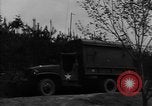
Smaller U.S. Army dispersed forces using better communications and aerial transport in the atomic age
A communications center setup in a U.S. Army GMC CCKW 2 1⁄2 ton 6X6 truck. Army radio operator at work inside the truck. Soldiers operating communications equipment on the roof of a vehicle. Soldiers at work inside the vehicle. U.S. army gun crews firing Howitzers; M1919 Browning .30 caliber medium machine guns; Browning M1917A1 Caliber .30 Heavy Machine Guns, and rifles, from positions hidden in foliage. U.S. troops manually rolling artillery pieces through the underbrush. Infantry being dropped off and picked up by Sikorsky H-19 Chickasaw helicopters. An artillery piece being transported by helicopter. About 10 helicopters in flight low over the ground.
Decline in industry and jobs, and Stock Market crash and start of Great Depression in the United States.
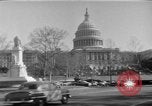
The film 'The Unfinished Revolution' opens by showing people recovering after the Great Depression in the United States. Most scenes circa 1929 - 1931 (but film produced in 1960s). Landmarks in Washington DC: the United States Capitol building with 1940s and 1950s cars and taxi cabs on roads in foreground. View of exterior of Supreme Court building. Closer view of U.S. Capitol and then of the White House in Washington DC. Also the Washington Monument. Scene changes to the American West and a herd of sheep and of cattle grazes on pastures or ranch. Cowboys on horseback herd cattle on a giant field with snow covered mountains in the background. Farmers work in a field picking cotton. Scene changes to New York City with view of Manhattan skyline including Empire State Building, with new skyscrapers in construction in the foreground. View of market area and tenements; push cart vendors lined up on a street in a lower east side New York City neighborhood, and a Ford sedan on the street. Busy New York City streets filled with cars and pedestrians at end of 1920s. Children standing on fire escape in poor downtown area look down over suspended laundry lines between tenement buildings. An officer looks out from small window of a raised booth traffic light as the lights on the booth change color. A Ford automobile assembly line. Engineers work in a factory with minimum wages. A farmer plows a field of potatoes using four horses. A wheat thresher working a field. Trains at a crossing, on a bridge, and coal cars lined up at a coal yard. Busy New York Stock Exchange (NYSE) floor filled with people around time of 1929 stock market crash and start of Great Depression. Frenzied stock market scenes. Board outside a factory reads 'No Men Wanted'. Scenes of silent railroad yards and dormant factories. A man plays an accordian and collects coin donations. Jobless people wait in relief lines, soup kitchen lines, unemployment lines or queues and bread lines. Unemployed and homeless men asleep in public areas.

United States soldiers light toxic candles to create a smokescreen during a training operation
A United States Army training film about chemical warfare. United States soldiers light toxic candles (yielding only smoke in this training operation). Smoke rises from the candles and spreads in the surrounding area. U.S. troops wear gas masks. A soldier lights the toxic candles placed in a line on the ground.
CRITICALPAST.COM: About Us | Contact Us | FAQs - How to Order | License Agreement | My Account | My Lightboxes | Shopping Cart | Advanced Search | Featured Collections | Website Terms & Conditions | Privacy Policy ©2026 CriticalPast LLC.
License Agreement |
Terms & Conditions |
Privacy Policy
©2026 CriticalPast LLC.