


 Francais
 Deutsch
 Italiano

Refine Your Search
United States 1982 stock footage and images
- Showing 1411 to 1416 of 34981 results more
 Hide
Color Sound
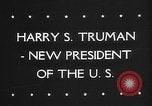
Harry S Truman assumes office of President of the United States following death of Franklin D. Roosevelt during World War 2
Harry S Truman appointed President of the United States. The U.S. Capitol building in view. Trees in the foreground. President talks on the phone. Harry Truman attends the 1944 Democratic convention with his daughter, Margaret Truman. People gather holding boards and placards of Truman in hand. A board reads: 'Truman for Vice President'. Franklin Roosevelt seated in a car during his fourth inauguration parade, on January 20, 1945, with motorcade proceeding on Constitution Avenue in Washington DC, and then driving up to the White House. Past events show President Franklin Roosevelt talking to Vice president Truman. Flag at half staff on the U.S. Capitol following death of President Roosevelt. Truman addressing a joint session of the Congress. General Marshall, Admiral King, Secretary of War Stimson all arriving at the White House to meet with President Truman. Also seen are James Byrnes and Truman receiving Lord Halifax, Anthony Eden, Secretary of State Stettinius in the White House. Truman speaks to joint session of congress on April 16, 1945 and expresses desire to continue the efforts and direction set by Franklin Roosevelt, saying, "With great humility I call upon all Americans to help me keep our nation united in defense of those ideals which have been so eloquently proclaimed by Franklin Roosevelt...." He also states, "So that there can be no possible misunderstanding, both Germany and Japan can be certain, beyond any shadow of a doubt, that America will continue to fight for Freedom until no vestige of resistance remains. Our demand has been, and it remains, unconditional surrender. We will face the problems of peace with the same courage that we have faced and mastered the problems of war. In the memory of those who have made the supreme sacrifice; in the memory of our fallen president, we shall not fail."
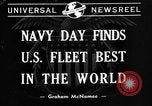
The United States Naval fleet is termed as the best fleet in the world on the Navy Day.
The United States Naval fleet on Navy Day. U.S. fleet is termed the best in the world. U.S. battleships, cruisers, destroyers and submarines underway at a sea. Planes take off from an aircraft carrier. An aerial view of the ships. Men work with equipment on a ship. Soldiers fire guns from a battleship. Smoke from firing and bombardment. A flag flutters from a flag pole on the ship. (World War II period).
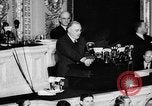
U.S. President Franklin Roosevelt State of the Union address to 77th Congress, known as the "Four Freedoms" speech.
U.S. President Franklin D. Roosevelt addressing the 77th Congress of the United States in the annual State of the Union address. In his "Four Freedoms" speech he speaks of threats to the U.S. and all the American Republics. He calls for support to nations suffering attack from aggressors, He calls for promotion of human rights. After speaking, President Roosevelt turns to greet Congressional leaders, John Nance Garner, his Vice-President (President of the Senate) and Speaker of the House of Representatives, Sam Rayburn. President Roosevelt is assisted as he departs the podium, using a cane. (World War II period).
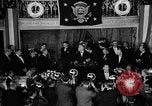
U.S. President Franklin Roosevelt delivers his address at Mayflower Hotel in Washington D.C. during the Navy Day Dinner.
U.S. President Franklin Roosevelt at Mayflower Hotel in Washington DC for the Navy Day Dinner. President delivers his address. People seated at tables. The President on the podium. Cameramen recording the event. The President talks about the state of emergency, U.S. Naval contribution to the country's defense. He mentions Hitler's attack on U.S. destroyers, killing of American soldiers, and Hitler's purpose. He discusses Hitler's plan to invade and divide South America. He voices his decision to stop Hitler and his people. He talks about America's defense and the Navy's contribution to the same. The crowd applauds. The President leaves the podium. Note: The President prefaces his remarks by acknowledging the presence of General William Donovan, who shares the stage with him. Donovan headed the Office of the Coordinator of Information (COI), later renamed the Office of Strategic Services (OSS). (World War II period).
Methods of nuclear weapon delivery by A7 A/B light attack Tactical Aircraft in the United States.
A U.S. Navy film about delivery of nuclear weapons in the United States. The film is titled 'Special Weapon Mission by A7 AB Carrier Aircraft'. A light attack Tactical Aircraft in flight at low level. A board at a door reads 'U.S. Pacific Fleet Air Intelligence Support Center -FAISC-'. A sailor enters the gate. A pilot works out the mission plan. He is given two targets and information regarding his mission. The pilot prepares headings, selects initial points, and decides the method of delivery and escape maneuver. He opens a book about methods of delivery. Animation depicts methods of weapon delivery followed by demonstrations by practice weapons. The Run in, Pull up and Release methods explained. Delivery method Retarded Lay Down gives the maximum protection. The second method Retarded Loft gives the fastest escape. Low Angle Loft, Medium Angle Loft, 65 Degree Angle Loft, 90 degree Loft and Over Shoulder Loft. The pilot decides on Wing Allowances. He selects navigation and other preparations. A briefing about weather and navigation. B-43 weapons are loaded in the aircraft at the hangar deck. The pilot checks in and adjusts settings for the nuclear bomb release. He adjusts monitor and control sets, electric settings, and depresses gun side.
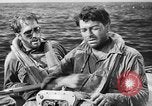
Different communication equipment used by units of the United States Army Signal Corps.
Communication means and equipment maintained and used by the U.S. Army Signal Corps during World War 2. Soldiers in a life boat use a hand cranked radio and an aircraft comes to rescue them. They wave at the aircraft. View of machines used for processing and printing V-Mail letters that are typed by machines and then delivered to soldiers. View of a soldier opening a small V-mail envelope and reading the note inside. Men and women work at various jobs in America in support of war production and war materiel. Men and women war production workers assembling various pieces of electronic equipment and radio devices. Men and women in large, busy clerical and administrative offices supporting typing and communications for the U.S. Army and military. Engineers work in a laboratory. A man loads a tube into a pneumatic message delivery system. Close up views of woman's hands on typewriter typing telegrams, letters, and messages. Women file clerks sort files. Technicians work on a telegraph machine. U.S. Army soldiers on a pole stringing communication wires. A soldier ties a wire on a tree. (World War II period).
CRITICALPAST.COM: About Us | Contact Us | FAQs - How to Order | License Agreement | My Account | My Lightboxes | Shopping Cart | Advanced Search | Featured Collections | Website Terms & Conditions | Privacy Policy ©2026 CriticalPast LLC.
License Agreement |
Terms & Conditions |
Privacy Policy
©2026 CriticalPast LLC.