


 Francais
 Deutsch
 Italiano

Refine Your Search
United States 1982 stock footage and images
- Showing 1717 to 1722 of 34981 results more
 Hide
Color Sound
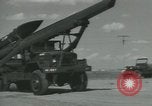
The U.S. Army conducts a number of test firings of tactical missiles for use in the field by Army troops
The U.S. Army test launches missiles in the United States. An Army Honest John missile is moved on its transporter launcher into position near some trees at an Army testing site. An army crew uses controls built into the launcher to raise it into a 45-degree launch angle. Closeup of soldier counting down to launch time and then signalling with his arm. Two hands are seen pushing down the plunger handle of an igniting control, and the missile launches in a burst of black smoke. It explodes in the distance raising a small mushroom cloud from its tactical nuclear warhead. A Little John, replacement is launched and disappears in distance. Next, an MGM-18 Lacrosse missile is seen on launch pad and then fired, leaving a trail of white smoke. View of it crashing onto the ground without any explosion.
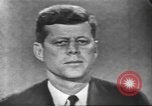
Kennedy and Nixon talk about racial prejudice in the presidential campaign during a presidential election debate in the U.S.
The third Kennedy-Nixon Presidential Debate in the United States. Roscoe Drummond of New York Herald Tribune asks Democratic candidate Senator John F Kennedy to comment on the purpose of the secret domestic militant organization Ku Klux Klan (KKK) in the presidential campaigns. Kennedy answers that the head of the Ku Klux Klan in a statement stated that he would vote for Nixon and not him. Kennedy states that he has never suggested that Nixon has slightest sympathy and involvement with the Ku Klux Klan. Republican candidate U.S. Vice President Richard M Nixon states that it is the Americans who will choose the President. He states that elections are not any test of religion, race but test of a man. He states that Communism is the enemy of all religions and he opposes the Klan organization. He concludes, early in the civil rights movement, that if civilians believe in America they cannot have religious or racial prejudice in the presidential campaign.
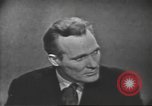
John F Kennedy and Richard Nixon comment on need for labor laws during a presidential election debate in the U.S.
The third Kennedy-Nixon Presidential Debate in the United States. Frank McGee from NBC News asks Republican candidate U.S. Vice President Richard M Nixon to comment on the need and purpose of new laws to protect the public against labor unions' power. Nixon talks about his speech on this topic. He disagrees with Kennedy's statement favoring compulsory arbitration as a President's weapon to stop national emergency strike. He states that in Steelworkers Union speech Kennedy had indicated government seizure as the best way to stop a strike. Nixon states that he does not believe in either compulsory arbitration nor seizure. He says that the management should be involved in dispute settlement. He concludes and urges the need for the greatest cooperation possible between labor and management. Democratic candidate Senator John F Kennedy states that he has never suggested compulsory arbitration as the solution of national emergency disputes. He talks about seizure. He states about president's course and setting up of a fact-finding committee.

Prior to U.S. Presidential Election of 1968, Nixon recounts his past and tells what he wanted to become when he was a child.
Self-portrait of Republican nominee Richard Nixon aired during his 1968 presidential run against Hubert Humphrey and George Wallace in the United States. An interviewer asks Richard Nixon what he felt like when he was a boy. Childhood pictures of Richard Nixon. Nixon says he never thought of becoming the President of the United States and wanted to become a railroad engineer. He recounts his past and speaks how he got interested in law and politics.
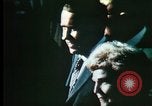
Republican nominee Richard Nixon express his views about the presidential race before U.S. Presidential Election of 1968.
Self-portrait of Richard Nixon aired during his 1968 presidential run against Hubert Humphrey and George Wallace in the United States. An interviewer asks Richard Nixon what did he think when he made a decision to run for the President of the United States in 1968. A picture showing Richard Nixon and his wife Pat Nixon. The interviewer asks if he felt any strain on the family. Nixon says he thought of his family first. A picture showing his wife Pat Nixon and daughters Julie Nixon and Tricia Nixon. Nixon calls this presidency more of a challenge in terms of America being involved in the Vietnam War and in the Cold War with the Soviet Union. A photograph shows Richard Nixon with his wife Pat Nixon, daughters Julie and Tricia and Julie's husband David Eisenhower at a beach. He says that present time is different from World Wars I and II because now America is a great power and there should be a best possible leader to lead the nation. Nixon states that America needs a kind of leadership that would obtain peace and avoid war and surrender. A picture of Mr. and Mrs. Richard Nixon.
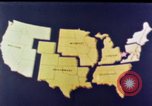
The process of tax return processing with aid of early computers at Internal Revenue Service Centers in the United States.
A film discussing automatic data processing in tax administration at U.S. Internal Revenue Service National Computer Center. Workers process the income tax returns and make use of ADP (Automatic Data Processing) machines or computers at computer service centers in the United States. The workers sort tax return papers, open packets and empty mail bags filled with tax return documents. A chart depicts the whole process of income tax return processing. Computer data tapes are stored at service centers. Examiners check essential preliminaries on tax return form like signatures, dates, address, and social security number. Information is then sent to punch cards. Female workers at equipment. It is explained how error is checked and Good Tape, Error Tape, and Error Register machines are shown. An error register equipment gives details of problems causes during the tax processing which is handled by Error Resolution Branch. Letters listing the problems encountered in processing tax information are sent to tax payer if necessary from service division. Return file is maintained. Functions of the service station involves sending of notices sent to tax papers which includes notice for due balance and notice of error. A settlement register is examined by trained personnel. Workers at various equipment in service station. It is further explained how a tax payer can avoid errors by shows the essential entries on W-2 form. Various entries including social security number are highlighted.
CRITICALPAST.COM: About Us | Contact Us | FAQs - How to Order | License Agreement | My Account | My Lightboxes | Shopping Cart | Advanced Search | Featured Collections | Website Terms & Conditions | Privacy Policy ©2026 CriticalPast LLC.
License Agreement |
Terms & Conditions |
Privacy Policy
©2026 CriticalPast LLC.