


 Francais
 Deutsch
 Italiano
Refine Your Search
United States 1982 stock footage and images
- Showing 20605 to 20610 of 26493 results more
more Hide
Hide
German invasion of France,sinking of RMS Lusitania and resignation of William Jennings Bryan
Events during World War I. Sketches : workers in a German arms factory. German soldiers advance towards France. Animation of a map shows the German invasion of France through Belgium. Kaiser Wilhelm II, the German Emperor. Buildings damaged by invading Germans. U.S. president Thomas Woodrow Wilson advises Americans to stay calm. American people read papers. Cartoon depicts the President about his domestic reforms. The German atrocities in Belgium. Man holds a dead person. Sketch depicts Germany crushing everything on its way. The apprehensive people of America. Sketches of American man against a German leader. Trucks and taxi cabs on the Orne river. A gun barrel. Bombs being dropped on the German ships. Worker at a factory in America. Sketch of a man standing beside a flag having the dollar sign shows the prosperous America. Sketch shows the various resources required by the American industries. An American ship carrying war materiel. Sailors in German submarines. German submarines target allied ships. Sketches of U.S. president Wilson warning Germany. On 1st May 1915 RMS Lusitania a British luxury ship at sea as it starts from New York. Paper shows a warning by the German government. A German sailor on board a submarine as it targets a ship. The RMS Lusitania ship sinks killing many, including Americans. The U.S. secretary of State William Jennings Bryan and Thomas Woodrow Wilson with other officials. The former U.S. president Theodore Roosevelt addresses people opposing President Wilson's policy. The President prepares a note for Germany. Sketch of U.S. Democratic Presidential candidate William Jennings Bryan during his resignation. Sketch of Kaiser Wilhelm II.
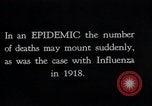
A graph shows a sudden increase in the deaths in New York City due to 1918 influenza pandemic and other diseases.
A graph shows a sudden increase in the deaths due to influenza in New York City during the 1918 Spanish flu epidemic. Spike in the graph is shown for the 1918 influenza outbreak. Slide states "A steady decline of the death rate is shown by communities in which an intelligent public uses the results of scientific knowledge." A strata chart shows the deaths per one thousand people during the period from each of pneumonias, tuberculosis, and cerebro-spinal meningitis, and then deaths from the diseases summed. A chart at the end reads, "What sciences hope to do" and then it reads "Reduce all transmissible diseases to 0 - With the cooperation of an intelligent public."
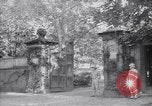
Front of Dumbarton Oaks in Georgetown U.S.
Front gate of Dumbarton Oaks with a car driving inside. A plaque outside inscribed with "Dumbarton Oaks" is there. Front of the building where men with military police walking inside. Exterior of Executive Office Building of State Department. September 1944.

Cops curb rioters in Dublin after Eamon de Valera wins election.
Post election condition during 1932 in Dublin, Irish free State. A huge gathering outside a government building in Ireland. Eamon de-Valera is seen. William T. Cosgrave with another official comes out of the building. Police work through crowd in a line and control rioters and agitators.
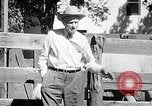
Farmers explain how they suffered the drought and dust bowl storms in Dalhart, Texas, during 1934.
Farmers of Dalhart, Texas describe the terrible sand storms they suffered in the region during 1930s. In 1960 interview, farmer Harold Hogue describes a severe dust storm he experienced in 1934. Scene change to mid 1930s footage showing dust bowl views of desolated farms, drought stricken lands and houses and farm equipment all piled high and buried in dust and dirt. A 1960s' farmer on his tractor describes how the dust storms destroyed his wheat crops and left sand and dust on everything. He states that they experienced 110 dust storms in the Spring of 1934.
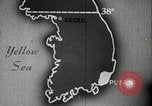
UN landings at Inchon and reoccupation of the capital, Seoul, by UN forces during the first year of the Korean war.
Animated map shows South Korea, from 38th parallel, South, and highlights Pusan, and the advances being made by UN forces after being reinforced. Next, the UN amphibious landings at Inchon (or Incheon) are shown on the map. Flashes of naval gunfire are seen in the blackness of night. Next, a Landing Craft Tank (Rocket), LCT(R), is seen firing barrages of rockets toward shore, at Inchon. On September 15, 1950, U.S. troops are seen landing at Incheon, from boats of the attack transport ship, USS Noble (APA-218). Return to the animated map shows advance of UN forces from Inchon joining with those advancing from Pusan, until they occupy most of the area south of the 38th parallel. UN infantry are seen engaged in urban combat in the city of Seoul, accompanied by M26 Pershing tanks and M46 Patton tanks. Building burning in the city. UN soldiers firing rifles inside damaged building. American soldiers, under fire, carrying wounded on litter. Medical corpsmen tending to casualties, including wounded Korean civilians. Republic of Korea (ROK) infantry following four of their soldiers carrying their flag, stretched out horizonally, between them. (Narrator states they are carrying it back to the liberated capital of Seoul.) ROK troops escorting large number of prisoners of war, marching with hands on heads. UN forces distributing rice and clothing to the Korean inhabitants of Seoul. Soldiers helping little Korean children don clothing. Bodies of men, women, and children who were slain by retreating enemy troops, are laid out on the ground, attended by Grieving relatives. Large quantities of captured North Korean weapons are piled up, including those made in the Soviet Union.
CRITICALPAST.COM: About Us | Contact Us | FAQs - How to Order | License Agreement | My Account | My Lightboxes | Shopping Cart | Advanced Search | Featured Collections | Website Terms & Conditions | Privacy Policy ©2026 CriticalPast LLC.
License Agreement |
Terms & Conditions |
Privacy Policy
©2026 CriticalPast LLC.