


 Francais
 Deutsch
 Italiano
Refine Your Search
United States 1982 stock footage and images
- Showing 20971 to 20976 of 26493 results more
more Hide
Hide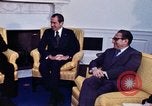
President Nixon with Arab leaders and Dr. Kissinger in the Oval Office of the White House in Washington DC.
U.S. President Richard Nixon in the Oval Office of the White House in Washington DC. The President converses with U.S. Secretary of State Henry Alfred Kissinger and Arab leaders in the Oval Office.
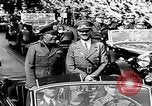
Twentieth Century scenes spanning German annexation of Austria; Italy-Ethiopia conflict; Korean War; and Vietnam War.
Adolf Hitler and Benito Mussolini standing together in an open car during a motorcade in Munich, in 1938. Civilian spectators render Nazi salutes as they pass. Next, British Prime Minister, Neville Chamberlain, arriving for the Munich treaty conference, steps from a British Airways Lockheed Model 14 passenger plane. An honor guard of helmeted and white-gloved German soldiers stands at attention during his welcome. Adolf Hitler climbs stairs of Berghof together with Chamberlain and Hitler's interpretor, Paul Otto Schmidt, on September 15, 1938 for their conference. Crowds of Germans give Nazi salute and cheer as Hitler and Mussolini appear on a balcony. Prime Minister Chamberlain back from the conference, speaks to the crowd at Heston Aerodrome on 30 September 1938, saying, among other thing, "We regard the agreement signed last night, and the Anglo-German naval agreement as symbolic of the desires of our two peoples never to go to war with one another again." Damaged buildings and ruins of city. Mussolini giving an impassioned speech. Italian cavalry carrying out a charge in Ethiopia. Italian troops employing machine guns in the Second Italo-Ethiopian War circa 1936. Italian infantry charging across sand dunes. Ethiopian Emperor Haile Selassie at the League of Nations podium. Nazi Swastika eagle statue. A formation of German troops, during the Anschluss (German annexation of Austria,in 1938). Hitler at a podium. People rendering Nazi salute in annexed city. At this point, the film transitions to 1950 as North Korean troops cross the 39th parallel and start the Korean War. A nighttime artillery barrage. North Korean troops firing a Browning M1917 machine gun and rifles. The feet of American soldiers are jumping out of foxholes as U.S.M26 Pershing tanks fire their guns from tilted positions below hills. A Pershing tank crosses a bridge back into South Korea, where a sign reads:"You are now crossing the 38th parallel, Co.B 728 MP." Scene shifts again, to President Lyndon B. Johnson delivers speech about Vietnam at a news conference on July 28, 1965, in which he states,among other things, "Three times in my lifetime...Americans have gone to far lands to fight for freedom..." as he explains U.S. involvement in Vietnam and the Vietnam War.
Lord Mountabatten receives welcome and being greeted by naval officers at NAS in Anacostia, Washington D.C.
Arrival of Lord Mountbatten at Naval Air Station (NAS) at Anacostia, Washington D.C. Navy band on the field prior to the arrival of the Earl. Color guard (Marine) at attention. Naval honor guard at attention. British sedan parked on the edge of field. British MP stands. Plane director motions the plane to parking area. R4Y taxis to parking area. U.S. Navy Admiral Arleigh A. Burke, Rear Admiral Baker, stand by waiting for disembarkation of Admiral of the Fleet The Earl Mountbatten of Burma, KG, The First Sea Lord and Chief of Naval Staff of Great Britain, Lord Mountbatten and party. Ramp of plane being lowered. Lord Mountbatten leaves the ramp, stops momentarily by the side boys. He is greeted by Adm. Burke. He goes through the receiving line. Admiral Burke and two British Officers stand at attention during rendering of honors. Marine honor guard in front of operations at NAS. Naval honor guards. Lord Mountbatten speaks to Admiral Burke. He gets into the sedan. Admiral Burke and Rear Admiral Baker walk. Admiral Burke gets into a sedan. Personnel on top of operations platform looking on. Four star Admiral's flag. Long line of Naval personnel holding state flags.
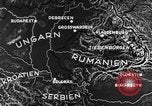
German Luftwaffe Ju-87 Stuka dive bombers attack Soviet tanks. German troops on the ground in Hungary during World War II
German Air Force engages Soviet ground forces in Hungary during World War 2. Opening scene shows map of Hungary, Croatia, Serbia, Romania. Next, in view from cockpit , a loose formation of German Ju-87 Stuka dive bombers is seen in flight. They bomb and strafe Soviet tanks on the ground. (Narrator states that German aircraft flew thousands of missions destroying more than three hundred Soviet tanks.) German soldiers are seen in trenches in Hungary. Next, are scenes of fires and of German soldiers near a burning Soviet tank.
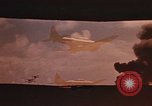
Aftermath of the Battle of Midway in World War II
Views of U.S. Navy pilots, their aircraft, and aftermath of Japanese bombing of Midway Island, in World War 2. Opening scene shows a formation of U.S. Navy Douglas Dauntless aircraft in flight. A U.S. Navy pilot climbs from the cockpit of an F4f Hellcat airplane on the deck of an aircraft carrier. His aircraft displays symbols for two Japanese aircraft downed. Another pilot in cockpit of his airplane that displays symbols for 7 downed Japanese aircraft. He climbs from his cockpit. Other pilots climbing out of their aircraft. One displays symbols for 6 kills. Three of them pose in front of an airplane. Scene shifts to Midway Island where a hangar is still burning from Japanese bombing. Glimpse of Gooney birds. Sentries stand on the airfield, with black smoke rising in the background. Closeup of wing from a downed Japanese airplane. Marines look through tangled pieces of crashed airplanes. One leans on a bent propeller blade. Heavy black smoke from petroleum fire is seen in background. Scene shifts to a PBY Catalina flying boat in flight, searching for survivors of the Battle of Midway. A U.S. Navy aircraft is seen floating in the sea, as a Navy warship heads toward it. A survivor is seen being helped from a PBY aircraft. Earlier picture of him smoking a cigarette inside the PBY aircraft. Sailors help him to a waiting ambulance. Other rescued survivors are seen standing about. Sailors place a litter aboard a PBY and use it to transport another survivor to sick bay. (Narrator states this is the 13th survivor rescued by the pilot of this PBY Catalina.) Ambulatory survivors being covered with blankets as they sit in the back of an ambulance, that then drives away with back door still open. Views of destroyed hospital on Midway Island. Red cross markings on are shown in the debris.
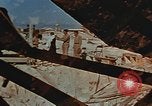
U.S. Navy and Marine personnel recover after the battle of Midway in World War II
Recovery actions by U.S. Navy and Marine personnel in the wake of the Battle of Midway in World War 2. Opening scene shows religiious services being held by a bomb crater that had once been a chapel on Midway Island. That evening, marines are assembled near flag-covered coffins of fallen comrades, in a burial ceremony. A marine chaplain conducts a funeral service, as Marines stand, with their rifles, at parade rest Several views from different perspectives of the event. An honor guard fires a volley with rifles. The American flag is at half staff, in the background. Among the officers seen is Marine Major James Roosevelt, son of the U.S. President, Franklin Roosevelt. Next, Navy boats are seen offshore, carrying the fallen for burial at sea. U.S. Navy aircraft fly in formation overhead. A marine scans the sky with binoculars as dense black smoke continues to billow from the petroleum facility bombed by the Japanese several days ago, and hangs like a pall over Midway Island. The American flag on a tall pole, is highlighted against the black smoke. Film ends with series of Slates summarizing Japanese losses in the Battle of Midway. The first shows 4 Japanese Carriers sunk. It is painted over by a brush containing red paint. Another slate announces 28 Japanese Battleships, Cruisers, Destroyers sunk or damaged. A paint brush places a large black cross over that slate. A final slate states 300 Japanese aircraft destroyed. The red paint brush appears again, but this time it marks a big “V” for Victory across the slate.
CRITICALPAST.COM: About Us | Contact Us | FAQs - How to Order | License Agreement | My Account | My Lightboxes | Shopping Cart | Advanced Search | Featured Collections | Website Terms & Conditions | Privacy Policy ©2026 CriticalPast LLC.
License Agreement |
Terms & Conditions |
Privacy Policy
©2026 CriticalPast LLC.