


 Francais
 Deutsch
 Italiano
Refine Your Search
United States 1982 stock footage and images
- Showing 2419 to 2424 of 26493 results more
more Hide
Hide
Harnessing of different forms of energy and utilization of manpower for the industrial development of the United States.
A documentary depicts events in the development of the United States and shows scenes of commerce, industry and natural resources. Shirtless men in khaki shorts (US Army?) practice calisthenics during an exercise drill. American men and women work in a factories and peace time industries post war, and laboratories (scene of a chemist with test tubes and beakers and burners). A man blowing glass. Harnessing of water, wind, solar and soil energy. Scenes of turbines, generators and motors to use energy. Men working in factories to increase production. Smoke comes out of stacks and chimneys. Iron ore processing and hot conditions. People work in different industries. Mass production in the U.S. Typewriters being assembled in a factory. Kitchen hand mixers on an assembly line at a manufacturing plant. Assembly line of automobile industry. 1940s era cars and trucks moving along assembly line in car manufacturing factory.
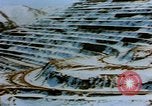
Many scenes of mining and processing of natural resources in the 1940s for industrial development in the United States.
Various scenes of industrial development in the United States with focus on industry and natural resources. View of terraced pits of a mine. Men on a scaffold in a stone quarry using picks to. Oil drilling operations with a field of oil derricks and a derrick in the foreground pumping oil from the oil field. Coal is fed into a large rotating drum machine. Bulldozer digging earth at a copper mine. Man using a power tool to shape granite. Many blocks of building stone. A mining worker pushes the handle to trigger a TNT explosion and a large amount of rock and dirt explodes outward at an iron ore mine. A black locomotive engine pulling full coal cars on a railroad beside the largest open pit mine in the world. A hear firing process at a factory for a very large dome of glass. Worker in a factory or plant melting aluminum. Molten copper is poured to be cast in molds. Rolled, drawn, and spun copper is produced. Logging operations are shown. Lumber jacks climb a giant tree and cut the top third off. It crashes to the ground. Two men use axes to cut a deep groove in a giant tree to fell it. The trees shown being harvested are Giant Sequoias or Giant Redwoods. A massive Giant Redwood tips and begins to fall as lumber jacks finish using axes to cut it to its tipping point. Men use a two man saw to cut a felled giant redwood into sections. Large logs of Redwood being rolled off a platform into water to be floated to a sawmill. Men in a lumber sawmill work with a giant saw as it cuts huge slabs of pine lumber. Stacks of finished lumber shown at a mill. A wooden home under construction using lumber. Pulp wood is shown, then a view of a man in a suit observing the loading or unloading of giant paper rolls at a ship harbor, with skyscrapers of the city skyline in the background. Printing press in operation as it applies color and ink to giant rolls of paper. Newspaper workers unload finished newspapers from a newspaper printing press and stack them. (World War II period).

After a grocery shopping trip to Denver a woman returns to her Colorado home via an aircraft in the United States.
A grocery shopping trip undertaken by a woman in the United States. Shadow of an aircraft on a tarmac. The aircraft in flight. It lands near an isolated house in Colorado. A woman gets off with a grocery bag after a shopping trip to Denver.

Missile components are loaded into a modified Stratocruiser aircraft in the United States.
A modified Stratocruiser aircraft in the United States. Two pieces of the aircraft. People gathered near the aircraft. Two people in one part as seen from the other part. The aircraft is a modification of a conventional Stratocruiser. Missile components are loaded into the aircraft. The two pieces of the aircraft are joined together. The aircraft becomes whole again.

During HUAC hearing in the United States, Herbert Biberman is questioned about his affiliation with the Communist Party
A hearing of the House Un-American Activities Committee (HUAC) in the United States, under Congressman J. Parnell Thomas (the "Thomas Committee") . People seated during the hearing. Hollywood director and screenwriter Herbert Biberman is questioned about his occupation in the Screen Writer's Guild and his affiliation with the Communist Party. Biberman begins his response and does not directly or quickly answer the question, which draws an angry, heated response from J. Parnell Thomas pounding a gavel, shouting from Congressman Thomas and from Robert Stripling, and demanding an answer. Biberman is subsequently asked, "are you or have you ever been a member of the Communist Party" and Biberman begins a response in which he decries the work of the committee and its negative effects on the Hollywood film industry. Biberman, one of the "Hollywood Ten," is dismissed from the stand.

A USAAF C-47 Skytrain aircraft lays communication wires over a difficult terrain in the United States (WW2)
A U.S. Army Air Forces C-47 Skytrain aircraft lays wires in the United States during World War II. Men work on an equipment as they prepare for aerial wire laying. A C-47 aircraft takes off. The aircraft in flight as it lays wires over a difficult terrain. A man speaks over a field phone after the communication wires have been laid.
CRITICALPAST.COM: About Us | Contact Us | FAQs - How to Order | License Agreement | My Account | My Lightboxes | Shopping Cart | Advanced Search | Featured Collections | Website Terms & Conditions | Privacy Policy ©2026 CriticalPast LLC.
License Agreement |
Terms & Conditions |
Privacy Policy
©2026 CriticalPast LLC.