


 Francais
 Deutsch
 Italiano

Refine Your Search
United States 1982 stock footage and images
- Showing 2425 to 2430 of 34981 results more
 Hide
Color Sound

German Chancellor Konrad Adenauer meeting with John Foster Dulles in the United States
Chancellor Konrad Adenauer of Germany arrives at a building in the United States with entourage in a Cadillac and two staff cars. Photographers take pictures. They come out of the car and enter a building. Adenauer is greeted by United States Secretary of State John Foster Dulles, and they shake hands. The officials converse with each other.

Demonstration of air rescue members rescuing victims in the United States.
Demonstration of an air rescue in the United States. A United States aircraft in flight. Rescue members look through binoculars from the aircraft. Victims being taken out from the aircraft. An official speaks over a phone in a control room. Airmen rush to a parked aircraft. The rescue aircraft taxis and takes off. Victims in a raft. The aircraft lands on water surface and rescue members take the victims inside the aircraft.
U.S. Navy and Marines conduct Amphibious Assault exercise.
As film begins, U.S. Marine paratroopers are seen jumping from an R4D (Douglas DC-3) transport aircraft. View of the airplane with Marines parachuting from its cargo door. (The aircraft has "QF"and number 17225 stenciled on its tail, and United states Marines on its fuselage.) A marine descending on opened parachute is seen from below. Narrator describes them as "Pathfinders," to establish landing zones. As they hit the ground, the parachuting marines quickly set up homing devices, electronic signals and markers to guide incoming helicopters. The amphibious assault carrier, USS Princeton (LPH-5) is seen underway at sea, with her deck full of marine helicopters. She is accompanied by a transport ship. Closeups of the carrier and helicopters, from low flying helicopter overhead (unseen). Scene shifts to pilots being briefed aboard the ship. Marines in battle dress on the carrier flight deck. They double-time and board their assigned Sikorsky H-34 helicopters. View from inside a helicopter as marines board it. View from helicopter flying above those on flight deck shows those below with their engines running. Deck crew directs launching of the choppers. The H-34s are followed by Sikorsky H-56 helicopters carrying heavy equipment. Several views of them flying near the ship. Formation of helicopters in flight en route to landing areas. Helicopters heading to the beach and landing in formation. Closeup of them landing and marines moving quickly to exit and take up their positions ashore. An artillery piece suspended from a helicopter, being lowered to the ground. A number of views of marines and equipment deploying from helicopters. Scene shifts to landing craft in formation approaching the beach. Explosion occurs on shore.

Advertisement for U.S. Marine Corps Reserves. Views of F9F-6 Cougar jet fighter
Advertisement for the U.S. Marine Corps Air Reserve. Traffic on a highway in the U.S. Among cars seen is a 1954 Studebaker . A civilian is escorted to a parked Marine F9F-6 Cougar aircraft parked on an airfield ramp.(In background, a woman stands next to a 1954 Lincoln Capri Hardtop convertible car.) The civilian examines the cockpit while narrator humorously compares the aircraft's features, such as air conditioning, to an automobile. A properly equipped Marine pilot climbs into the cockpit and prepares to fly the aircraft, while narrator encourages listeners to join the Marine Corps Reserves.
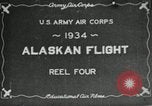
The U.S. Army Air Corps processes photo-mapping films covering 21,000 square miles, brought back by the 1934 Alaska Flight
Followup to the U.S. Army Air Corps 1934 Alaska Flight. The U.S. Army Air Corps Photographic department processes and assembles the 60 rolls of film shot by the USAAC 1934 Alaska Flight during its aerial photo-mapping mission over 21 thousand square miles of Alaska territory. Photographic workers mount film onto large rolls and place them into developing solutions. Long strips of film are seen drying on rotating slatted drums.Oblique negatives placed in rectifying printer are transformed into vertical photographs. Workers develop the negatives. Developed single wing photographs. Composite five lens photographs ready for mapping.

The film 'March on Marines' shows views pertaining to the U.S. Marine Corps from 1775 to the 20th century.
Film opens referring to U.S. Marines in 1775. In a reenactment men carrying the "Don't Tread on Me" flag march to resist the British. Next, they are seen in a battle at sea. Scene shifts to 20th Century, where Marines are seen marching in a parade in an American city. Scene shifts again, to a ship at a dock with U.S. Marines disembarking. Closeup of some in class A and dress uniforms carrying duffel bags. They sing as they move from the ship to the dock and then march along a pier, past sailors aboard a lightly armed ship.. (World War II period).
CRITICALPAST.COM: About Us | Contact Us | FAQs - How to Order | License Agreement | My Account | My Lightboxes | Shopping Cart | Advanced Search | Featured Collections | Website Terms & Conditions | Privacy Policy ©2026 CriticalPast LLC.
License Agreement |
Terms & Conditions |
Privacy Policy
©2026 CriticalPast LLC.