


 Francais
 Deutsch
 Italiano

Refine Your Search
United States 1982 stock footage and images
- Showing 2545 to 2550 of 34981 results more
 Hide
Color Sound

People leave their homes with their belongings and head towards the west in the United States to escape Dust Bowl conditions.
People leave their homes in the Great Plains, United States. A tower and damaged houses in the Great Plains due to dust storm "dust bowl" conditions during the Great Depression. A girl walks near a house. People leave their homes with their belongings, loading them into a trailer towed by their car. They migrate west. Views of deserts. Vehicles driven on a road. People live in tent communities during westward migration in the United States. Vehicles arrive near a tent. Men sitting idle. Women unload carts. Two men seated outside the tent. Farm machinery and equipment on the ground. Useless farms and barren trees in the plains.
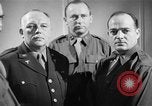
World War 2 Combat Exhaustion patients undergo personality tests, receive sleep therapy and various treatment in the U.S.
Treatment for combat exhaustion cases among U.S. soldiers following combat in World War II. U.S. officers talk about operation plan of a hospital and speak about three sections including admission, treatment and rehabilitation. A patient undergoes a physical examination. A dental survey and necessary laboratory studies. Doctors seated at table to perform an intelligence tests and mental examination. Psychiatric and other personality tests and intelligence test are administered including Rorschach test and Kohs block design test. The doctors check the psychiatric and physical report of the patient by looking at an X-ray. Patients receive sleep therapy: A nurse and an army doctor give narcosis therapy (continuous sleep treatment), by administering barbituates that keep a patient asleep for 18-20 hours per day for several days. Insulin is used on "loss of weight" cases: Combat exhausted soldiers lying on beds and receiving insulin before breakfast by nurses to stimulate their appetite. A nurse checks the weight of a patient during treatment. A nurse checks the diet which will be given to the patients in a kitchen. A patient receives an electric shock therapy treatment. A doctor injects a medicine into a patient. The patients go through physical exercises to maintain physical fitness. The patients are reeducated to know the causes of diseases. (Note: Clips deals with treatment for Combat Exhaustion, also later termed Post-traumatic Stress Disorder or PTSD.)

Rescue operation steps followed by the crew of a submarine as it sinks in the united States.
A U.S. Navy training film "Submarine Escape" depicts rescue precautions in emergency for men if a submarine sinks. A sunken submarine in the United States. Operation officers check an operation board that the reporting time of the submarine has passed out. A man makes a radio call to the submarine but it does not answer. A squadron officer leaves the office of communication and contacts with an officer of Ships and Shore Station for aid. Two aircraft and an airship in flight to find the submarine and to rescue its crewmen. A ship at sea. Two methods of rescue to be followed in emergency: individual (S.E.A.) and collective (Rescue Chamber). Crewmen in the submarine as it goes down. They smoke. A man on a phone receives no answer. A man checks condition. Two men stand near a compartment. Floating debris in the sea. Men in a forward compartment to talk over the problems that the ship is encountering. Important steps to be followed in an emergency written on a board. Men follow the steps. A man gives a pack of absorbent powder. A man spreads a mattress cover on a lower bunk. He puts on rubber gloves. He pours the powder and spreads it in thin layer. Instructions are read by a man. Emergency drinking water, fruit juices and oxygen for safety. The man waits. Men rest. The men prepare for escape collectively. They wear the rescue gear. Men prepare for escape individually. A man wearing a rescue gear signals by gesturing. The men work with rescue gear and equipment.

Coast Guard saves rescues passengers of SS Manhattan as the ship gets stuck on a reef off Florida in the United States.
The ocean liner SS Manhattan (later USS Wakefield) runs aground off West Palm Beach in Florida, United States. Scenes from January 12,1941: People at a beach. USS Wakefield (Manhattan) in the background. During her third voyage to California the ship runs aground off West Palm Beach, Florida. A sign on the ship: 'Manhattan United States Lines'. Coast Guard personnel save the passengers of the ship.
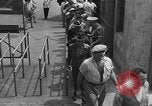
MPs inspect workers and monitor loading of cargo at a U.S. port during World War II
Activities of the U.S. Army Military Police in the United States during World War 2. Workers walk in lines and are being checked by Military Police (MPs) as they enter a port. An MP monitors loading of cargo at the port. An MP standing and traffic in the background.

Examples of U.S. Army Military Police assisting civilians during disasters
Activities of the U.S. Army Military Police in the United States during various disasters. Firefighters at a major conflagration. MPs in a military ambulance flying a red cross flag, rushing toward the site. Smoke seen rising in the background. A sign on a building: 'US Army Disaster Relief Headquarters'. An MP stands at the entrance and directs people seeking help. Scenes from the 1951 Kansas River Flood, with low aerial view of the Frisco (St. Louis–San Francisco) Railway 19th Street Yards, Kansas City, Missouri, during the Great Flood of 1951. Flood waters in the industrial area, cutting off trains and covering factories. A residential area inundated by flood waters. Military Police and local police in a boat patrolling the flooded area. Military Police in an amphibious jeep evacuating a boy and his dog from the flooded area. MPs with the boy and his dog driving out of the flooded area.
CRITICALPAST.COM: About Us | Contact Us | FAQs - How to Order | License Agreement | My Account | My Lightboxes | Shopping Cart | Advanced Search | Featured Collections | Website Terms & Conditions | Privacy Policy ©2026 CriticalPast LLC.
License Agreement |
Terms & Conditions |
Privacy Policy
©2026 CriticalPast LLC.