


 Francais
 Deutsch
 Italiano

Refine Your Search
United States 1982 stock footage and images
- Showing 3451 to 3456 of 34982 results more
 Hide
Color Sound
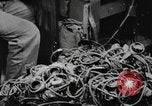
Reclamation and cannibalization of communications equipment in the United States.
Salvage and reclamation activities in the United States during World War II. Damaged communication equipment are reclaimed. Switch boards, radio receivers and transmitters, walkie-talkies, microphones and other equipment are repaired. Men working on the reclamation of these equipment. The equipment are cannibalized. Women working on parts of the equipment.

U.S. Secretary of War Henry Lewis Stimson seated at a desk in his office in Washington, DC (WW2)
U.S. Secretary of War Henry Lewis Stimson in his office in Washington during World War II. Stimson seated at his desk. He holds a document.

In the United States military analysts- Baldwin, Schubert and MacKenzie discuss about the Allied invasion of Europe.
A film titled: 'Invasion' shows a man seated at a desk in the United States. Three military analysts - Hansom Baldwin, Schubert and MacKenzie are seated at the desk along with the man. The man asks them questions about the Allied invasion of Europe. They explain their theories on the best way to invade Europe. Their explanations are followed by animation of the invasion moves. Baldwin states that bombing strategies of the Allies can prove to be a major factor in the decline of German Chancellor Adolf Hitler. Animated map shows air raids on German positions. A discussion about the best invasion route is carried out. (World War II period).
Replica of a fortified town in Germany and visual aids being used during a training of soldiers in the United States.
A film titled: 'The Sergeant Shows em How' on training of U.S. soldiers during World War 2. Tents being erected on the ground. Soldiers washing their faces. A soldier wipes with face with a cloth. Soldiers washing their mess kits after a meal. A replica of a fortified town in Germany is built at the camp. View of artificial houses along street sides. Soldiers construct buildings. Target boards in a trench. Nazi German flags flying on flag poles on the buildings of the trainin camp. Soldiers discussing amongst themselves. Men working inside a building. Several visual aids being used for the training purposes. Opened equipment is wrapped in plexiglass so men can examine the pieces during training to understand how the equipment works. Soldiers explaining about various war equipment and ammunition.

Animation depicts the supply of guns and ammunition after being produced in a factory in the U.S. to a battlefield.
A film on problems of military supply. Animation shows a shell being fired at a target board. Production of shells and guns in a factory in the United States. They are loaded in a train and the train moving on a railway track. Then they are carried by ships. They are loaded in an airplane and the airplane in flight overhead. They are then carried by trucks and finally by mules to a battlefield. The soldiers then are able to use the ammunition. (World War II period).

Physical examination and tests of men before their recruitment in the army in the United States.
A training film titled: 'Introduction to the army' depicts induction and training of soldiers in the army. Exterior of a house in the United States. A man named Harold Leonard Davis working in the garden of the house. A postman gives him a mail. The mail is for Davis from the President's office to report for pre induction physical examination. He rushes to his friend's house who is in the army. He knocks at the door. His friend's mother opens the door. He goes inside and wakes up his friend. He talks about the induction. Davis and his friend have breakfast and his friend talks about his induction. Men lined up outside an armed forces induction station. They enter the building. They take off their clothes and a man place the clothes in racks. A doctor conducting physical check up of the men. Their teeth, eyes, ears and nose are examined. Their blood test is conducted. A psychiatrist talking to a man. Officers interviewing the man. (World War II period).
CRITICALPAST.COM: About Us | Contact Us | FAQs - How to Order | License Agreement | My Account | My Lightboxes | Shopping Cart | Advanced Search | Featured Collections | Website Terms & Conditions | Privacy Policy ©2026 CriticalPast LLC.
License Agreement |
Terms & Conditions |
Privacy Policy
©2026 CriticalPast LLC.