


 Francais
 Deutsch
 Italiano

Refine Your Search
United States 1982 stock footage and images
- Showing 43 to 48 of 34981 results more
 Hide
Color Sound

The U.S. Army wins the football game for charity against the U.S. Navy in New York, United States
Football game for charity in New York, United States. U.S. Navy midshipmen march on the football field. Spectators in the stadium. The U.S. Army troops march. A horse representing U.S. Army and a goat mascot of the U.S. Navy team on the field. Aerial view of the U.S. Navy attendees gathering. Players of the two teams on the field during the game. Aerial view of the spectators watching the game. The U.S. Army wins the match by 6-0.

United States Army Cadets at United States Military Academy at West Point in New York, United States.
United States Military Academy at West Point in New York, United States. Artillery on a mounted area with buildings in background and view out over the Hudson River. United States Army cadets stand in line with rifles in their hands.
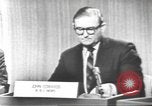
U.S. Vice President Nixon speaks about U.S. foreign policy towards Latin America prior to the presidential elections in the U.S.
The fourth presidential election debate held between Democratic nominee Senator John F. Kennedy and Republican nominee U.S. Vice President Richard Nixon in New York, United States on 21st October 1960. News correspondent John Edwards asks Senator Kennedy if he can give the names of three or four Americans whom he can appoint as the Secretary of State. Senator Kennedy replies to the question and says that this decision can only be made by the president and not presidential candidates. He says that he has made no judgment about who should be the Secretary of State. News correspondent Quincy Howe asks Richard Nixon to comment. Nixon says that it would be the responsibility of the next president to appoint the Secretary of State. Vice President Nixon speaks about a previous comment made by Senator Kennedy regarding Fidel Castro's regime. He says that President Eisenhower's administration appropriated five times as much for Latin America as was appropriated by the previous administration. He speaks that Democratic Congress has cut eighty million dollars off of the Voice of America appropriations to Latin America.
Peacetime activities and contributions by the U.S. Army in the United States.
Scenes from Army Day on April 6, 1934. Secretary of War George Henry Dern, in broadcast to the nation about importance of the Army, in peacetime. Brief glimpses of the Yellowstone River lower falls and Old Faithful and Beehive geysers erupting in Yellowstone Park, Wyoming. View amongst log buildings in Reproduction of Army Fort Dearborn, at the 1933 Century of Progress Exposition in Chicago, Illinois. A pioneer wagon; Native American Indians in ceremonial regalia; antique locomotives and trains at the Exposition. Army General Leonard Wood being sworn in as the Governor General of the Philippines. Closeup of General of the Armies, John J. Pershing, America's highest ranking Military officer. Headquarters of Walter Reed Army hospital, in Washington, DC, named for U.S. Army Major Walter Reed, who confirmed that yellow fever is transmitted by mosquito. Acting on this, the U.S. was able to complete the Panama Canal. View of French dredging equipment sitting idle in the water after Yellow Fever prevented them from completing the Panama Canal. Closeup of U.S. Army General William C. Gorgas, who, in 1904, headed the Sanitary Department that controlled mosquitoes and eradicated Yellow Fever, so the Panama Canal could be finished. View of alligator in swamp near the Panama Canal. Photograph of George Washington Goethals, Chief Engineer credited with making the canal happen. Explosives employed in Panama Canal construction. Earth and rocks being loaded into open rail cars. A steamship transiting the Panama Canal. The Washington Monument; U.S. Library of Congress; and the Lincoln Memorial, cited as examples of accomplishments by U.S. Army engineers. The Wilson Dam, under construction by Army engineers, in Muscle Shoals, Alabama and system of levees being built to control the Mississippi River. The raging Mississippi River during 1927 flood. Flood victims being assisted by U.S. Army soldiers, at a tent camp, receiving food and clothing. An Army airplane flying over a forest fire. Army personnel supervising men in the Civilian Conservation Corps or CCC. Mail being loaded aboard an Army airplane, as airmail service is being opened between Washington DC and New York City. President Woodrow Wilson talking with Army pilot Major Reuben H. Fleet. Mail being loaded into the nose of an airplane. U.S. Army Douglas World Cruiser airplanes in flight, returning from their trip around the world in 1924. A pilot sitting in front seat of a Douglas O-38 airplane, pulls a fabric hood over his cockpit to practice "blind flying". View of the aircraft in flight, with instructor pilot in the open rear cockpit. Army aviators taking a camera and a rifle aboard their airplane as they prepare to leave on an aerial mapping flight. Aerial view of skyscrapers of Manhattan Island, New York City. Army Signal Corps personnel working on communications devices. A cable ship operating at sea, laying cable in support of the U.S. Army's Alaskan cable and telegraph system. Men loading chemicals into hoppers on Army crop dusting airplane. Several views of Army airplanes crop dusting. Glimpse of boll weevil, the target of their efforts. Closeup of Karl Connell, who as a major in the AEF, in World War I, invented a superior gas mask known as the “Connell” or “Victory” mask. A group of miners wearing gas masks enter a smoky mine entrance. The Army invented tear gas, which is shown being used to thwart a bank robbery, in a staged demonstration. Brigadier General Hugh Johnson, appointed by President Franklin Roosevelt, as head of the Great Depression era National Recovery Administration, or NRA, is seen about to give a speech. Narrator cites him as an example of U.S. Army officers who also serve the country in civilian life. Scene shifts to cadets on parade at the United States Military Academy, West Point, New York.

U.S. Atlantic Command mobilizes to the Atlantic coast of the United States during the Cuban Missile Crisis of October, 1962.
Events held in the United States during the Cuban Missile Crisis of October, 1962 when the United States and the Soviet Union confronted each other with nuclear destruction. U.S. Army Strategic Army Corps (STRAC) is assigned to U.S. Forces, Atlantic Command. U.S. troops take part in various military exercises. A U.S. Air Force aircraft takes off from an airstrip. U.S. 1st Armored Division tanks rolling. The U.S. Army starts to mobilize. Troops travel by trains and jeeps.
Construction of U.S. B-25 Mitchell bomber aircraft in the United States to carry out combat operations during World War II.
Film titled 'Combat Report' depicts the construction of U.S. B-25 Mitchell bomber aircraft to attack German submarine during World War II. Exteriors of U.S. War Department building in Washington D.C., United States. U.S. Assistant Secretary of War for air Robert Lovett and Under Secretary of War Robert Patterson seated at desk. U.S. officer looks at combat report at his desk. View of a oil tanker hit by torpedo as it sinks in the Gulf of Mexico. View of crewman at controls and a tower. Combat report being typed. U.S. sailors type report at typewriters. Man speaks into radio. Navy officer instructs an officer. U.S. B-25 Mitchell bomber aircraft in flight over sea. Pilot and copilot at controls in B-25. The position of attack being radioed to a U.S. B-25 Mitchell bomber aircraft in flight over sea. Interior views of cockpit of B-25 bomber, and of Instrument panel of B-25. Engine of planes. Men in war production aircraft factory at work building and assembling aircraft during World War 2. Blast furnace in factory. The airplane engines being assembled, tested and installed in B-25.
CRITICALPAST.COM: About Us | Contact Us | FAQs - How to Order | License Agreement | My Account | My Lightboxes | Shopping Cart | Advanced Search | Featured Collections | Website Terms & Conditions | Privacy Policy ©2026 CriticalPast LLC.
License Agreement |
Terms & Conditions |
Privacy Policy
©2026 CriticalPast LLC.