


 Francais
 Deutsch
 Italiano
Refine Your Search
V2 stock footage and images
- Showing 6265 to 6270 of 9941 results more
more Hide
Hide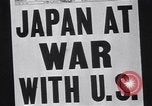
Various newspaper headlines announce war with Japan, guns mounted, airplanes parked in line during World War II.
Newspaper headlines announce U.S. declaration of war on Japan in World War 2, such as 'Japan at war with US'. Supplies moved along a conveyor belt to waiting ships. Arms buildup in the United States as the U.S. enters World War II. Stockpiles of new tanks, Army trucks, and fighter airplanes lined up as U.S. war production increases.
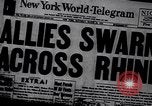
Newspaper headlines as Allies cross Rhine, dead concentration camp victims, German prisoners near end of World War II in Europe
Views of various newspaper headlines during world war 2. Headline announces that the Allies have crossed the Rhine River in Germany. View of U.S. Army soldiers in jeeps and trucks crossing a bridge over the Rhine. Point of view (POV) shot from inside open moving automobile crossing bridge. Dead Bodies of concentration camp victims in a camp following liberation by the Allies. German Army prisoners running in formation with their hands up, under guard by the Allies. Large group of Germany military prisoners in a queue. A young boy German soldier is seen crying. Nazi flag being burned: Flag with swastika mark of Nazis is on fire and seen burning.
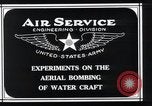
Brig Gen William Mitchell and Capt Moffet observe aerial bombing experiments on submarine U-117 and destroyer G-102.
Experiments on the aerial bombing of water crafts off Virginia Capes in the United States. C-Class airship (blimp) on mooring mast and in flight over the water. Bombing crews gathered in field for briefing. Mass takeoffs of SE-5A scout planes, a 2 seater DeHaviland-4B and Martin Bombers NBS-1. U.S. Navy battleship of the Atlantic Fleet watch the maneuvers. Bombing observation ships, the seaplane tender USS Shawmut and transport USS Henderson at sea. 4 ex-German vessels - The submarine U-117, destroyer G-102, cruiser Frankfort, and battleship of the First Class the Ostfriesland at sea. Brigadier General William Mitchell observes the bombing from a DH-4 while U.S. Navy's Captain Moffet observes from a USN NC-8. June 21, 1921: The bombing begins with starting shots on the U-117. Three 163lb HE bombs dropped on the submarine. The submarine half submerged and its debris on the surface after sinking. July 13, 1921: The destroyer G-102 bombed by an Army aircraft. Smoke from the explosions.
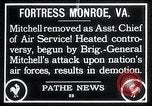
Aerial bomb tests and antiaircraft firing tests at Fort Monroe, Virginia, testing ideas of Brigadier General Billy Mitchell
Brigadier General Billy Mitchell smiling, standing in field, wearing an overcoat. Glimpse of aviator in helmet and goggles, behind him. Members of Congressional Committee and U.S. Army and Navy officers in field to observe tests of antiaircraft fire efficacy. Martin MB2 biwing bomber parked in field behind them. Army officers, stand in front of a biwing bomber, holding ends of "sleeve target" to be used in gunfire test. Airborne scene of sleeve target being towed by airplane. Aerial bomb tests lead by General Mitchell. General with other officials. Army artillery batteries firing at the sleeve target. View of sleeve target. Battery of Army machine gunners firing at sleeve target. General Billy Mitchell with another officer, examining the sleeve target after the test, and smiling because only one bullet penetrated it. General Mitchell and another officer inspecting bombs to be used for demonstration. Dive bombers attack target of battleship outlined on the ground. Bombs bursting on target. Views aboard bombers, showing bombs falling from the aircraft and hitting targets below.
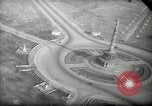
The ruined Reichstag and other buildings seen in aerial views of Berlin, Germany.
Aerial view of Berlin two years after World War 2. Aerial view of the Siegessäule (Großer Stern, 10557 Berlin, Germany) and the Großer Stern in the Großer Tiergarten. View of the ruins of the Kaiser Wilhelm Memorial Church (Kaiser-Wilhelm-Gedächtniskirche Breitscheidplatz, 10789 Berlin, Germany) and the Budapester Strasse in the Tiergarten district of Berlin. Aerial view of the Potsdamer Platz, the Reich Chancellery (Reichskanzlei Wilhelmstraße 77 Berlin, Germany), and the Reichstag building (Platz der Republik 1, 11011 Berlin, Germany), showing further damage caused by bombing. Aerial view of bomb damaged Zoo Flak G-tower bunker at Tiergarten. Aerial view of Mitte district, showing the Ministry of Aviation building (now known as the Detlev-Rohwedder-Haus Wilhelmstraße 97, 10117 Berlin, Germany).
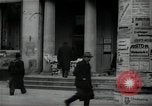
People at news stand in Kurfurstendamm in Berlin, Germany.
People buying from a newsstand in Kurfurstendamm, in the British Occupied Zone of West Berlin after World War 2. The building where the newsstand is located shows damage sustained from bombings. An advertising column (“Litfaßsäule” in German) stands in front of the building. People buy newspapers from the newspaper stand.
CRITICALPAST.COM: About Us | Contact Us | FAQs - How to Order | License Agreement | My Account | My Lightboxes | Shopping Cart | Advanced Search | Featured Collections | Website Terms & Conditions | Privacy Policy ©2026 CriticalPast LLC.
License Agreement |
Terms & Conditions |
Privacy Policy
©2026 CriticalPast LLC.