


 Francais
 Deutsch
 Italiano
Refine Your Search
V2 stock footage and images
- Showing 6439 to 6444 of 9941 results more
more Hide
Hide
Depth charge explosion at sea and smoke columns rise at a beach during invasion of Saipan, Mariana Islands.
Smoke columns rise at a beach during U.S. invasion of Saipan, Mariana Islands, during World War 2. Depth charge explosion at sea. U.S. Navy ships in the area.
Bombardment at Satawan Atoll during invasion of Saipan, Mariana Islands in World War II.
View of sunrise during invasion of Saipan, Mariana Islands in World War 2.. Satawan Atoll under bombardment. Ships off the coast of Saipan including a New Mexico class battleship.
U.S. warships shell shoreline during battle of Guam, in World War II.
Views from a U.S. warship shelling shoreline, near Agana, Guam, in preparation for amphibious assault, during World War 2. Smoke rising from shoreline as shells strike. Tracers visible from the camera ship and smoke rising from her guns as she fires. The USS Minneapolis (CA-36) seen close to shore. Smoke rising from naval gunfire, as shells burst at shoreline. A U.S. airplane flies low over shoreline, laying a smoke screen. Heavy barrages from U.S. warships raise heavy smoke as shells strike. Scene shifts to aboard the USS Minneapolis, where her forward triple turrets are seen pointed to starboard towards Guam, as she fires her 8"/55 caliber guns. Sky is filled with heavy black smoke rising from a point on shoreline.
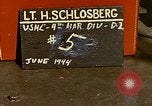
Landing boat comes into shore; faces of U.S. Marines during invasion of Saipan, Mariana Islands in World War II.
Landing boat comes into shore with supplies during invasion of Saipan, Mariana Islands. Faces of U.S. Marines, including some African American soldiers. A Marine pushes an oil drum in the water. Men on top of military vehicles as they leave beach area. World War 2.

Story of "Black Cat" -- PBY Catalinas used as night bombers against Japanese convoys in World War II
Convoy of Japanese supply ships in the Southwest Pacific during World War 2. Mysteriously, two explode. One sinks and one is left burning. Narrator describes similar losses of Japanese cargo vessels and Japanese reports attributing the losses to new superior American aircraft. View of Japanese Military High Command buildings in Tokyo, Japan. An Imperial Japanese Navy Night Fighter (QHAFMFA6) seen taking off. Japanese admiral boards warship to plan Imperial Navy strategy and tactics. Attacking aircraft is shown as a U.S. Navy PBY Catalina Flying Boat. Several views of Catalina flying boats in flight, painted black for night flying (called "Black Cats"). Aerial view of islands with small harbors where a PBY can hide during daylight. Base personnel gather at a catalina base awaiting an overdue returning PBY. She appears and buzzes base to announce successful mission. The PBY then lands in nearby harbor, taxis toward shore and is met by sailors in boats who attach a tow line to winch the PBY ashore, tail first. Squadron Commander meets the plane as the crew disembarks. Commodore Thomas S. Combs, Commander Aircraft 7th Fleet, arrives by jeep with Group Commander, Captain Peck. Crew gives quick accounting of mission. Corpsmen take wounded combat cameraman from the PBY on a stretcher. Tow pulls the PBY to area of ramp for servicing and repairs. Maintenance personnel note crew report of problems and begin corrective actions. They count 8 bullet holes in starboard wing.They find hole in fuselage from shrapnel that wounded the cameraman, and repair it. They repair a gas tank leak and refuel the PBY. View of 525lb and 1000lb bombs in Squadron dump. Armorers assemble belts of 50cal machine gun ammunition.They rearm the PBY with bombs under one wing and a torpedo under the other, and machine gun ammunition. They remove two black cats (animals) from inside the airplane. PBY crew plays water polo with a coconut. View of officer's quarters. Pilots prepare for next mission and go to intelligence briefing
Views inside a U.S. Navy PBY aircraft on Patrol during World War II
View of gunner inside a U.S. Navy Consolidated PBY Catalina aircraft on patrol in World War 2. He demonstrates firing his 50 caliber machine gun, rotating it through various angles. The wind from the open canopy blows his clothing. Change of scene shows bombs dropping from under a PBY. The sequence shifts again, back to the gunner at his station.
CRITICALPAST.COM: About Us | Contact Us | FAQs - How to Order | License Agreement | My Account | My Lightboxes | Shopping Cart | Advanced Search | Featured Collections | Website Terms & Conditions | Privacy Policy ©2026 CriticalPast LLC.
License Agreement |
Terms & Conditions |
Privacy Policy
©2026 CriticalPast LLC.