


 Francais
 Deutsch
 Italiano
Refine Your Search
V2 stock footage and images
- Showing 6499 to 6504 of 9941 results more
more Hide
Hide
Two soldiers inspect pistol range, mound to stop bullets, and talk to a survivor at Dachau concentration camp in Germany.
Two U.S. soldiers inspect a concentration camp in Dachau in Germany, a year after the end of World War 2. A signboard saying 'This area is being retained as a shrine to 238,000 individuals who were cremated here. Please do not destroy'. A wooden box which was used to store the ashes of cremated victims. Multilingual signboard 'Pistol range for executions' Soldiers inspect pistol range, a mound of earth used to stop bullets. They talk to a Polish farmer, a survivor of the Camp Dachau. Signboards saying 'Crematory, Dachau Concentration Camp' and 'Ashes were stored here'.
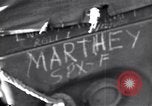
Christian altars and religious objects at liberated Dachau concentration camp in Germany, at end of World War II
Dachau concentration camp in Germany, after liberation in final days of World War 2. Sign on railroad station building 'Dachau'. Free standing corner post decorated with figures on top, showing three German soldiers in one direction and a German soldier pointing two German musicians in the other direction. One musician has a bass fiddle on his back and carries a folded umbrella. The other carries an accordion. Sign on the entrance to the Concentration Camp: 'Quarantine, Typhus. This concentration camp is off limits to all civil and military personnel. By order of General Patch, CG, Seventh Army'. Christian altars with Mother Mary, a monstrance, and an altar card at the concentration camp. Pile of dead bodies of victims of Nazi atrocities carried in horse carts by German civilians wearing gas masks.
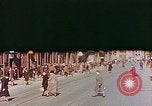
Civilians, damaged buildings and monuments of Wiesbaden, Germany after United States Army enters the city during World War II.
Views of damage in the city of Wiesbaden in Germany during end of World War II. Civilians walking on a street. Damaged buildings due to bombing. Statue of Kaiser Friedrich III seen between demolished buildings. Ruins and debris of buildings destroyed by aerial bombardment in World War 2. Sign over an archway reads "Kaiser Frederich Platz."
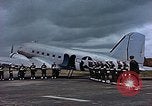
U.S. General Hoyt S. Vandenberg, Commander of the 9th Air Force greets officers of the Free French Air Force at end of World War II
A U.S. Army Air Corps honor guard stands around a C-47 transport plane, at an airport in Torgau, Germany at end of World War 2. Glimpse from behind of officers assembling on the ramp near the airplane. Closeup of the Ninth Air Force logo and the name, "Suzanne,"below the pilot's window on the aircraft. A staff car arrives and several U.S. Army Air Corps officers step from the car, including Lieutenant General Hoyt S. Vandenberg, Commander of the 9th Air Force and Major General Otto P Weyland, who would succeed him as 9th Air Force Commander. They join officers of the Free French Air Force at an area of the airfield ramp beside a destroyed hangar. They shake hands and talk with Free French Air Force officers, wearing black caps. The one in Leather jacket is General Martial Henri Valin Commander of Free French Air Force. Closeup of General Valin and General Vandenberg conversing. All stand at attention and salute colors or band plays National Anthems (unseen) General Vandenberg leaves walking toward the camera and boards his aircraft, as those behind shake hands and say good byes. A brass band plays and then the honor guard marches away from the aircraft. The right engine starts and then the left. An unidentified Air Corps Brigadier General waves goodby as the C-47 taxis out for takeoff.
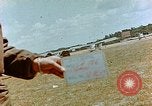
Aerial view of damaged and destroyed buildings,and houses in Braunschweig, Germany, resulting from bombing by Allied forces in World War II
Aerial views from an airplane flying over the ruins of Braunschweig Germany, right after the end of World War 2, in Europe. Whole city blocks of buildings have been reduced to empty spaces and skeletons of buildings remain elsewhere. At first glance, a large building surrounded by trees seems undamaged, but closer examination shows it roof completely destroyed. However another large building in those woods does appear undamaged. Roadways and some areas appear cleared of debris. Almost all buildings have been destroyed. Aircraft films from higher altitude, showing miles of territory surrounding the city. Closer view at lower altitude shows the scenic river, Oker, bounded by trees and nearby houses with all windows and most roofs gone. At TC: 02:07 the Brunswick Cathedral is seen near the few other relatively undamaged buildings.

Newsreel: Victims of Nazi Rule Welcomed depicting arrival of WWII European refugees at a harbor in New York.
Newsreel titled 'Victims of Nazi Rule Welcomed'. The U.S. ship "Marine Flasher" carrying European Refugees arrives at a harbor in New York in the year after the end of World War 2. A huge crowd waits at the harbor. The refugees are welcomed with warmth by their relatives and friends in an emotional environment. Man given a warm hug by his relatives. A woman and her child. Sobbing woman welcomes her loved one. Mother and child, and two other women show prisoner number tattoos on their arms, administered by the German Nazis in a concentration camp.
CRITICALPAST.COM: About Us | Contact Us | FAQs - How to Order | License Agreement | My Account | My Lightboxes | Shopping Cart | Advanced Search | Featured Collections | Website Terms & Conditions | Privacy Policy ©2026 CriticalPast LLC.
License Agreement |
Terms & Conditions |
Privacy Policy
©2026 CriticalPast LLC.