


 Francais
 Deutsch
 Italiano
Refine Your Search
V2 stock footage and images
- Showing 6505 to 6510 of 9941 results more
more Hide
Hide
Newsreel depicts a refugee camp of Czechoslovakian Jews after their land was taken over by pro-German Hungary
Early in World War 2, newsreel shows a Jewish refugee camp in Bratislava, Czechoslovakia (shortly before it became part of the First Slovak Republic, or Slovakia). An open ground with tents as the refugee camp for Czech Jews in exile, whose land was taken over by Hungary (during its time of pro Nazi Germany foreign policy.) Starving Jewish women and infant children. Men cutting trees with a saw. Boy getting all hair shaved off his head. A number of Jewish refugees including children line up for a small amount of food kept on a table, and warm themselves by the fire.
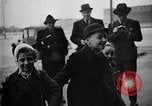
Czech Jewish people, primarily women and children, flee Prague, boarding a plane of the Dutch Airlines KLM
Evacuation of Czech Jews fleeing Nazi German persecution in Czechoslovakia early during World War 2. The Jewish refugees board a Koninklijke Luchtvaart Maatschappij or KLM (Dutch Airlines) airplane. Most passengers are women and small children. A woman, from the plane waves to her relatives standing at the airport terminal building. A large crowd gathered outside the terminal building and ticketing office. Boys and girls wave and smile as they enter the tarmac area and approach the parked aircraft. The Pilot of the plane looks from the cockpit. The same plane brought such a group to Croydon Airport (Airport House, Purley Way, Croydon CR0 0XZ, United Kingdom), London, United Kingdom, in January 1939.

French officers examine facilities used by Gestapo during Nazi occupation of France in World War II
Views of Nazi facilities that had been used by the Gestapo to torture and kill prisoners during the German occupation of Paris, France, in World War 2. A long low tunnel is seen (that had been a rifle range for the Ministry of Aviation). French soldiers and Partisans examine wooden stakes and hand prints of victims on the walls. Closeup of the uniformed French officers examining the wooden stakes where prisoners were executed by firing squads. Numerous bullet holes and damage is evident in the stakes. A blindfold and rosary are found on one stake. In another area, the officers examine wooden coffins ready for use. In the courtyard, a large excavation is shown where numerous bodies were dug up. Wooden boxes are seen that contained bodies.
Villagers of Bande, Belgium, massacred by Nazis on Christmas Eve, in retribution for deaths of three German soldiers, in World War II
A sign identifies the village of Bande, in Belgium, during World War 2. View of snow-covered village rooftops from a distance. Closeup of a cafe in the village. Bodies of 34 young men from the village are seen lying in the cellar of the cafe. All had been executed on Christmas Eve, by a unit of the Nazi SD (Sicherheitsdienst) affiliated with the SS (Schutzstaffel) in retribution for the deaths of three German soldiers killed by Belgian maquis (Resistance fighters) on September 5, 1944. (Bande had been occupied by U.S. forces soon thereafter, but was retaken by German forces in the December Ardennes offensive, setting the stage for the massacre.) British troops that re-occupied the village on January 10th, 1945, are seen removing the bodies from the cellar and placing them on the snow-covered street. Wooden coffins are stacked up at the side of the building. Some closeups of the victims are seen. Scene shifts to a snowy field where the bodies are on the ground and men wrap them in sheets and place them in coffins. Closeup of British soldiers placing cover on a coffin and affixing an identification tag on it. Next, the Village Priest presides over a mass funeral for the victims, as villagers stand along the line of coffins. Women in black grieve over the victims. British soldiers carry the coffins to army trucks.The villagers follow behind the trucks as they proceed to the graveyard for burial. The coffins are placed on the ground at the cemetery.
Russian prisoners at the Paderborn concentration camp raid the food stores after being liberated by Allied army during WW II.
Paderborn concentration camp in Germany visited after World War II. The 2nd division of the 9th Army of the Allied military forces arrive at the camp with their tanks and weapons. The liberated Russian prisoners raid food stores for stealing baking flour kept at the stores. Prisoners break the door of store. Man eating baking flour. Men fight over a little flour. Soldiers control the prisoners.
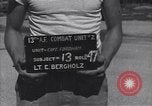
General Twining congratulates pilots of the 339th Fighter Squadron, on Guadalcanal, Solomon Islands during WWII
Major General Nathan F. Twining, Commanding General, 13th Air Force. arrives to congratulate fighter Pilots of the U.S. Army Air Forces, at Henderson Field, on Guadalcanal, Solomon Islands, during World War 2. (The 339th had successfully accomplished a highest priority mission, shooting down Japanese Admiral Isoroku Yamamoto's airplane on April 18, 1943.) Major General Twining, wearing a pith helmet, steps out of his jeep and walks towards a group of 339th Squadron Pilots. He examines the nose wheel of a P-38, as a group of pilots stand around him. General Twining converses for a while with Major John W. Mitchell, Commander, 339th Fighter Squadron, who led the mission to down Admiral Yamamoto's airplane. Later, members of the 339th Squadron are photographed in conversations with one another.
CRITICALPAST.COM: About Us | Contact Us | FAQs - How to Order | License Agreement | My Account | My Lightboxes | Shopping Cart | Advanced Search | Featured Collections | Website Terms & Conditions | Privacy Policy ©2026 CriticalPast LLC.
License Agreement |
Terms & Conditions |
Privacy Policy
©2026 CriticalPast LLC.