


 Francais
 Deutsch
 Italiano
Refine Your Search
V2 stock footage and images
- Showing 6535 to 6540 of 9941 results more
more Hide
Hide
German occupation, martial law, and Danish resistance in Denmark during World War II
Film about Denmark after the Nazi German occupying force declared martial law and state of war with Denmark, in 1943-44 during World War 2. It was made by Danes and smuggled out of Denmark during that period. Opens with view of a church building and flocks of birds. Views of German army troops marching into Copenhagen, Denmark on April 9, 1940. SS troops dressed in black, marching. German soldiers carrying rifles with fixed bayonets, goosestepping. A fire burning at site sabotaged by Danish resistance elements in 1943. Derailed trains carrying goods to Germany. Fire at a German factory. Danish workers with bicycles staging a strike in protest German measures in response to resistance actions. Danes gathered in outdoor observance memorializing those killed by the Germans. A shop owned by German sympathizers (Quislings) destroyed by other Danes. People gathered on street on 29 August 1943, when the occupying German forces attacked the remaining Danish garrison and declared martial law. Announcement posted in Danish on a wall. View of Danish Naval vessels ordered scuttled by the Danish Admiralty, including the coastal defense ship,Peder-Skram, seen in front of a large building, the submarine, Havfruen (not seen) and others seen sunk at docks in Copenhagen harbor. Bullet hole through a glass window. A week later, on Sunday, 5 September, 1943, a German Panzer light tank is seen moving on a street, as pedestrians go about their business in Copenhagen. German soldiers patrolling on a motorcycle with sidecar. A man holding his hands up as he is hustled through a crowd under arrest by a German in black uniform (possibly Gestapo or SS). Motorcycle driving through pedestrians on the sidewalk. Spectators line a fence by an open field near a building labeled "Badstue Badminton." One, a woman, speaks through the fence to a Danish soldier interned there. View of the quarters of the Royal Guard at Rosenborg, occupied by German soldiers and with Nazi flag flying above it. Civilian relatives of interned men wait outside army headquarters for news about them. A courtyard, during a mass funeral, is filled with memorial flower wreaths covering the coffins of Danish soldiers and civilians killed by the Germans. Camera focuses on a wreath from King Christian of Denmark, among the many others. Two German soldiers march up a path at the Royal Residence Amalienborg, where King Christian is arrested. Views from moving camera as Danish flags are seen flying all over the city of Copenhagen, on 26 September, 1943, to celebrate the King's 73rd Birthday. The major exception is the Nazi Gestapo headquarters in the "Shellhus" (the prewar Shell Oil offices) shown in isolation. Views of people moving their belongings on hand carts after their homes were taken over by Germans. The slogan in English, "Do it well and do it now,"is seen left by Danish resistance fighters where they sabotaged a German military installation.
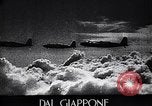
Japanese aircraft bomb the city of Chungking (Chongqing) ,China,during World War II.
Film begins showing formations of Japanese Mitsubishi Ki-21 bombers (Type 97 Heavy Bombers) in flght on a mission to bomb the Chinese city of Chungking (Chongqing) in World War 2. They begin releasing their bombs. Views from one of the aircraft of bomb striking in profusion on the ground. Very closeup of the front of one of the bombers in flight. More views of bombs dropping. View from an attacking airplane of bombs striking the port of Chongqing on the Yangtze River. Next, firefighters are seen directing hoses of water on fiercely burning fires, and then in streets of the city directing water onto smoking buildings. Large building consumed by fires out of control.
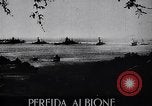
British Navy attacks French Vichy fleet at Mers-el-Kebir, Oran, Algiers, during World War II
Opening scene shows ships of the French fleet in the harbor of Mers-el-Kébir, Oran, Algeria, during World War 2. French tricolors seen flying from the superstructure of the French battleship, Dunkerque. A motorboat arrives, delivering a note from British Admiral Somerville, via HMS Foxhound (destroyer) to Vichy French naval officer Marcel-Bruno Gensoul, with final warning ultimatum against siding with the Axis powers. Sailors on the Dunkerque watch over the railing of their ship. The messengers board the Dunkerque. French and British Navy sailors exchange signal light messages between ships. Onboard the Dunkerque, the message is delivered to French Admiral Marcel-Bruno Gensoul. Closeup of the message. More signal light messages between ships. (The French had rejected the ultimatum.) French sailors are seen running across a concrete pier separating small pleasure boats in the foreground, from the French warships on the other side of the pier, in the background. View of sailors running to battle stations aboard French ships. An explosion occurs in the waters of the harbor. Striking shells create explosions near the French warships. The Battleship Dunkerque with heavy black smoke rising from her funnel getting underway. French sailors on a battleship with heavy white smoke surrounding them as they stand near her 13-inch guns. The French battleship, Bretagne, exploding after being hit by British gunfire. French sailors fighting fires on burning deck of a warship. Another view of the exploding battleship, Bretagne. A British warship firing its 15-inch guns. Unidentified French warship hit in its aft section by gunfire and exploding in heavy smoke. French survivors in life vests and lifeboats throughout the harbor. Wreckage of some destroyed French ships. (Note: The attack was part of Operation Catapult, a British plan to neutralize or destroy French warships in Vichy France, to prevent them from falling into German hands.)
British spitfire aircraft engage German Heinkel 111 bombers during the Battle of Britain in World War II
A formation of German Heinkel 111 bombers is seen flying in formation during period of World War 2 blitz attacks on England. View from copilot's side of the cockpit of one bomber. View of Pilot in the left seat. View from window in left side of the bomber. View from inside the nose of bomber as it approaches shore of England. Pilot and copilot don oxygen masks. Views from gunner's position in the bomber's nose, as a British spitfire fighter plane attacks. German gunner fires machine gun, continuously, at the attacking spitfire, as it zooms past the bomber's nose. Another spitfire attacks directly head-on. The German gunner fires. The spitfire pulls up and over the bomber. Gunner firing at two spitfires passing beside it. One of them is struck and streams smoke as it slowly falls downward to crash (unseen). Another spitfire aircraft making a head-on attack, is fired upon and makes an aerobatic maneuver away. Closeup of the German machine gun firing tracer rounds, and striking another spitfire that inverts and dives down streaming smoke.
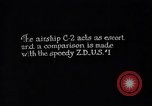
Trainee students of a Balloon and Airship schools ran by the U.S. Air Service, during a flight in a dirigible, in United States.
Students of Balloon and Airship schools ran by the U.S. Air Service, training on balloons and dirigibles at various places in United States. Dirigibles ZDUS-1 and C-2 flying over countryside, farmlands and over a river. Student operators in the control room of ZDUS-1 communicate with members at various stations. Uniforms and equipment of the operators. A person in flying uniform cooks eggs and potatoes on a stove at the rear of airship. Crew members eat food inside cabin compartment.
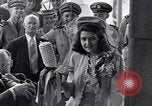
Sponsors, citizens, and U.S. Navy officials at launching of USS Santa Fe, CL-60, in Camden, New Jersey.
Launching and christening of USS Santa Fe (CL-60) Cleveland Class light crusier from the Camden, New Jersey yards of New York Shipbuilding, during World War 2. Men, women and U.S. Navy officers and sailors at the harbor during the ceremony, including Santa Fe Mayor Manuel Lujan, and 14 year old Caroline Trevelyan Chavez who receives coaching on how to christen the ship and then smashes a bottle of Santa Fe River water on the bow as the crowd claps and the ship slides down the ways. Ambient sound heard briefly at the christening and afterwards with crowd cheering at different times in the clip. The cruiser slides down the ways enters into the Delaware River. Dignitaries raise their hats to bid goodbye to the ship. The ship turning about in the Delaware River.
CRITICALPAST.COM: About Us | Contact Us | FAQs - How to Order | License Agreement | My Account | My Lightboxes | Shopping Cart | Advanced Search | Featured Collections | Website Terms & Conditions | Privacy Policy ©2026 CriticalPast LLC.
License Agreement |
Terms & Conditions |
Privacy Policy
©2026 CriticalPast LLC.