


 Francais
 Deutsch
 Italiano
Refine Your Search
V2 stock footage and images
- Showing 673 to 678 of 9857 results more
more Hide
Hide
Royal Air Force's new huge sleek Victor-Bomber in its ultra modernistic appearance at an airbase goes into operational service.
Royal Air Force's new Victor-Bomber in its ultra modernistic appearance. The new Victor Bomber parked at an airbase. The bomber goes into operational service. Airmen standing near the Victor Bomber discuss about papers. Crewmen fill jet fuel in a V-bomber. The huge sleek V-bomber takes off and flies in sky.
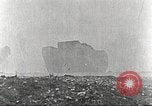
Extract from 1927 British feature film "The Somme," portraying events during the Battle of the Somme, in World War I
Scene from 1927 feature film about World War 1. British tank crosses a battlefield under fire. It is a Mk V tank with dummy guns fitted to simulate a fighting tank. British troops sheltering in a shell-hole recognize it as friendly and follow it towards enemy lines, where it rides over the parapet of a German trench and crushes a machine-gun position. (The tank is an anachronism; the Mark V did not enter service until 1918.)
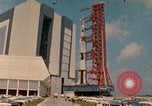
NASA Project Gemini activities and overview of Gemini program and participants at Kennedy Space Center, Florida
National Aeronautics and Space Administration (NASA) Gemini program activities to prepare for the Apollo moon mission. Footage spanning multiple years in 1960s. Multiple views of the Saturn V launch vehicle (rocket) on launch platform and as it is moved into position at the Kennedy Space Center, Florida. Helicopter lifting off beside Saturn V with rocket and launch tower in background. Spotlights at night shined onto a Gemini Titan II rocket. Narrator explains purpose of Gemini as precursor to Apollo program. A specially configured USAF C-135 (Boeing 707) aircraft taking off and views inside, as it performs parabolic sweep maneuvers to give astronauts some experience with "weightlessness"and the operation of equipment in such conditions. View of a swimming pool with Gemini astronauts practicing neutral buoyancy with their vehicle and equipment in semi-weightless conditions. Views of Gemini astronauts training in a simulator and undergoing special parachute training. Astronaut survival training including exits from capsule at sea, desert, and jungle training. Gemini astronauts boarding capsule for an orbital mission from Launch Pad 19 at the Kennedy Space Center. Narrator names all the Gemini astronauts: Grissom, Young, McDivitt, White, Cooper, Conrad, Borman, Lovell, Schirra, Stafford, Armstrong, Scott, Cernan, Collins, Gordon, Aldrin. View of NASA Gemini astronauts entering capsule, being seated, secured, and door closed and secured before launch.
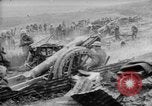
Montage of combat scenes (primarily British) from World War I
British forces manning 8-inch howitzers on the Western Front in World War 1. Others firing a 155mm heavy long gun near a village in France. British gunnery Sergeant using a megaphone to relay instructions to gun crew. Firing a heavy gun at close to zero elevation. Firing 8-pouder field pieces in the midst of trenches in No-Mans land. Firing a howitzer equipped with mud flaps (girdles) on its wheels to minimize bogging down in the mud. Glimpse of German soldiers unpacking artillery shells with a 15 cm Kanone 16 in the background. A British 8-pounder firing among trenches. British infantry moving across a quiet battlefield. A British Mark IV tank moving across trenches. A British battery of howitzers firing. Closeup of gun crew firing an 8-pounder from under camouflage covering. British troops lined up in a deep reinforced trench. They climb over the top. Glimpse of two German soldiers rushing up out of a reinforced bunker. British infantry advancing across battlefield, under fire. On carries a Lewis gun and the other a rifle with fixed bayonet. Huge explosions raise black smoke as a British Mark IV tank moves in foreground. German gunners in a fortified bunker, firing a Maxim MG 08 machine gun. Closeup of machine gun. View from trench underneath, as a British tank rolls overhead. View from above shows it is a Mark V "male" tank, armed with a short 6-pounder (57-mm) Hotchkiss gun in the right sponson. British infantry running across the battlefield with smoke everywhere. A shell strikes and one soldier falls ans rolls over. . Another glimpse of German machine gunners firing. View from behind barbed wire as a British Mark V tank advances toward the camera. White smoke is punctuated by puffs of black smoke from shelling. A line of soldiers are silhouetted against light sky as they flee across a hill top. A shell striking and fire burning in a French village. Views of desolate "no man's land." British infantry, including pipers, walking across the battlefield. Stubs of trees and destroyed remains of a village. A line of British infantry leaning forward in trench behind an earthen berm. They charge over the top. One remains lying against the hill. Troops silhouetted against the sky as they move across the battlefield and down a deep ravine and up the other side.
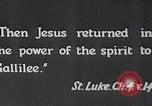
Palestinian fishermen catching fish in the Sea of Galilee
Slide reads “Then Jesus returned in the power of the spirit to Gallilee. St.Luke.Ch.4.v.14.”. View of a lake located on the site of what believed is to be Capernaum, a fishing village from the biblical and Roman era in Galilee, Palestine. Aerial view of the desert, olive groves and Lake Tiberias in Galilee. View of a tree in front of Lake Tiberias, also known as the Sea of Galilee. Slide reads “Now as he walked by the sea of Galilee he saw Simon and Andrew his brother casting a net into the sea. St.Mark.Ch.1.v.16.”. A man casts a net in the Sea of Galilee. Fishermen holding a drag net to catch fish near the shore. Fishermen in boat let down a sea net in deep water. Fishermen on boat pulling sea net. Fishermen hauling fishing net from deep water in the shore. Fishermen with net on a small boat. Palestinian fishermen fixing nets under a tree.

President Nasser starts construction phase of Egypt's Aswan High Dam project.
President Gamal Abdel Nasser launches the construction of the first Soviet-financed phase of Egypt's monumental Aswan High Dam project. King Mohammed V of Morocco attends the launch as the guest of honor. Crowds gathered under a large tent for the event. Egyptian military band playing music. Photographers take pictures of King Mohammed V of Morocco. President Nasser speaks to journalists. An enormous rockslide explosion takes place during the groundbreaking ceremony.
CRITICALPAST.COM: About Us | Contact Us | FAQs - How to Order | License Agreement | My Account | My Lightboxes | Shopping Cart | Advanced Search | Featured Collections | Website Terms & Conditions | Privacy Policy ©2026 CriticalPast LLC.
License Agreement |
Terms & Conditions |
Privacy Policy
©2026 CriticalPast LLC.