


 Francais
 Deutsch
 Italiano
Refine Your Search
V2 stock footage and images
- Showing 6811 to 6816 of 9941 results more
more Hide
Hide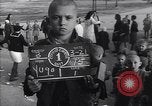
Yugoslavian boys and girls play outdoors at a school or orphanage
Young Yugoslavian boys and girls play and run outdoors in the yard of a school or orphanage during World War 2. Boys and girls hold a rope. Children pose. Building with a sign and Yugoslavian flag.
Marshal Josip Broz Tito makes a short address.
Delegates around the conference table with Marshal Tito, leader of the Yugoslav Partisans in World War 2. Marshal Tito speaking to the group.
Marshal Josip Broz Tito rides his horse.
Marshal Tito, leader of the Yugoslav Partisan forces, and other Allied officers walk out of a building, during World War 2. Marshal Tito gets on his horse. Tito rides the horse beside a row of trees. Tito poses on horseback.
Marshal Tito at a conference with other delegates in Belgrade.
A U.S. plane lands in Belgrade, Yugoslavia, during World War 2. British and U.S. civilian and military officials disembark. Delegates around a conference table. Marshal Tito, leader of Yugoslav Partisan forces, lights his pipe. Men behind exchange documents. Delegates sign the documents. Marshal Tito makes a short address.
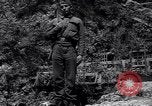
Marshall Tito, with American and British envoys and his headquarters staff at their Mountain Headquarters in World war II
Film opens showing a Partisan Sentry posted outside Marshall Tito's mountain stronghold in Drvar, Western Bosnia, Yugoslavia, during the Spring of 1944, in World War 2. Views of other sentries on guard duty. A Partisan officer steps onto the porch of the headquarters and looks through a pair of binoculars. Closeup of a sentry. Scene shifts to Marshall Tito stepping from the main porch to a lower one, accompanied by American Army Major Linn M. Farish, American Liaison to the Partisans, and British Brigadier General Fitzroy Maclean, Winston Churchill's special envoy to the Yugoslav leader. Tito smokes a pipe, as he and Farish converse. MacLean smokes a cigarette. In next scene Farish is also smoking a cigarette. Major Farish removes his hat and tosses it over the railing (perhaps because Tito is not wearing one). Tito pumps his arm several times while MacLean removes his hat. Then, speaking to MacLean, Parish pumps his arm as well. Next, they are joined by Tito's Chief of Staff, General Koča Popović. Views of Tito and Popović. Change of scene shows a British military photographer upon a railing taking a still picture of Tito and his Partisan Supreme Command (cabinet and principal staff officers). After the photographer leaves, they remain together with Tito's pet dog, Tigar.
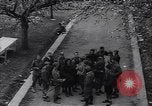
Yugoslav Partisan fighters in uniform are shown as they gather together during World War II
View from above of men and women Yugoslav Partisan fighters assembling for the camera.during World War 2. Closeup of them conversing with one woman, not in uniform, who is a 21-year old Montenegrin who left school to join the Partisans. Camera pans across some of the group. Next, a closeup shows a young boy in uniform with a rifle, at left of the group, as uniformed Partisans converse with the Montenegrin woman volunteer. Next scene shows her holding a short barrel submachine gun, as Partisan soldiers show her how to insert a clip of ammunition. Glimpse of the group from above, again.
CRITICALPAST.COM: About Us | Contact Us | FAQs - How to Order | License Agreement | My Account | My Lightboxes | Shopping Cart | Advanced Search | Featured Collections | Website Terms & Conditions | Privacy Policy ©2026 CriticalPast LLC.
License Agreement |
Terms & Conditions |
Privacy Policy
©2026 CriticalPast LLC.