


 Francais
 Deutsch
 Italiano

Refine Your Search
V2 stock footage and images
- Showing 6805 to 6810 of 9941 results more
 Hide

Miners in the Soviet Union work to support the war effort during World War II
Miners use multiple motor-driven drills to penetrate roof of mining tunnel in the Soviet Union during World War 2. Heavy dust drops from the drill holes and completely covers the miners as they work. As drilling proceeds, they exchange original drill bits with longer ones to penetrate deeper. Open rail cars filled with chunks of mineral ore are seen traveling along a rail line carrying the ore from the mine.

Soviet farmers harvest wheat during World War II.
Soviet farmers are seen harvesting grain in a field, during World War 2. Closeup of men and women operating a tractor pulled paddle-style harvester. They leave sheaves of cut grain behind as they continue harvesting. Closeup of men and women gathering the sheaves with pitch forks and loading them onto wagons. A line of horse-drawn wagons, loaded with sheaves, moves along the edge of the field. Closeup of a wheat field. View of tractor pulling a harvesting combine as it cuts wheat. Closeup of reaper blades.Closeup of Soviet farmer in the combine. He wears several medals on his work jacket. View from behind two farmers in the combine. Threshed wheat being discharged from the combine. Farmer catches some in his hands. Farmers stand knee-deep in threshed wheat in a truck next to the combine.

Soviet film of action on Eastern Front during German Operation Barbarossa in World War II
Film starts showing Soviet infantry walking across an open field, during World War 2. . Heavy artillery firing from camouflaged positions in woods. Soviet soldier loading shell into a 120 mm mortar PM-38. Shells bursting near low structures. Soviet infantry moving quickly but cautiously across the area. Sounds of machine gun and smalls arms fire is heard. The Soviet troops enter area of several buildings. Change of scene shows Soviet woman soldier dressing and bandaging the wound of another soldier. Both are in battle gear including steel helmets. Closeup of the soldiers bandaged arm. More views of artillery firing from woods. Soviet soldiers processing a captured German soldier prisoner of war. Soviet soldiers enjoy reading a Russian newspaper. Soviet soldiers scanning skies for aircraft, through binoculars and telescope. Two German aircraft are seen flying low over the area. Soviet soldier signals for anti aircraft artillery to fire. A plane is seen diving toward the ground. Still image of black cloud from the ground is shown as narrator comments.

Men, women, and children work to harvest wheat and build defenses in the Soviet union against German invasion during World War II
Film begins showing an armed member of Soviet home guard standing in a wheat field during World War 2.. Nearby a tractor is pulling a harvesting combine machine across part of the wheat field. The harvester is being operated by a woman. A man stands by her side. Closeup of that man and then of him and the woman operating the harvester. Many children are seen bent over gleaning remains in the wake of the harvester. They bring their findings to a boy who empties them into a large sack. Another girl empties a bucket of gleanings into the boy's sack. View of two men standing on platform of the harvester, where they are filling sacks with harvested wheat and depositing them on the ground as the harvester moves along. Closeup of the man and woman atop the harvester. Closeup of the reaper blades cutting the wheat. Camera pans to edge of the wheat field, where civilians are busy building defenses. Camera moves closer and shows the worker in deep ravine to serve as a tank barrier. This group are mostly men. The next scene shows women and girls shoveling earth. Scene shifts to men cutting a new tank trap. Others are burying wood obstacles into the ground. A woman is seen preparing food in a large kettle over a fire. She uses a large ladle to sample the food. Women and girls are working on the defense works in the background.Change of scene shows men placing large logs into the edge of a deep multi-level tank trap. Men and women shovel earth to the top of a log fortification.
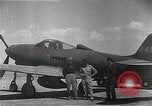
U.S. Lend-lease aircraft being supplied to USSR by way of Iran in World War II
Film about the shipping of American Lend-Lease aircraft to the Soviet Union, via the " Persian Corridor " during World War 2. It focuses on activities at Abadan Airfield, Iran. U.S. Army Air Forces (USAAF) Colonel Charles Porter, Commanding Officer of the Allied Abadan military establishment in Iran, stands with a Soviet Colonel, who supervises Soviet work on the field. With them is USAAF Brigadier General Macmillan., who was visiting the base at this time. They pose in front of a P-39 Bell Aircobra airplane displaying a red Soviet Star insignia. Next, ground crews are seen towing aircraft on the field, including a Douglas A-20 Havoc and a Curtiss P-40 Warhawk. Mechanics work on several P-40 airplanes on the ramp. A North American Aviation T-6 Texan aircraft is being refueled from a truck .Closeup of ground crewman holding refueling hose over the wing of the T-6. USAAF mechanics conduct post-assembly checks on a North American B-25 Mitchell bomber and tow another one (Serial number 41-3225) from a hangar, to the Soviet side of the field, after completing its inspection. Soviet mechanics are seen checking guns in the rear cockpit of an aircraft. Glimpse of several P-40 aircraft and a T-6 aircraft on a ramp. Soviet and American mechanics working together on the wings of aircraft. Closeup of two working together. As a Soviet soldier watches, an American airman uses a paint brush to change the American white star on an airplane, into the Soviet red star. The two shake hands when the painting is done. Soviet ground crew push a P-40 aircraft into position for starting. A soviet pilot, wearing a seat pack parachute, climbs into the cockpit. Closeup of him as he nods to a ground crewman for engine start. He taxis out and takes off. Several T-6 aircraft on the Soviet side of the field are seen, ready to be flown away. Views of other aircraft being readied for ferrying to Russia. Camera pans over the airfield and the many aircraft parked there.
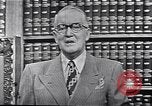
Barry Goldwater speaks on the growth of Federal government encroaching on states' rights
William Bradford Huie and Hardy Burt talk with Senator Elect Barry Morris Goldwater (Republican Party, Arizona). Goldwater speaks about his interest in politics starting during World War 2. Goldwater talks about the growth of the Federal government, stating that it has gotten too big, and that it has a tendency to preempt State functions of states. He says the big federal government has too many federal agencies and too many bureaus. He says the federal government Agriculture Department has multiple agencies in counties that are performing overlapping duties. Goldwater says that what the government is doing can be done more efficiently and cheaper, and in many cases at the state level instead. He speaks about the fear of socialism growing. He cites the example of states being required to involve the federal government when they want to open a new grammar school or high school. He says the issue is one of control and the government taking too much of the tax dollar, and that there could one day be a federal government in Washington DC that believed in socialism, and that if it controlled the schools, it could be telling the schools what to teach. He agrees with presenter that federal tax policies are making it difficult for state and local governments. He says that 78 cents of each tax dollar used to stay local, and now 78 cents of each tax dollar goes to the federal government in Washington DC is not being spent as efficiently as if it was controlled at the local level. Goldwater speaks about the lower standard of living of Native American Indians, and the need to make them "first class citizens". He notes that the Native American Indian can now vote in Arizona, but there is a need to repeal discriminatory laws that prohibit Native American Indians from buying alcohol (liquor), a skillet with handle on it, a gun, or an axe.
CRITICALPAST.COM: About Us | Contact Us | FAQs - How to Order | License Agreement | My Account | My Lightboxes | Shopping Cart | Advanced Search | Featured Collections | Website Terms & Conditions | Privacy Policy ©2026 CriticalPast LLC.
License Agreement |
Terms & Conditions |
Privacy Policy
©2026 CriticalPast LLC.