


 Francais
 Deutsch
 Italiano
Refine Your Search
V2 stock footage and images
- Showing 6931 to 6936 of 9941 results more
more Hide
Hide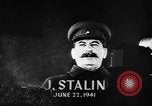
Russian war strategy against German invasion in World War II
Citizens in the Soviet Union mobilize for war effort against Germany in World War 2. Joseph Stalin gives a speech on June 22, 1941. Newspaper printing press running and newspapers being printed and distributed to spread news about mobilization. Russian men from every village come forward to fight against Germany. Russian men on horseback ride to mobilize. Groups of men and women mobilizing in recruitment drives for soldier activities and war production work in factories and mines. Young teenage boys work in a coal mine so older men can fight in the war. Russians of all ages mobilized. Russian women and young boys with rifles. Russians guard their fields and cattle and watch the skies for German invasion aircraft. Russian old men keep vigil in fields.
U.S. Armor and infantry advancing from Osterode to St. Andreasberg in Germany during World War II
United States Infantry moving up from Osterode to St. Andreasberg in Germany, during World War 2. U.S. Armor, and troops of the 16th Infantry Regiment, 1st Infantry Division, making their way forward on road overlooking artificial lake (Söse Talsperre) between Osterode and Riefensbeek. They clear obstacle of felled trees from the road. Tanks, tank destroyers, and infantry proceeding uphill along the road.
United States Infantry moves up from Osterode to St. Andreasberg in Germany, during World War II
U.S. Troops of the 16th Infantry Regiment, 1st Infantry Division,advancing from Osterode to St. Andreasberg, during World War 2. A lieutenant directs several soldiers as they begin to ascend a wooded hill. Big Red One (1st Infantry Division) patch visible on left shoulder of a soldier. Several small units of infantry lined up behind them start climbing up the hill. Jeep descends from hill to road beside artificial lake (Söse Talsperre) between Osterode and Riefensbeek, where troops and vehicles are proceeding toward a dam in the background.
U.S. Troops of 16th Infantry Regiment advance from Osterode to St. Andreasberg in Germany, during World War II
U.S. troops of the 16th Infantry Regiment, 1st Infantry Division, moving up from Osterode to St. Andreasberg in Germany, during World War 2. Infantrymen near clearing in the forest, and climbing hilly terrain. Troops in dispersed formation near a dam bordering the wooded area. Mountains in the background. (Note: The exact location is at the Söse Talsperre, an artificial Lake between Osterode and Riefensbeek.)

Postwar field Testing of German Armor, by Allies, 1945
Postwar Allied testing of German Armor at secret Henschel tank testing grounds (Henschel Panzerversuchsstation) in Haustenbeck, a village in the center of the Sennelager training area, West of Oesterholz and Schlangen, and East of Lager Staumühle, Germany. Seen are Valentine tank, Tiger II (AKA King Tiger, or Royal Tiger) Tank and Self-propelled Gun mounted on Valentine chassis tank. The Royal Tiger Tank with broken gun barrel moves on the ground and breaks through a grove of small trees. The tanks circle a Tiger E, chassis number 250001, which has been abandoned and stripped after years of testing. The seventy-six mm antitank gun mounted on a Valentine chassis fires shells at the Tiger E. (Note: These tests could provide data affecting future Allied tank designs.They were organized by Major-General Sir Percy Cleghorn Stanley Hobart, a renowned pioneer in motorized mobile warfare. Paradoxically, his ideas influenced German tank development and tactics before World War 2. Also present was Dr. Arnold from the Henschel and Sons Company that manufactured tanks at its Mittelfeld Works.)
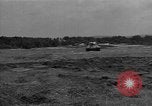
German Jagdtiger tank destroyer being tested at the Henschel tank testing grounds, Mittelfeld, near Kassel, Germany.
German Jagdtiger tank destroyer, with "Porsche" running gear, being tested at tank testing grounds associated with the Henschel Werk III tank factory in Mittelfeld near Kassel, Germany, soon after conclusion of World War 2 in Europe. Tank is tested in forward and reverse. Affect of running in piled dirt is evaluated. (The filmed Vehicle is # 305004, which was eventually shipped back to the UK and is now at the Tank Museum at Bovington.)
CRITICALPAST.COM: About Us | Contact Us | FAQs - How to Order | License Agreement | My Account | My Lightboxes | Shopping Cart | Advanced Search | Featured Collections | Website Terms & Conditions | Privacy Policy ©2026 CriticalPast LLC.
License Agreement |
Terms & Conditions |
Privacy Policy
©2026 CriticalPast LLC.