


 Francais
 Deutsch
 Italiano
Refine Your Search
V2 stock footage and images
- Showing 6937 to 6942 of 9941 results more
more Hide
Hide
United States President Roosevelt speaks of Fascist decline in Italy
United States President Franklin Roosevelt sits in a room. He speaks of Fascist decline in Italy during World War 2, saying "the first cracks in the Axis has come." He stresses that the U.S. terms to Mussolini in Italy are still unconditional surrender. President wears a bow tie during his speech.
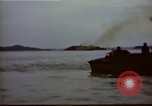
Rocket barrage fired from Wolmi-Do Island towards Inchon in Korea
Rocket barrage fired from Wolmi-Do Island towards Inchon in Korea (also spelled Incheon). Silhouette of destroyer. U.S. Marines in combat gear tying an American flag to a weather vane in a town. Marines pose near it. Marines of the 2nd Battalion, 5th Marines and 1st Division raise first American flag in Inchon during Korean War.
Air-Sea rescue and accident during World War II in the Pacific Theater of operations
Celebes, Netherlands East Indies (NEI). Air-Sea Rescue June 11, 1945. View from low flying aircraft of a 13th Air Force B-24 ditched in Japanese-controlled waters off the coast of Celebes, NEI. A Catalina PBY flying boat of the Jungle Air Force's 2nd Emergency Rescue Squadron, lands and picks up the B-24 crew. However, as it takes off on the water, it founders and crashes, killing three men. An accompanying PBY lands immediately and picks up all survivors who are aboard a rubber raft. Crew members on the wing of the PBY, help survivors aboard.
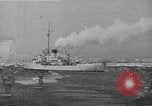
United States Coast Guard in Greenland during World War II
Overseas activities of U.S. Coast Guard in World War 2. View from ship bow in heavy North Atlantic seas. A map shows Greenland. U.S. Coast Guard Coast Guard Cutter in Greenland waters with mountains and snow behind. U.S. Coast Guard officers conferring with Danish Naval officer. James K. Penfield, first United States consul in Greenland, being brought ashore by U.S. Coast Guard officers. Coast Guardsmen supplying food and supplies to natives of Greenland. Views of Greenland's Cryolite mine with men rappelling down its sides. Coast Guardsmen, released from U.S. service, and employed as armed guards, by the Government of Greenland, are seen protecting the Cryolite mine. Topographic survey of Greenland being conducted by Coast Guard personnel. Coast Guard two-place Bi-wing float plane is seen at rest in harbor and then later taking off.. U.S. Coast Guardsmen install, and test fire,a 3 inch gun, to protect a Greenland harbor. Coast guardsmen capture and occupy radio stations planted by Germans in Greenland. Newspaper from December 14,1944 describes how three German Arctic expeditions were broken up by the U.S. Coast Guard. A ship is torpedoed and burns in convoy of ships in North Atlantic Captain of another ship observes through binoculars. Several crew members are rescued from a raft. Coast Guard Cutter fires depth charges. Ships fire deck guns and antiaircraft guns against enemy. Destroyer Escort Savage (DE-386) at sea, manned by U.S. Coast Guard crew.. Admiral Russell R. Waesche decorates Coast Guardsmen. Coast Guard Cutter "Hamilton", the first American warship torpedoed in the Atlantic in WWII. Commandant Russell Waesche gives a statement in Washington D.C.
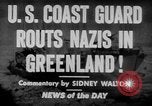
Operations of United States Coast Guard at Shannon Islands in Greenland during World War II
U.S. Coast Guard Cutters on patrol in waters off Greenland in World War 2. Views of icebergs. The cutter 'Northland' trapped in pack ice. A party of crew members drag a depth bomb across the ice to explode and clear the way ahead. Off the coast of Shannon Island, American guns fire at a German trawler. Coast Guardsmen launch an amphibious assault against Shannon Island, and capture Germans at an outpost on the Greenland site. High powered radio equipment and weather instruments captured from weather stations. Small boats carry German prisoners -- the crew of German trawler captured by the U.S. Coast Guard.
Amphibious forces carried by U.S. Coast Guard, at Guadalcanal and in North Africa during World War II
United States Coast Guard operations in World War 2. Underwater views of ship's anchors being weighed, Convoy of U.S. ships in Pacific Theater, in July, 1942. The Attack Transport, USS Hunter Liggett underway, with crews doing amphibious training. Members of the 1st Marine Division aboard USS Hunter Liggett with Coast Guardsmen. Officers confer aboard vessel. Marines read books on ship. August 7, 1942, U.S. Marines begin amphibious assault against Japanese on Guadalcanal. Naval guns bombard Guadalcanal Island. Marines descend from the USS Hunter Liggett, on nets and enter LCVPs (Higgins boats) operated by Coast Guardsmen, to assault the island. Marines hit the beach from the boats. Marines firing small howitzers and advancing on the island. November 7, 1942, convoy of eight hundred ships en route to North Africa. Warships bombard the shore. An officer observes through binoculars. British and American troops descend on nets into LCVPs from Attack transports: USS Joseph T. Dickman (APA-13);USS Leonard Wood (APA-12); and USS Samuel Chase (APA-26). Troops hit the beaches of North Africa, under fire.
CRITICALPAST.COM: About Us | Contact Us | FAQs - How to Order | License Agreement | My Account | My Lightboxes | Shopping Cart | Advanced Search | Featured Collections | Website Terms & Conditions | Privacy Policy ©2026 CriticalPast LLC.
License Agreement |
Terms & Conditions |
Privacy Policy
©2026 CriticalPast LLC.