


 Francais
 Deutsch
 Italiano
Refine Your Search
V2 stock footage and images
- Showing 7501 to 7506 of 9941 results more
more Hide
Hide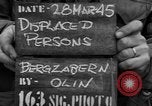
Displaced persons obtain food and water at the former Wehrmacht barracks at Bad Bergzabern, Germany during final days of World War II in Europe.
Displaced people in Bergzabern, Germany a about a month before the end of World War 2 in Europe. .Film begins showing destroyed buildings and rubble in the town. A long extension ladder is raised in an open lot. Many people are gathered in a street and in a large field. Some in the field are cooking meals. An American army truck is parked in a vacant lot, next to a covered elevated platform. Closeup of people obtaining water from a pipe at the platform. A large number of people assembling in a field where others are dispensing soup from large buckets and distributing other foods. Milk is being ladled from large milk cans into containers held by recipients. Closeup of a young man eating from a large bowl.
United States 99th Infantry Division soldiers rest in Neustadt, Germany during World War II.
United States 99th Infantry Division soldiers attempt to cross Danube in Neustadt, Germany during World War II. Soldiers of 2nd Battalion, 395th Regiment of United States 99th Infantry Division rest behind the dikes. Soldiers talk and smile.
United States 99th Infantry Division soldiers in Neustadt, Germany during World War II.
United States 99th Infantry Division soldiers attempt to cross Danube in Neustadt, Germany during World War II. Soldiers of 2nd Battalion, 395th Regiment of United States 99th Infantry Division carry an assault boat as they move unopposed into the forest. Soldiers pinned down beside the assault boat in the woods to escape enemy attack. Crew fires a mortar. Medics carry a wounded soldier on litters. A soldier hurriedly digs foxhole beside an assault boat.
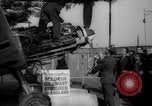
Crashed German Messerschmitt, Me 109, on display in Croydon, London, England.
Visitors to an outdoor display, to look at a crashed German Me 109 fighter plane, during the Battle of Britain in World War 2. The plane is under a camouflage net canopy. A sign in front of the plane reads 'made in Germany and finished in England'. Royal Air Force Sergeants and civilians look at it. Sergeants turn the propeller blades, which are severely bent, and point at bullet holes in the aircraft. A sign on the fence surrounding the display reads: "In Aid of the local Spitfire Fund." An RAF pilot climbs into the cockpit of the Me 109, as another helps close its canopy. Later, the RAF pilots examine the plane's wing flaps and an open wing hatch.
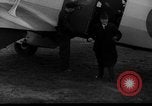
Dignitaries visit a British aircraft shadow factory in Britain.
Royal Air force aircraft shadow factory at work during World War 2. A dignitary gets off a plane. He along with other important persons inspects finished Royal Air Force aircraft lined up. Dignitaries visit the aircraft factory. They get some information about the manufacturing process as they speak to the workers. Men work at machines in the factory. A fighter aircraft pulled out of a hangar. Dignitaries watch the aircraft in flight.
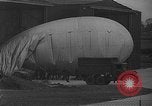
British barrage balloon in flight in England during Battle of Britain in World War II.
British preparedness for German Luftwaffe attacks during Battle of Britain in World War 2. A British barrage balloon being inflated. Balloon suspended from ropes floats in air. Balloon attached with a string to a jeep. Barrage balloon in flight as dignitaries look on.
CRITICALPAST.COM: About Us | Contact Us | FAQs - How to Order | License Agreement | My Account | My Lightboxes | Shopping Cart | Advanced Search | Featured Collections | Website Terms & Conditions | Privacy Policy ©2026 CriticalPast LLC.
License Agreement |
Terms & Conditions |
Privacy Policy
©2026 CriticalPast LLC.