


 Francais
 Deutsch
 Italiano
Refine Your Search
V2 stock footage and images
- Showing 7825 to 7830 of 9941 results more
more Hide
Hide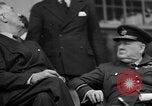
Winston Churchill, Franklin Roosevelt and Joseph Stalin sit on a porch of Russian Embassy in Tehran, Iran.
Footage from the Tehran Conference (project "Eureka") during World War 2. The British Prime Minister Winston Churchill, the United States President Franklin Roosevelt and the General Secretary of the Communist Party Joseph Stalin sit on a porch of the Russian Embassy in Tehran, Iran. The three leaders were in Iran for the Tehran Conference at the Soviet Embassy. Officers stand in the background. Prime Minister Churchill's daughter is introduced to Stalin. Premier Molotov, Harry Hopkins and Anthony Eden stand behind.
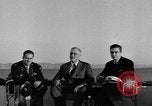
President Franklin Roosevelt with his sons, Franklin Delano Roosevelt, Junior and Elliott Roosevelt
United States President Franklin Roosevelt seated on a chair after the Tehran Conference (Project Eureka) during World War 2. Seated on his right is Harry Hopkins. Seated on his left is General Dwight Eisenhower. President Franklin Roosevelt's two sons stand behind him. Both his sons, Elliott Roosevelt and Franklin Delano Roosevelt, Junior are in uniforms.
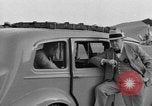
President Franklin Roosevelt and British Prime Minister Winston Churchill in Egypt viewing pyramids
United States President Franklin Roosevelt seated in a car, in Egypt, during his World War 2 visit for the Cairo Conference. The British Prime Minister Winston Churchill in civilian dress stands alongside the car. General Dwight Eisenhower, President Franklin Roosevelt and Sarah Churchill lunch on sandwiches. A view of the pyramids. A native points out the pyramids.
Sword of Stalingrad presented to Marshall Joseph Stalin in Russian Embassy, Tehran, Iran.
Marshall Joseph Stalin and Russian staff officers move towards the table on which sword of Stalingrad is displayed in Russian Embassy, Tehran, Iran, during timeframe of Tehran Conference in World War 2. Marshall Voroshilov and British Prime Minister Winston Churchill with other officials stand around the table. Prime Minister Churchill shakes hands with Marshall Joseph Stalin. The sword is presented to Joseph Stalin by Prime Minister Churchill. He hands it to a Russian soldier who marches with it. Sword is carried to U.S. President Franklin Roosevelt. It is handed to Marshall Voroshilov.
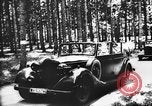
German General Friedrich Paulus visits Hitler at the Wolf's Lair Headquarters during World War II. Bulgarian Prime Minister Bogdan Filov, also visits
German General Friedrich Paulus arrives by car at Hitler's Wolf's Lair (Wolfsschanze) Eastern headquarters near the East Prussian town of Rastenburg, during World War 2. Paulus is greeted by a German Colonel, who escorts him to the entrance of a building where he is more formally greeted by Field Marshal Wilhelm Keitel. Scene shifts to General Franz Halder, Chief of the German General staff, personally greeting him, as well. Next, Paulus gives Nazi salute as Adolf Hitler walks toward him to welcome him to the Wolf's lair. They exchange handshakes. He is seen to say: "Mein Fuhrer" as he steps back. Others greet Hitler and exchange salutes with Hitler. Then Hitler walks away. Next scene shows a sedan arriving carrying Bogdan Filov, Prime Minister of Bulgaria. Next view is inside the building, where Hitler strolls in and greets Filov, who bows deeply as he shakes hands with him.
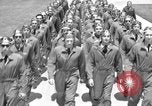
United States Army Air Forces training, in 1943. Student pilots marching
Large columns of United States Army Air Forces student pilots wearing flight suits, helmets and goggles, march at an airbase in United States. A car in the background. A hangar filled with Link trainers for instrument flying training. A student pilot demonstrates the Link trainer, with the cover open. AT-6 aircraft taking off. Beech AT-10 aircraft in formation. AT-6 aircraft in formation. (World War 2 period.)
CRITICALPAST.COM: About Us | Contact Us | FAQs - How to Order | License Agreement | My Account | My Lightboxes | Shopping Cart | Advanced Search | Featured Collections | Website Terms & Conditions | Privacy Policy ©2026 CriticalPast LLC.
License Agreement |
Terms & Conditions |
Privacy Policy
©2026 CriticalPast LLC.